
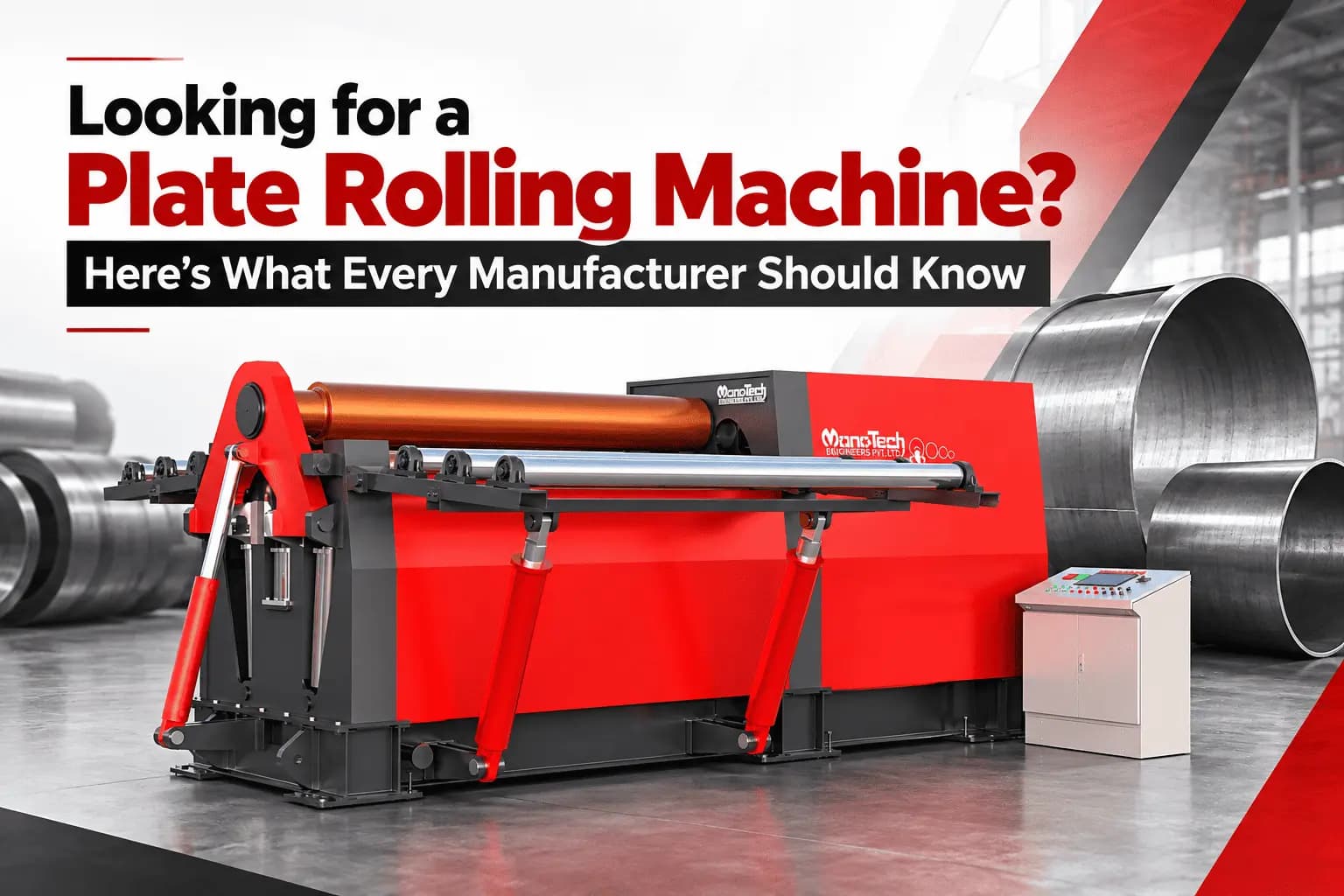
Looking for a Plate Rolling Machine? Here’s What Every Manufacturer Should Know
Choosing the right Plate Rolling Machine is an important decision for manufacturers involved in sheet metal fabrication, pressure vessels, storage tanks, pipes, structural components, and heavy engineering. The right machine can improve bending consistency, reduce rework, minimize flat ends, and support higher production efficiency.
However, selecting a plate rolling machine should not be based only on plate thickness or price. Material strength, working width, minimum rolling diameter, pre-bending capacity, roller configuration, production volume, and automation level all influence machine selection.
As an experienced Plate Rolling Machine Manufacturer in India, Monotech Engineers Pvt. Ltd. provides plate rolling solutions designed around specific industrial forming requirements.
This guide explains what manufacturers should know before selecting a plate rolling machine for their factory.
What Is a Plate Rolling Machine?
A Plate Rolling Machine, also known as a Plate Bending Machine, is an industrial metal-forming machine used to convert flat metal plates into cylindrical, curved, conical, or other rolled profiles.
The machine uses multiple rollers to apply controlled bending force to the plate. As the plate moves between the rollers, progressive deformation creates the required radius.
Plate rolling machines are commonly used for processing:
Mild steel
Stainless steel
Carbon steel
Aluminium
Structural steel
Other industrial metal plates
The actual machine capacity depends not only on plate thickness but also on material strength, plate width, roller configuration, and the required finished diameter.
How Does a Plate Rolling Machine Work?
A Plate Rolling Machine works by passing a metal plate between a set of rollers while controlled pressure is applied.
The basic process generally includes four stages.
1. Plate Feeding
The plate is positioned and fed between the machine rollers. Correct alignment at this stage is important for achieving consistent rolling results.
2. Pre-Bending
The leading edge of the plate is bent to minimize the straight portion that can remain after rolling. Depending on the machine configuration, the opposite edge can also be pre-bent.
3. Main Rolling
The plate is progressively passed through the rollers while roller positions are adjusted to create the required curvature.
4. Final Diameter Formation
Rolling continues until the required cylindrical or curved profile is achieved. The finished component is then removed according to the machine's unloading arrangement.
Modern Hydraulic Plate Rolling Machines can provide controlled roller movement, while automated systems can further improve repeatability for repetitive production.
Types of Plate Rolling Machines
Different applications require different machine configurations. Understanding the major types can help manufacturers choose an appropriate solution.
3 Roll Plate Rolling Machine
A 3 Roll Plate Rolling Machine uses three main rollers for plate bending. Depending on the design, these machines may use pyramid, asymmetrical, or pre-pinch configurations.
They are widely used for:
General fabrication
Storage tanks
Cylindrical shells
Pipes
Structural components
Medium and heavy plate rolling
Three-roll machines can provide an effective combination of flexibility, forming capability, and investment value.
4 Roll Plate Rolling Machine
A 4 Roll Plate Rolling Machine uses four rollers to provide greater control over plate gripping and movement during the rolling process.
This configuration can be particularly useful for repetitive production and applications requiring controlled pre-bending.
Typical advantages may include:
Improved plate gripping
Controlled plate movement
Efficient pre-bending
Better repeatability
Reduced manual handling
Suitability for automated rolling cycles
The choice between a 3 roll and 4 roll machine should always depend on the actual component and production requirement.
Hydraulic Plate Rolling Machine
A Hydraulic Plate Rolling Machine uses hydraulic systems to control roller movement and generate the required forming force.
Hydraulic systems are widely preferred for industrial applications because they can offer controlled movement and high forming capability.
They are particularly suitable for applications involving thicker materials and demanding fabrication requirements.
Automatic Plate Rolling Machine
An Automatic Plate Rolling Machine incorporates automated control over selected rolling operations.
Automation can help manufacturers improve:
Process repeatability
Production consistency
Cycle time
Operator efficiency
Control of repetitive jobs
For factories manufacturing similar cylindrical components in higher volumes, automation can significantly reduce dependence on manual adjustments.
3 Roll vs 4 Roll Plate Rolling Machine: Which Should You Choose?
This is one of the most common questions manufacturers ask before purchasing a Plate Rolling Machine.
A 3 roll machine can be an effective solution for general fabrication and a broad range of rolling applications. Different three-roll configurations also allow manufacturers to select machines according to pre-bending and production requirements.
A 4 roll machine offers additional plate control because the plate can remain gripped between the rollers during various stages of the forming process.
For repetitive production, automation, and controlled pre-bending, a four-roll configuration may offer operational advantages.
However, neither design is automatically better for every application.
Machine selection should be based on:
Plate thickness
Plate width
Material grade
Minimum diameter
Production volume
Required tolerances
Pre-bending requirement
Automation requirement
Available investment
A technical evaluation of the actual component is more reliable than selecting a machine simply according to the number of rollers.
How to Choose the Right Plate Rolling Machine
Before investing in a Plate Rolling Machine, manufacturers should evaluate the following technical parameters carefully.
Plate Thickness
Maximum plate thickness is an important specification, but it should never be considered independently.
A machine capable of rolling a certain thickness at a large diameter may not necessarily roll the same plate to a significantly smaller diameter.
Always provide the required thickness and finished diameter when requesting machine capacity.
Working Width
The working length of the rollers must accommodate the maximum plate width required for production.
Manufacturers should also consider future requirements. Purchasing a machine with insufficient working width can restrict future production capability.
Material Grade and Strength
Material properties have a direct effect on the bending force required.
For example, two plates of identical thickness and width may require different machine capacities if their yield strengths differ.
Therefore, provide the actual material grade rather than simply stating "steel plate."
Minimum Rolling Diameter
The required minimum diameter is critical when selecting machine capacity.
Smaller diameters generally require greater forming capability and appropriate roller geometry.
The machine manufacturer should evaluate the relationship between:
Plate thickness
Material strength
Roller diameter
Working width
Required finished diameter
Pre-Bending Capacity
Pre-bending is important for manufacturers seeking to reduce flat portions at the ends of rolled plates.
Without adequate pre-bending, additional correction or secondary processing may be required.
For repetitive cylinder manufacturing, pre-bending capability should be considered an important machine-selection parameter.
Production Volume
A fabrication workshop producing occasional cylinders may have different requirements from a manufacturer producing hundreds of repetitive components.
For higher production volumes, features such as hydraulic positioning, programmable control, and automated sequences may provide greater value.
Why Pre-Bending Matters in Plate Rolling
When a flat plate enters the rollers, a small portion near the plate edge may initially remain insufficiently bent because of the distance between the roller contact points.
This can create what are commonly known as flat ends.
Pre-bending helps form these plate edges before completing the main rolling cycle.
Effective pre-bending can help:
Minimize flat ends
Reduce secondary correction
Improve cylinder formation
Reduce additional handling
Improve production efficiency
Manufacturers producing welded cylindrical components should therefore consider both rolling and pre-bending capacities when comparing machines.
CNC and Automation in Plate Rolling Machines
Modern manufacturing increasingly focuses on process repeatability and reduced operator dependency.
A CNC Plate Rolling Machine can use programmable controls to manage selected machine movements and rolling parameters.
Depending on machine configuration, automation may help manufacturers store or reproduce rolling sequences for repetitive components.
Potential benefits include:
Consistent production
Improved repeatability
Reduced manual adjustment
Better control over repetitive jobs
Reduced operator dependency
Faster production setup
Automation is particularly valuable when a factory repeatedly manufactures components with similar dimensions.
However, the appropriate level of automation should always be determined according to production volume and application complexity.
Plate Rolling Machine Applications
A Plate Rolling Machine is used across numerous manufacturing and engineering sectors.
Storage Tank Manufacturing
Metal plates can be rolled into cylindrical sections used for industrial storage tanks.
Pressure Vessel Manufacturing
Accurate plate rolling is required to form shells for various pressure vessel applications.
Pipe Manufacturing
Heavy-duty plate rolling machines can be used to form large-diameter pipe sections.
Boiler and Process Equipment
Rolled cylindrical sections are required for various industrial process equipment and fabrication applications.
Wind Tower Manufacturing
Large plate rolling machines can form cylindrical and conical sections used in wind tower structures.
Shipbuilding
Curved plate components are required in various marine and shipbuilding fabrication processes.
Structural Fabrication
Plate rolling machines can produce curved structural sections for infrastructure and engineering projects.
General Heavy Engineering
Industrial fabricators use plate rolling technology for customized cylinders, cones, curved plates, and other engineered components.
Important Specifications to Share Before Requesting a Quote
If you are contacting a Plate Rolling Machine Manufacturer, providing complete application information can significantly improve machine selection.
Share the following details:
Material type
Material grade
Maximum plate thickness
Minimum plate thickness
Maximum plate width
Required minimum diameter
Maximum finished diameter
Cylinder or cone requirement
Pre-bending requirement
Expected production quantity
Required accuracy
Manual, NC, or CNC preference
Automation requirement
These details allow the manufacturer to evaluate the application rather than recommending a machine based only on nominal plate thickness.
Common Plate Rolling Machine Buying Mistakes
Choosing the wrong machine can affect productivity for years. Some common purchasing mistakes include:
Selecting only according to Plate Rolling Machine price
Ignoring material yield strength
Not specifying minimum rolling diameter
Ignoring pre-bending capacity
Selecting insufficient working width
Not considering future production requirements
Underestimating production volume
Ignoring automation requirements
Not evaluating machine rigidity
Overlooking after-sales support
The lowest initial investment does not necessarily provide the lowest long-term production cost.
Machine performance, reliability, productivity, maintenance, and service support should all be evaluated.
Why Choose Monotech Engineers as Your Plate Rolling Machine Manufacturer?
Monotech Engineers Pvt. Ltd. provides industrial metal-forming machinery for manufacturers with diverse fabrication requirements.
Our plate rolling solutions are developed according to important application parameters such as plate thickness, working width, material properties, minimum diameter, pre-bending requirements, and desired automation.
Plate rolling solutions can include:
3 Roll Plate Rolling Machines
4 Roll Plate Rolling Machines
Hydraulic Plate Rolling Machines
Pre-Pinch Plate Rolling Machines
Automatic Plate Rolling Machines
Plate rolling solutions for cylindrical components
Plate rolling solutions for cone forming
Customized plate rolling solutions
As a Plate Rolling Machine Manufacturer in India, Monotech Engineers focuses on matching machine configuration with actual production requirements rather than relying solely on standard capacity specifications.
What Should You Check Before Finalizing a Plate Rolling Machine?
Before placing an order, ask your machine manufacturer these questions:
Can the machine roll my specified material grade and thickness?
What is the minimum achievable diameter for my application?
What is the pre-bending capacity?
Can it process my maximum required plate width?
Is the machine suitable for cylindrical and/or conical rolling?
What level of automation is available?
How are roller positions controlled?
What safety features are included?
What installation and operator training support is available?
What after-sales service and spare parts support is provided?
Conclusion
Selecting the right Plate Rolling Machine is not simply a matter of comparing plate thickness, roller length, and price.
Manufacturers should evaluate material strength, plate width, minimum diameter, pre-bending capacity, roller configuration, production volume, machine construction, automation, and after-sales support.
A correctly selected machine can help improve bending consistency, minimize rework, reduce operator dependency, and support long-term production efficiency.
If you are looking for a reliable Plate Rolling Machine Manufacturer in India, Monotech Engineers Pvt. Ltd. can help you evaluate a plate rolling solution according to your specific manufacturing requirements.
Monotech Engineers Pvt. Ltd.
Website: https://monotech-engineers.com/
Phone: +91 83759 64710
Email: monotech@nsenergygroups.com
Discuss your plate thickness, width, material grade, and required diameter with our team to identify the right Plate Rolling Machine for your application.
Frequently Asked Questions About Plate Rolling Machines
What is a Plate Rolling Machine?
A Plate Rolling Machine is industrial metal-forming equipment used to bend flat metal plates into cylindrical, curved, conical, or similar profiles using controlled roller movement.
What is a Plate Rolling Machine used for?
Plate rolling machines are commonly used for manufacturing storage tanks, pressure vessels, pipes, cylindrical shells, process equipment, structural components, and other fabricated metal products.
What is the difference between a 3 Roll and 4 Roll Plate Rolling Machine?
A 3 roll machine uses three primary rollers, while a 4 roll machine uses four. Four-roll configurations can provide additional plate gripping and control, while three-roll configurations are widely used across general and heavy fabrication applications. The appropriate choice depends on the production requirement.
How do I choose the right Plate Rolling Machine?
Consider plate thickness, material grade, working width, minimum rolling diameter, pre-bending requirement, production quantity, component geometry, and required automation before selecting a machine.
What is pre-bending in a Plate Rolling Machine?
Pre-bending forms the leading and trailing edges of the plate to minimize the straight sections or flat ends that can otherwise remain after the main rolling process.
What details are needed for a Plate Rolling Machine quotation?
Provide material grade, maximum thickness, working width, minimum required diameter, component type, pre-bending requirement, production volume, and desired automation level.