
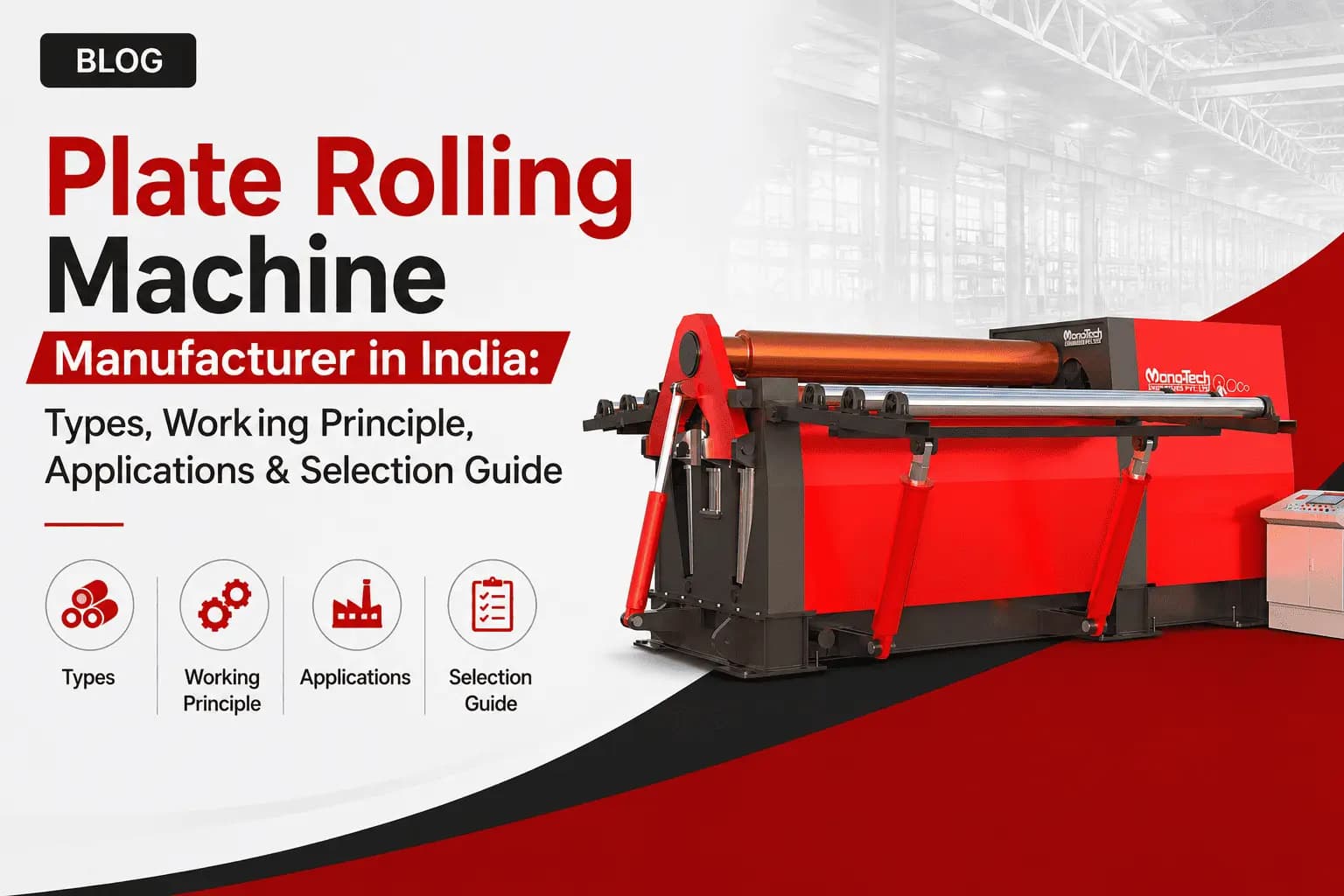
Plate Rolling Machine Manufacturer in India: Types, Working Principle, Applications & Selection Guide
A Plate Rolling Machine is an industrial metal-forming machine used to bend flat metal plates into cylindrical, conical, or curved shapes with controlled accuracy. These machines are widely used in heavy fabrication, pressure vessel manufacturing, boiler manufacturing, storage tanks, construction equipment, and industrial machinery manufacturing.
The right plate rolling machine depends on several factors, including plate thickness, plate width, material grade, required rolling diameter, production volume, pre-bending requirements, and automation level.
Monotech Engineers manufactures industrial plate rolling machines for applications where controlled forming, robust construction, productivity, and repeatable performance are important.
What Is a Plate Rolling Machine?
A plate rolling machine is a metal-forming machine designed to bend flat metal plates into a predetermined radius or shape. The machine uses rotating rollers to apply controlled mechanical force to the plate, gradually producing the required curvature.
Depending on the machine configuration and application, a plate rolling machine can be used to manufacture:
Cylindrical shells
Conical sections
Curved plates
Storage tank components
Pressure vessel shells
Boiler components
Heavy fabrication parts
Construction equipment components
Industrial machinery components
Plate rolling machines are available in different configurations and capacities to accommodate various material thicknesses, widths, strengths, and production requirements.
How Does a Plate Rolling Machine Work?
The plate rolling machine working principle is based on controlled plastic deformation of metal.
The plate is positioned between the machine's rollers. As the rollers rotate, friction draws the plate through the rolling zone while controlled pressure bends the material. The roller positions are progressively adjusted until the required radius or diameter is achieved.
The basic plate rolling process includes several stages.
1. Plate Feeding
The metal plate is properly positioned and introduced into the rolling area. Correct alignment is important for achieving uniform forming.
2. Initial Bending
The rollers apply force to the plate and begin creating the initial curvature.
3. Progressive Rolling
The plate passes through the rollers while the roller position is adjusted according to the required radius.
4. Radius Formation
The rolling process continues until the plate reaches the desired cylindrical, curved, or conical geometry.
5. Final Adjustment
Additional rolling passes may be performed when required to achieve the specified shape and dimensional accuracy.
6. Component Removal
Once the required geometry is achieved, the finished component is removed from the machine.
The actual rolling procedure depends on the machine design, material properties, plate thickness, width, required diameter, and production requirements.
Types of Plate Rolling Machines
Different fabrication applications require different machine configurations. The most commonly used configurations include three-roll and four-roll plate rolling machines.
3-Roll Plate Rolling Machine
A 3-roll plate rolling machine uses three rollers to progressively bend the plate into the required shape.
These machines are commonly used for general fabrication, tanks, cylindrical components, structural fabrication, and heavy engineering applications.
Three-roll machines can be engineered in different configurations depending on plate thickness, working width, material, rolling diameter, and production requirements.
They are particularly suitable for fabrication workshops that require flexibility across different types of rolling jobs.
4-Roll Plate Rolling Machine
A 4-roll plate rolling machine uses four rollers to provide greater control over plate positioning and forming.
The additional roller can help improve plate alignment and provide controlled pre-bending and rolling operations.
Four-roll machines can be suitable for production environments where repeatability, productivity, plate handling, and process control are important.
The selection between a 3-roll and 4-roll machine should be based on the actual production application rather than simply the number of rollers.
Hydraulic Plate Rolling Machine
A hydraulic plate rolling machine uses hydraulic systems to control roller movement and provide the force required for heavy plate forming.
Hydraulic systems are particularly useful in heavy-duty applications where high forming forces and controlled movement are required.
Depending on the machine configuration, hydraulic systems can be used for roller adjustment, pre-bending, side support, machine opening mechanisms, and other controlled movements.
Hydraulic plate rolling machines are commonly considered for demanding fabrication applications involving thicker plates and higher production requirements.
3-Roll vs 4-Roll Plate Rolling Machine: Which Is Better?
There is no single machine configuration that is best for every application.
A 3-roll plate rolling machine can be an effective choice for general fabrication and applications where flexibility is important.
A 4-roll plate rolling machine may be more suitable where faster plate positioning, controlled pre-bending, repeatability, and production efficiency are priorities.
The right selection should consider:
Plate thickness
Plate width
Material grade
Minimum rolling diameter
Maximum rolling diameter
Pre-bending requirements
Production volume
Required accuracy
Operator involvement
Automation requirements
A machine manufacturer should ideally evaluate these parameters before recommending the final configuration.
Plate Rolling Machine Capacity: What Should You Consider?
The capacity of a plate rolling machine should not be judged only by its maximum thickness specification.
Several engineering parameters determine whether a machine is suitable for a particular application.
Plate Thickness
Determine the minimum and maximum plate thickness that the machine will regularly process.
Plate Width
The maximum plate width determines the required working length of the rolling machine.
Material Grade
Mild steel, stainless steel, alloy steel, and other materials have different mechanical properties and forming requirements.
Rolling Diameter
The required minimum and maximum diameter directly influence machine selection and roller design.
Material Strength
Higher-strength materials may require greater forming force and a suitably engineered machine structure and drive system.
Pre-Bending Requirement
If the application requires efficient pre-bending, the roller configuration and machine design should be selected accordingly.
Production Volume
A machine used for occasional job work may have different requirements from a machine operating continuously in a high-production environment.
Applications of Plate Rolling Machines
Plate rolling machines are used across a wide range of industrial and engineering sectors.
Pressure Vessel Manufacturing
Plate rolling machines are commonly used to form cylindrical shells and sections required for pressure vessel manufacturing.
Boiler Manufacturing
Boiler manufacturers use rolled plates for cylindrical shells and other curved components.
Storage Tank Manufacturing
Industrial storage tanks require plates to be formed into accurate cylindrical sections. Plate rolling machines provide a controlled method for producing these components.
Heavy Fabrication
Heavy fabrication companies use plate rolling machines to produce curved structural components, shells, and industrial assemblies.
Construction Equipment Manufacturing
Construction equipment manufacturers may use rolled plates for buckets, curved components, structural parts, and other heavy-duty assemblies.
JCB Bucket Manufacturing
Plate rolling machines can be used for forming heavy plates used in bucket and shovel manufacturing.
The machine should be selected according to the actual material thickness, width, radius, geometry, and production requirements of the bucket component.
Industrial Machinery Manufacturing
Various industrial machinery and process equipment components require controlled plate forming, making plate rolling machines an important part of many fabrication facilities.
Plate Rolling Machine for JCB Bucket Manufacturing
JCB buckets and other heavy equipment components often require controlled curvature and consistent geometry.
A suitable plate rolling machine can help manufacturers form heavy plates into the required curved profile before further fabrication and welding operations.
For this application, manufacturers should consider:
Plate thickness
Plate width
Material grade
Required radius
Component geometry
Production quantity
Required repeatability
Machine working width
Selecting a machine based only on plate thickness may result in an unsuitable configuration. The complete application should be evaluated before finalizing the machine.
How to Select the Right Plate Rolling Machine?
Selecting the correct plate rolling machine requires a clear understanding of the manufacturing application.
Step 1: Identify Plate Thickness
Determine the minimum, average, and maximum thickness of plates that will be rolled.
Step 2: Determine Maximum Plate Width
Identify the widest plate that needs to be processed.
Step 3: Specify Material
Provide the material grade and mechanical properties wherever available.
Step 4: Define Rolling Diameter
Determine the minimum and maximum required finished diameter or radius.
Step 5: Evaluate Pre-Bending Requirements
If the application requires pre-bending, discuss the required edge condition and forming process with the machine manufacturer.
Step 6: Determine Production Volume
Consider whether the machine will be used for prototype work, job work, batch production, or continuous manufacturing.
Step 7: Select Machine Configuration
Based on the application, a 3-roll, 4-roll, hydraulic, motorized, or CNC-controlled configuration can be considered.
Step 8: Evaluate Automation
For repetitive production, automation and controlled roller positioning can improve productivity and repeatability.
Step 9: Share Component Drawings
Providing component drawings or sample dimensions can help the manufacturer recommend a more suitable machine configuration.
What Affects Plate Rolling Machine Price in India?
The plate rolling machine price in India varies depending on machine capacity, configuration, construction, automation, and application requirements.
Important factors include:
Plate thickness capacity
Working width
Roller diameter
Machine construction
Hydraulic system
Drive system
Motor power
Control system
Automation level
Pre-bending capability
Material type
Customization requirements
Because every industrial application can have different requirements, there is no single standard price that applies to every plate rolling machine.
For an accurate quotation, manufacturers generally need information about the plate thickness, width, material grade, required diameter, and production requirements.
Benefits of Using a Plate Rolling Machine
A properly selected plate rolling machine can offer several advantages for industrial fabrication.
Higher Productivity
Controlled mechanical rolling can reduce the time required to form heavy plates compared with manual forming processes.
Consistent Curvature
Controlled roller movement can help achieve more consistent curvature across components.
Reduced Manual Effort
Hydraulic and motorized systems reduce the physical effort required for forming heavy metal plates.
Better Process Control
Modern rolling machines can provide controlled movement, positioning, and forming operations.
Heavy-Duty Performance
Industrial plate rolling machines can be engineered for demanding fabrication environments and heavy plate applications.
Flexible Manufacturing
Depending on the machine configuration, the same equipment can be used for different materials, thicknesses, widths, and component geometries.
Plate Rolling Machine Maintenance
Regular maintenance is essential for maintaining machine performance and extending service life.
Important maintenance activities include:
Inspecting rollers regularly
Checking hydraulic oil condition
Inspecting hydraulic hoses and connections
Checking bearings and lubrication
Inspecting drive components
Checking roller alignment
Inspecting electrical and control systems
Keeping the machine clean
Following the manufacturer's maintenance schedule
Preventive maintenance can help identify potential problems before they affect production.
Why Choose Monotech Engineers for Plate Rolling Machines?
Monotech Engineers provides industrial metal-forming machinery designed around specific manufacturing requirements.
For a plate rolling machine project, the application can be evaluated based on:
Plate thickness
Plate width
Material
Required rolling diameter
Pre-bending requirements
Production volume
Automation requirements
Component geometry
The objective is to select or engineer a machine that matches the customer's actual production requirements rather than relying only on generic machine specifications.
For fabrication companies looking for a Plate Rolling Machine Manufacturer in India, application-specific engineering, machine construction, process requirements, and after-sales support should all be considered before making a purchase decision.
Conclusion: Plate Rolling Machine
A Plate Rolling Machine is an important metal-forming solution for industries that need controlled and repeatable bending of metal plates. From pressure vessels and storage tanks to boilers, heavy fabrication, and construction equipment, the right rolling machine can improve productivity, forming consistency, and manufacturing efficiency.
The best machine should be selected according to the actual application, including plate thickness, width, material grade, rolling diameter, production volume, and automation requirements.
Monotech Engineers provides industrial plate rolling solutions for manufacturers and fabricators looking for reliable metal-forming equipment in India.
If you are planning to purchase a Plate Rolling Machine, share your plate thickness, maximum plate width, material grade, required rolling diameter, and application with Monotech Engineers to determine a suitable machine configuration.
FAQs: Plate Rolling Machine
What is a plate rolling machine used for?
A plate rolling machine is used to bend flat metal plates into cylindrical, conical, or curved shapes. It is commonly used in pressure vessel, boiler, tank, heavy fabrication, construction equipment, and industrial machinery manufacturing.
How does a plate rolling machine work?
A plate rolling machine works by passing a metal plate between rotating rollers. Controlled pressure and roller movement progressively deform the plate until the required radius or shape is achieved.
What is the difference between a 3-roll and 4-roll plate rolling machine?
A 3-roll machine uses three rollers to progressively form the plate, while a 4-roll machine uses four rollers to provide additional control over plate positioning and forming. The appropriate configuration depends on the application and production requirements.
Can a plate rolling machine roll stainless steel?
Yes. Plate rolling machines can be designed for stainless steel applications. Machine selection should consider stainless steel grade, thickness, width, yield strength, and required rolling diameter.
Can a plate rolling machine make cones?
Yes. Suitable plate rolling machines can be configured for conical rolling applications, depending on the machine design, plate dimensions, material, and required cone geometry.