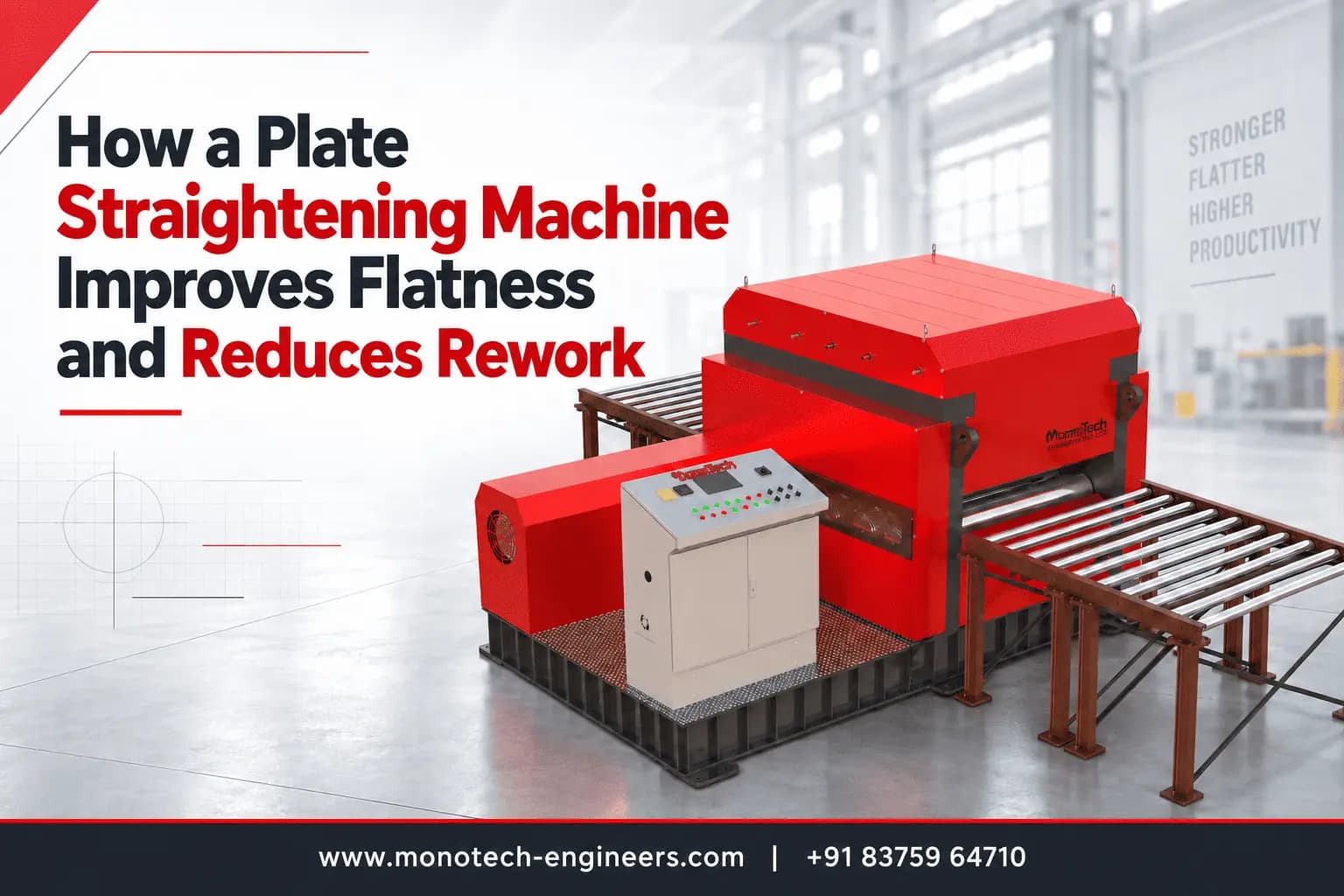
How a Plate Straightening Machine Improves Flatness and Reduces Rework
Maintaining consistent plate flatness is essential in modern fabrication. When steel plates arrive with waves, bends, edge curvature or internal stress, they can cause problems during cutting, welding, forming and assembly. These irregularities affect dimensional accuracy, slow production and increase material rejection.
A Plate Straightening Machine corrects these defects by passing the plate through a precisely arranged series of rollers. The controlled bending action redistributes internal stresses and produces a flatter, more stable plate. By preparing material correctly before downstream processing, manufacturers can improve product quality, increase productivity and significantly reduce rework.
Why Plate Flatness Matters in Manufacturing
Flatness is not simply a visual requirement. It directly influences the accuracy and reliability of subsequent manufacturing processes. A distorted plate can shift during laser or plasma cutting, create inconsistent bend angles, complicate welding fixtures and cause poor alignment during assembly.
Common problems caused by uneven plates include:
Inaccurate component dimensions
Difficulty in loading and positioning material
Poor cutting and bending results
Uneven weld gaps and assembly mismatch
Additional manual correction
Higher rejection and scrap rates
Longer production cycles
Using a Plate Straightening Machine before these operations creates a consistent material condition and helps downstream equipment perform more accurately.
How a Plate Straightening Machine Works
A Plate Straightening Machine uses multiple upper and lower rollers positioned in a staggered arrangement. As the plate moves between the rollers, it undergoes a series of controlled, alternating bends. These bends gradually reduce the stresses responsible for waviness and deformation.
The straightening process generally includes the following stages:
The deformed plate enters the machine through the infeed section.
The rollers apply controlled pressure based on plate thickness, width and material strength.
The plate is repeatedly bent in opposite directions as it travels through the roller system.
The bending intensity gradually decreases toward the exit.
The plate leaves the machine with improved flatness and reduced residual stress.
This systematic process is more consistent and repeatable than manual correction methods involving hydraulic presses, hammering or localized heating.
Plate Straightening Machine vs. Plate Leveling Machine
The terms Plate Straightening Machine and Plate Leveling Machine are often used interchangeably. Both are designed to improve flatness, but the appropriate machine configuration depends on the material thickness, width, yield strength and required tolerance.
A Plate Leveling Machine is commonly used to correct waves, coil set and minor shape defects across the plate surface. Heavy-duty straightening systems are designed to process thicker, stronger or more severely deformed plates. In both cases, the objective is to produce a stable and accurately flattened workpiece for further manufacturing.
How Plate Straightening Reduces Rework
1. Improves Cutting Accuracy
Flat plates remain stable on laser, plasma and oxy-fuel cutting tables. This helps maintain the correct focal distance and reduces movement during cutting. The resulting components are more accurate and require fewer corrections.
2. Produces Consistent Bending Results
When a warped plate enters a press brake, its inconsistent surface can affect positioning and bend angles. A Metal Plate Straightening Machine creates a uniform starting condition, allowing the press brake to deliver more consistent results across multiple components.
3. Reduces Welding Distortion Problems
Uneven plates create irregular gaps between components and make fixture alignment difficult. Straightened plates fit together more accurately, reducing excessive clamping, correction and weld preparation.
4. Minimizes Manual Correction
Manual straightening requires skilled labour and may produce different results from one operator to another. A machine-controlled process reduces dependence on hammering, heating and repeated press corrections, helping manufacturers save both time and labour.
5. Lowers Scrap and Material Waste
Plates that fail dimensional or flatness requirements may need to be reprocessed or rejected. By correcting the material early, manufacturers can prevent defective parts from moving through multiple value-added operations before a problem is discovered.
6. Improves Assembly Accuracy
Flat components are easier to align, position and join. This is particularly important in fabricated structures, machinery frames, construction equipment, transportation components and other applications where several cut plates must fit together accurately.
Benefits of an Automatic Plate Straightening Machine
An Automatic Plate Straightening Machine improves process control and repeatability. Operators can configure machine settings according to material grade, thickness and the required result. Automation helps maintain consistent pressure and roller positioning throughout production.
Key benefits include:
Repeatable flatness across production batches
Faster setup and processing
Reduced operator dependency
Consistent results for different plate specifications
Lower rework and rejection costs
Improved productivity in downstream operations
Better traceability and process control
For manufacturers handling multiple plate sizes or high production volumes, automation can shorten cycle times while maintaining consistent quality.
Applications of a Steel Plate Straightening Machine
A Steel Plate Straightening Machine can support a wide range of industries and fabrication processes, including:
Heavy engineering and machinery manufacturing
Construction and structural fabrication
Railway and metro component production
Shipbuilding and marine fabrication
Earthmoving and agricultural equipment
Pressure vessel and tank manufacturing
Automotive and commercial vehicle components
Steel service centres
Energy and infrastructure projects
The correct system should be selected according to the specific plate range and production requirements of the application.
Factors to Consider When Selecting a Plate Straightening Machine
Plate Thickness and Width
The machine must be capable of processing the minimum and maximum plate dimensions used in production.
Material Grade and Yield Strength
Different grades of steel require different straightening forces. Machine capacity should therefore be evaluated using material strength, not thickness alone.
Initial Deformation
The severity and type of distortion—such as waves, edge bends, centre buckles or overall curvature—affect the required roller configuration and machine power.
Required Flatness Tolerance
The required output depends on the final application. Components used for precision cutting, automated welding or close-tolerance assembly may need tighter flatness control.
Production Volume
Manufacturers with high-volume or continuous operations may benefit from an automatic system with programmable settings and material-handling integration.
Service and Technical Support
Machine installation, operator training, preventive maintenance and spare-parts support are important for long-term productivity.
Long-Term Impact on Production Efficiency
The greatest value of a Plate Straightening Machine is not limited to producing a visibly flat plate. It creates a reliable starting condition for every process that follows. More accurate cutting, bending, welding and assembly reduce interruptions and help manufacturers maintain predictable production schedules.
When rework decreases, businesses save material, labour, machine hours and energy. Better flatness also reduces hidden costs caused by delayed deliveries, repeated inspections and rejected finished components. The machine therefore supports both quality improvement and overall operational efficiency.
Conclusion
A Plate Straightening Machine is an important solution for manufacturers that need accurate, stable and production-ready plates. Through controlled roller straightening, it removes deformation, reduces residual stress and improves flatness before cutting, bending, welding or assembly.
Whether described as a Plate Leveling Machine, Metal Plate Straightening Machine or Steel Plate Straightening Machine, the right system can reduce manual correction, lower scrap and deliver more consistent results. For businesses focused on improving productivity and controlling manufacturing costs, an Automatic Plate Straightening Machine provides a dependable way to reduce rework and strengthen overall process quality.
FAQs:Plate Straightening Machine
1. What is a Plate Straightening Machine?
A Plate Straightening Machine is industrial equipment that uses a series of rollers to correct waves, bends and other flatness defects in metal plates. It prepares the material for accurate cutting, bending, welding and assembly.
2. How does a Plate Straightening Machine reduce rework?
It creates a flatter and more stable plate before downstream processing. This improves dimensional accuracy, reduces assembly mismatch and minimizes repeated cutting, bending, welding or manual correction.
3. What is the difference between a Plate Leveling Machine and a Plate Straightening Machine?
Both machines improve plate flatness. The terminology and configuration may vary according to the plate thickness, material strength, type of deformation and required tolerance. Heavy-duty straightening machines are generally used for thicker or more severely distorted plates.
4. Which materials can be processed on a Metal Plate Straightening Machine?
Depending on its design and capacity, the machine may process mild steel, stainless steel, high-strength steel, aluminium and other metal plates. The manufacturer should confirm suitability based on thickness, width and yield strength.
5. Can an Automatic Plate Straightening Machine handle different plate sizes?
Yes. A properly selected automatic machine can be configured for a defined range of plate thicknesses, widths and material grades. Programmable controls help operators apply suitable settings for different jobs.
6. Where is a Steel Plate Straightening Machine commonly used?
It is commonly used in heavy engineering, construction equipment, railway fabrication, shipbuilding, automotive manufacturing, pressure vessels, steel service centres and general sheet-metal fabrication.
7. Does plate straightening improve welding quality?
Yes. Flatter plates provide better joint alignment and more consistent weld gaps. This can reduce excessive clamping, correction and distortion-related rework during fabrication.
8. How should manufacturers choose the right Plate Straightening Machine?
They should evaluate plate thickness, width, material yield strength, initial deformation, desired flatness tolerance, production volume and the level of automation required. Reliable installation and after-sales support should also be considered.