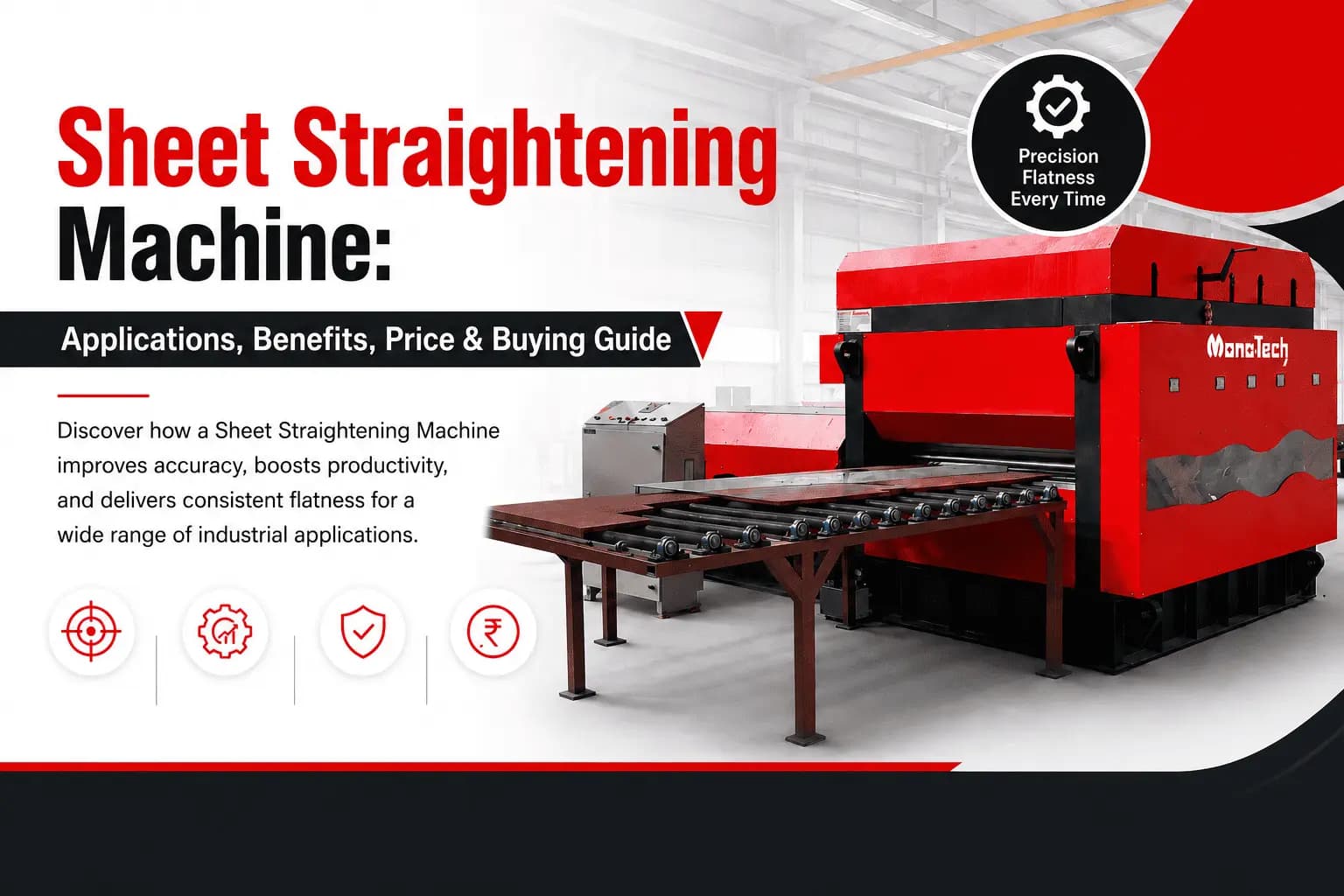
Sheet Straightening Machine: Applications, Benefits, Price & Buying Guide
In metal fabrication and heavy engineering, even minor sheet deformation can affect cutting accuracy, welding quality, machining, and final assembly. Bending, waviness, twisting, and thermal distortion are common problems that manufacturers face after laser cutting, plasma cutting, welding, forming, or material handling.
A Sheet Straightening Machine provides a controlled and efficient solution for correcting these imperfections and improving the flatness of metal sheets and plates. Monotech Engineers manufactures industrial straightening solutions designed for different material types, thicknesses, widths, and production requirements.
What Is a Sheet Straightening Machine?
A Sheet Straightening Machine is an industrial machine used to correct deformation in metal sheets and plates. It works by applying controlled pressure through a series of straightening rollers.
As the sheet passes through the rollers, it is gradually bent in controlled directions. This process helps reduce residual stresses and correct unwanted deformation, resulting in improved flatness and straightness.
Modern Metal Sheet Straightening Machines can be configured according to the material, thickness, width, and required straightening accuracy.
How Does a Sheet Straightening Machine Work?
The basic working principle involves controlled roller pressure.
The metal sheet enters the machine and passes through multiple rollers. Each roller applies a specific amount of pressure to the material. The sheet undergoes repeated controlled bending, which gradually reduces deformation.
The straightening process generally involves:
Feeding the distorted sheet into the machine
Applying controlled roller pressure
Progressive correction of bends and waves
Reducing internal residual stresses
Producing a flatter and more accurate sheet
The number of rollers, roller diameter, roller arrangement, and adjustment system depend on the machine's capacity and application.
Applications of Sheet Straightening Machine
The Sheet Straightening Machine Application extends across industries where sheet flatness and dimensional accuracy are important.
Common applications include:
Laser-cut sheet metal components
Plasma-cut components
Mild steel sheet components
Fabricated structures
Automotive components
Electrical panels and enclosures
Heavy engineering components
Machinery parts
Welded assemblies
Structural fabrication components
Straightening is especially useful when thermal or mechanical processes cause distortion that could affect subsequent manufacturing operations.
Heavy Duty Sheet Straightener Machine
For thick sheets, plates, and demanding industrial applications, a Heavy Duty Sheet Straightener Machine provides the required strength and controlled straightening capability.
Heavy-duty straightening machines are designed with robust construction and suitable drive and adjustment systems to handle demanding production conditions.
Before selecting a heavy-duty machine, manufacturers should consider the maximum material thickness, working width, material grade, distortion level, and required production capacity.
MS Sheet Straightening Machine
An MS Sheet Straightening Machine is designed for straightening mild steel sheets and components.
MS sheets can develop deformation because of:
Laser or plasma cutting
Welding
Forming operations
Residual stresses
Material handling
Improper storage or transportation
Using an appropriate straightening machine can help restore the required flatness before machining, welding, fabrication, painting, or assembly.
Automatic Straightening Machine for Sheet Metal
An Automatic Straightening Machine for Sheet Metal is suitable for manufacturers looking for consistent and repeatable production.
Depending on the configuration, automation can help control material feeding, roller adjustment, and straightening parameters. This reduces manual intervention and can improve production consistency.
For high-volume manufacturing, automated straightening can also help improve productivity and reduce variations between components.
Benefits of a Sheet Straightening Machine
Investing in the right straightening machine can offer several manufacturing advantages.
Improved Sheet Flatness
Controlled roller straightening helps reduce bends, waves, and other forms of deformation.
Better Dimensional Accuracy
A flatter sheet provides a more consistent base for cutting, machining, forming, welding, and assembly.
Reduced Material Rejection
Correcting deformation before downstream processing can help reduce rejection caused by dimensional and flatness issues.
Improved Productivity
Machine-based straightening can reduce dependence on manual correction methods and provide more repeatable results.
Better Downstream Processing
Accurately straightened sheets can improve the efficiency and consistency of subsequent manufacturing operations.
Sheet Straightening Machine Price: What Determines the Cost?
The Sheet Straightening Machine Price depends on several technical factors. There is no single price applicable to every application because machine specifications vary according to customer requirements.
Important factors include:
Maximum sheet thickness
Minimum sheet thickness
Maximum working width
Material type and grade
Straightening capacity
Roller configuration
Machine construction
Hydraulic or mechanical arrangement
Automation requirements
Control system
Production capacity
Customized specifications
Instead of selecting a machine based only on price, manufacturers should evaluate its capacity, performance, reliability, and suitability for the intended application.
How to Choose the Right Sheet Straightening Machine?
Selecting the right machine requires understanding the actual production requirement.
1. Material Type
Specify whether the machine will process mild steel, stainless steel, aluminium, or other materials.
2. Sheet Thickness
The minimum and maximum thickness to be processed should be clearly defined.
3. Sheet Width
The maximum working width determines the required machine size and roller configuration.
4. Required Accuracy
Define the required flatness and straightening accuracy based on the downstream application.
5. Production Volume
High-volume manufacturing may benefit from automatic or semi-automatic straightening systems.
6. Type of Distortion
The machine should be selected according to whether the problem involves bending, waviness, twisting, or thermal distortion.
Why Choose Monotech Engineers?
Monotech Engineers is an industrial machinery manufacturer providing sheet and plate straightening solutions for diverse engineering and fabrication requirements.
The machine configuration can be considered according to material characteristics, sheet dimensions, production requirements, and desired straightening performance.
For businesses searching for a reliable Plate Straightening Machine Manufacturer or Sheet Straightening Machine Manufacturer, choosing an experienced engineering company can help ensure that the machine is properly matched to the application.
Conclusion:Sheet Straightening Machine
A Sheet Straightening Machine is an important solution for manufacturers dealing with distorted sheets, plates, and fabricated components. By providing controlled mechanical correction, it can improve flatness, dimensional consistency, productivity, and downstream manufacturing quality.
Whether you require an MS Sheet Straightening Machine, Heavy Duty Sheet Straightener Machine, or Automatic Straightening Machine for Sheet Metal, machine selection should be based on material, thickness, width, production volume, and required accuracy.
Monotech Engineers provides industrial straightening solutions designed around specific manufacturing requirements, helping businesses achieve consistent and reliable straightening performance.
FAQs:Sheet Straightening Machine
1. What is a Sheet Straightening Machine used for?
A Sheet Straightening Machine is used to correct bends, waves, twists, and other deformation in metal sheets and plates. It improves flatness and prepares the material for further manufacturing processes.
2. What materials can be processed by a Sheet Straightening Machine?
Depending on the machine configuration, it can process materials such as mild steel, stainless steel, aluminium, and other suitable metal sheets and plates. Material thickness and grade should be considered before selecting the machine.
3. What factors affect Sheet Straightening Machine Price?
The price depends on sheet thickness, working width, material type, machine capacity, roller configuration, automation level, control system, and customization requirements.
4. How do I select the right Sheet Straightening Machine?
Selection should be based on material type, minimum and maximum thickness, sheet width, distortion type, required flatness, production volume, and automation requirements.
5. Why choose Monotech Engineers for a Sheet Straightening Machine?
Monotech Engineers provides industrial sheet and plate straightening solutions based on specific application and production requirements. The machine configuration can be considered according to material, dimensions, capacity, and required straightening performance.