
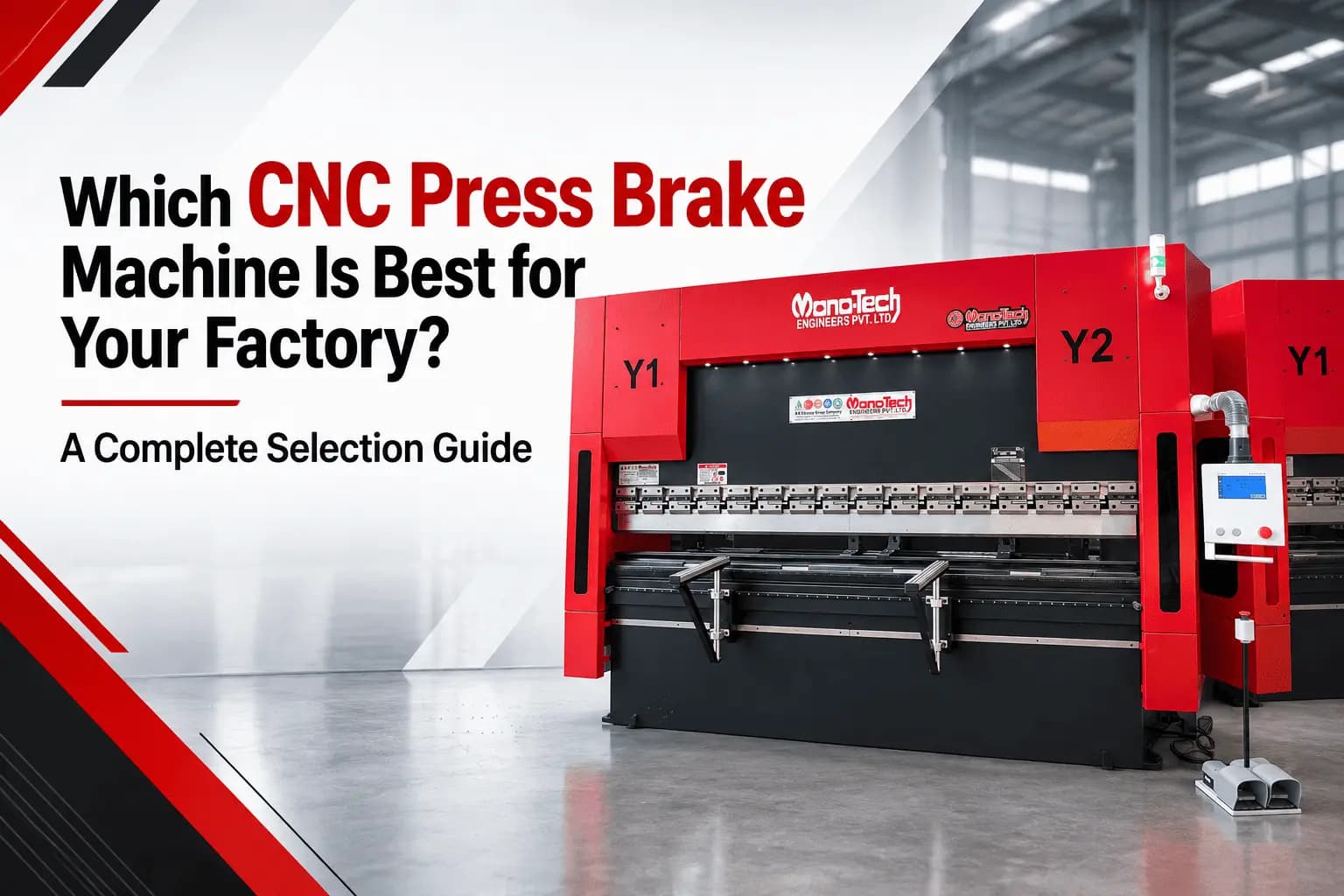
Which CNC Press Brake Machine Is Best for Your Factory? A Complete Selection Guide
Choosing the right CNC Press Brake Machine is an important decision for any sheet metal fabrication business. The machine you select directly influences bending accuracy, productivity, repeatability, setup time, and the range of components your factory can manufacture.
However, selecting a press brake based only on tonnage or price can lead to problems later. Sheet thickness, material grade, bending length, component geometry, tooling, CNC axes, production volume, and required accuracy all need to be considered before making a decision.
This guide explains how to choose a CNC Press Brake Machine according to your actual production requirements and what manufacturers should evaluate before investing in a new machine.
What Is a CNC Press Brake Machine?
A CNC Press Brake Machine is an industrial sheet metal bending machine designed to produce controlled bends in metal sheets and plates. CNC technology controls important machine movements and allows operators to program bending parameters for different jobs.
Compared with conventional bending equipment, CNC-controlled press brakes can provide better repeatability, faster setup, programmable job sequences, and greater flexibility for complex components.
Depending on the machine configuration, CNC control may manage ram positioning, back-gauge movements and other axes required for accurate component positioning.
For factories manufacturing multiple components or carrying out repetitive bending operations, these capabilities can significantly improve production efficiency.
Why Choosing the Right CNC Press Brake Matters
A press brake should match the parts your factory actually produces.
Buying an undersized machine may limit the thickness, length or material that can be processed. On the other hand, purchasing significantly more capacity and automation than required can increase investment without delivering proportional production benefits.
The right CNC Press Brake for sheet metal should provide a practical balance between:
Required bending capacity
Component dimensions
Accuracy and repeatability
Production volume
Number of CNC axes
Tooling requirements
Operator productivity
Future production requirements
Therefore, machine selection should begin with your components rather than simply comparing machine specifications.
1. Determine the Required Press Brake Tonnage
Tonnage is one of the first specifications to evaluate when selecting a CNC Hydraulic Press Brake Machine.
The required bending force depends on several factors, including:
Material type: Different metals have different tensile strengths and therefore require different bending forces.
Sheet thickness: As material thickness increases, the required bending force rises considerably.
Bending length: A longer bend generally requires greater total force.
Die opening: The selected V-die opening influences the force required to form the bend.
Bending method: Air bending, bottom bending and other forming methods can have different force requirements.
Instead of estimating tonnage only from material thickness, manufacturers should evaluate the actual combination of material, thickness, bending length, tooling and component geometry.
2. Select the Correct Bending Length
Working or bending length determines the maximum component width that can be accommodated by the press brake.
For example, a manufacturer producing long panels requires a different machine configuration from a company primarily bending smaller brackets and enclosures.
When determining the correct working length, consider both your current products and realistic future requirements.
Buying a machine that is too short can restrict future jobs, while choosing an unnecessarily long machine may increase floor-space and investment requirements.
3. Consider the Material You Need to Bend
Not every material behaves the same during bending.
Mild steel, stainless steel and aluminium have different mechanical characteristics. Material strength, thickness variation, grain direction and springback can influence the final bending result.
Before requesting a machine quotation, provide the manufacturer with details such as:
Material grade
Maximum and minimum thickness
Maximum bending length
Required bend angles
Component drawings
Production quantity
This allows the CNC Press Brake Machine manufacturer to recommend a more appropriate machine capacity and configuration.
4. Decide How Many CNC Axes You Need
The number and configuration of CNC-controlled axes can have a major impact on flexibility and productivity.
A simpler machine configuration may be sufficient for straightforward repetitive components. More complex jobs can benefit from a Multi Axis CNC Press Brake Machine with additional controlled movements.
Depending on the machine design, CNC axes may control functions such as ram movement, back-gauge positioning and independent positioning movements.
Multi-axis control is particularly useful when producing components with multiple bends, different flange dimensions or more complex geometries.
However, more axes do not automatically mean a better machine for every factory.
The objective should be to select the number of axes your applications genuinely require.
5. Evaluate the CNC Controller
The controller plays an important role in day-to-day press brake operation.
A modern CNC system can simplify job programming, machine setup, positioning and repeat production.
When comparing controllers, consider:
Programming interface
Job storage
Tooling database
Graphical programming capabilities
Bend sequence support
Axis control capability
Operator usability
Diagnostic functions
An advanced controller is especially valuable when your factory frequently switches between different components.
6. Check Back-Gauge Capability
Accurate flange dimensions depend heavily on reliable workpiece positioning.
The back gauge positions the sheet before bending and can be configured with multiple CNC-controlled axes depending on the application.
For straightforward components, a standard back-gauge configuration may be sufficient. More complicated components may require additional positioning flexibility.
When evaluating a press brake, consider the range, positioning accuracy, repeatability and axis configuration of the back gauge rather than looking only at the machine's tonnage.
7. Pay Attention to Tooling
Even a high-quality Precision Sheet Metal Bending Machine cannot deliver the required component geometry without appropriate tooling.
Punches and dies should be selected according to material thickness, bend angle, inside radius and component design.
Before purchasing a press brake, consider whether you need:
Standard V-dies
Different die openings
Gooseneck punches
Radius tooling
Segmented tooling
Special-purpose tooling
Sharing actual component drawings with the machine manufacturer can help determine the tooling required for your production.
8. Consider Accuracy and Repeatability
For repetitive production, producing one correct component is not enough. The machine must be capable of maintaining consistent results throughout the production batch.
Machine frame rigidity, hydraulic control, CNC positioning, back-gauge performance, tooling and material variation can all influence bending results.
This becomes particularly important for industries manufacturing components such as electrical panels, cabinets, automotive parts, industrial enclosures, machine components and precision fabrication assemblies.
9. Evaluate Safety Features
Press brakes generate significant forming forces, so safety must be considered during machine selection.
Depending on the machine configuration and applicable requirements, safety systems may include guarding, emergency-stop systems, light curtains, laser-based protection and other operator-protection arrangements.
Factories should evaluate both machine productivity and safe operating practices when selecting equipment.
10. Consider Your Production Volume
Your production pattern should influence the level of automation you select.
A fabrication workshop processing different low-volume jobs may prioritize programming flexibility and fast setup.
A factory producing repetitive components may benefit more from automated positioning, stored programs, multi-axis control and reduced manual adjustments.
Understanding your product mix is therefore essential before finalizing CNC Press Brake Machine specifications.
CNC Press Brake Machine Price: What Determines the Cost?
CNC Press Brake Machine price can vary significantly depending on machine capacity and configuration.
Major factors influencing price include:
Tonnage capacity
Working length
CNC controller
Number of controlled axes
Back-gauge configuration
Tooling package
Hydraulic and electrical components
Safety systems
Automation features
Optional accessories
Price should therefore not be evaluated independently of machine capability.
A lower initial purchase price may not always represent better value if the machine cannot meet future production requirements or requires excessive manual setup.
Which CNC Press Brake Machine Is Best for Your Factory?
There is no single CNC press brake configuration that is ideal for every manufacturer.
The right machine depends on what you need to manufacture.
If your factory produces relatively straightforward components, a practical CNC configuration with appropriate tonnage and working length may be sufficient.
If you manufacture components with multiple bends, varying flange dimensions or complex geometries, a Multi Axis CNC Press Brake Machine can provide greater positioning flexibility.
For high-volume production, the priority may shift toward automation, fast setup, program storage and production consistency.
Before selecting your machine, prepare these five details:
Maximum sheet thickness
Maximum bending length
Material grade
Component drawings
Expected production volume
These details make it considerably easier for a press brake manufacturer to recommend an appropriate configuration.
Why Choose Monotech Engineers for CNC Press Brake Machines?
Monotech Engineers Pvt. Ltd. provides CNC press brake solutions for industrial sheet metal bending and fabrication requirements.
Rather than selecting a machine only from standard capacity figures, manufacturers should consider the components that need to be produced. Monotech Engineers can evaluate application requirements such as material type, sheet thickness, bending length, component geometry and required machine configuration.
CNC and multi-axis press brake solutions can be configured according to different production requirements, from general sheet metal fabrication to more demanding precision bending applications.
For manufacturers looking for a CNC Press Brake Machine Manufacturer in India, selecting a supplier with application understanding, machine manufacturing capability and technical support is as important as comparing basic machine specifications.
Conclusion: CNC Press Brake Machine
The best CNC Press Brake Machine is not necessarily the machine with the highest tonnage, the longest working length or the greatest number of axes.
It is the machine that matches your components, materials, production volume and accuracy requirements while providing sufficient flexibility for future manufacturing needs.
Before making an investment, evaluate tonnage, bending length, material, CNC axes, controller, back gauge, tooling, safety and after-sales support together.
If you are planning to invest in a new CNC press brake, share your material thickness, bending length and component drawing with Monotech Engineers to identify a suitable machine configuration for your application.
FAQs: CNC Press Brake Machine
1. Which CNC Press Brake Machine is best for a factory?
The best CNC press brake depends on material thickness, material strength, bending length, component geometry, production volume and required accuracy. A machine should be selected according to actual components rather than tonnage alone.
2. How do I choose the right CNC Press Brake Machine?
Start with maximum material thickness, bending length and material grade. Then evaluate required tonnage, CNC axes, back gauge, controller, tooling, safety features and production volume. Sharing component drawings with the manufacturer can help determine the appropriate configuration.
3. What factors affect CNC Press Brake Machine price?
CNC press brake pricing is influenced by tonnage, working length, CNC controller, number of axes, back-gauge configuration, tooling, safety systems, components and automation level. Machines with higher capacity and advanced automation generally require a higher investment.
4. What is the advantage of a Multi Axis CNC Press Brake Machine?
A multi-axis CNC press brake provides greater control over machine and back-gauge positioning. This can improve flexibility when manufacturing parts with multiple bends, different flange dimensions and complex geometries while reducing manual positioning requirements.
5. What information should I provide before buying a CNC Press Brake Machine?
Provide the manufacturer with your material grade, minimum and maximum sheet thickness, maximum bending length, component drawings, required bend angles, production quantity and accuracy requirements. These details help determine suitable tonnage, working length, tooling and CNC configuration.