
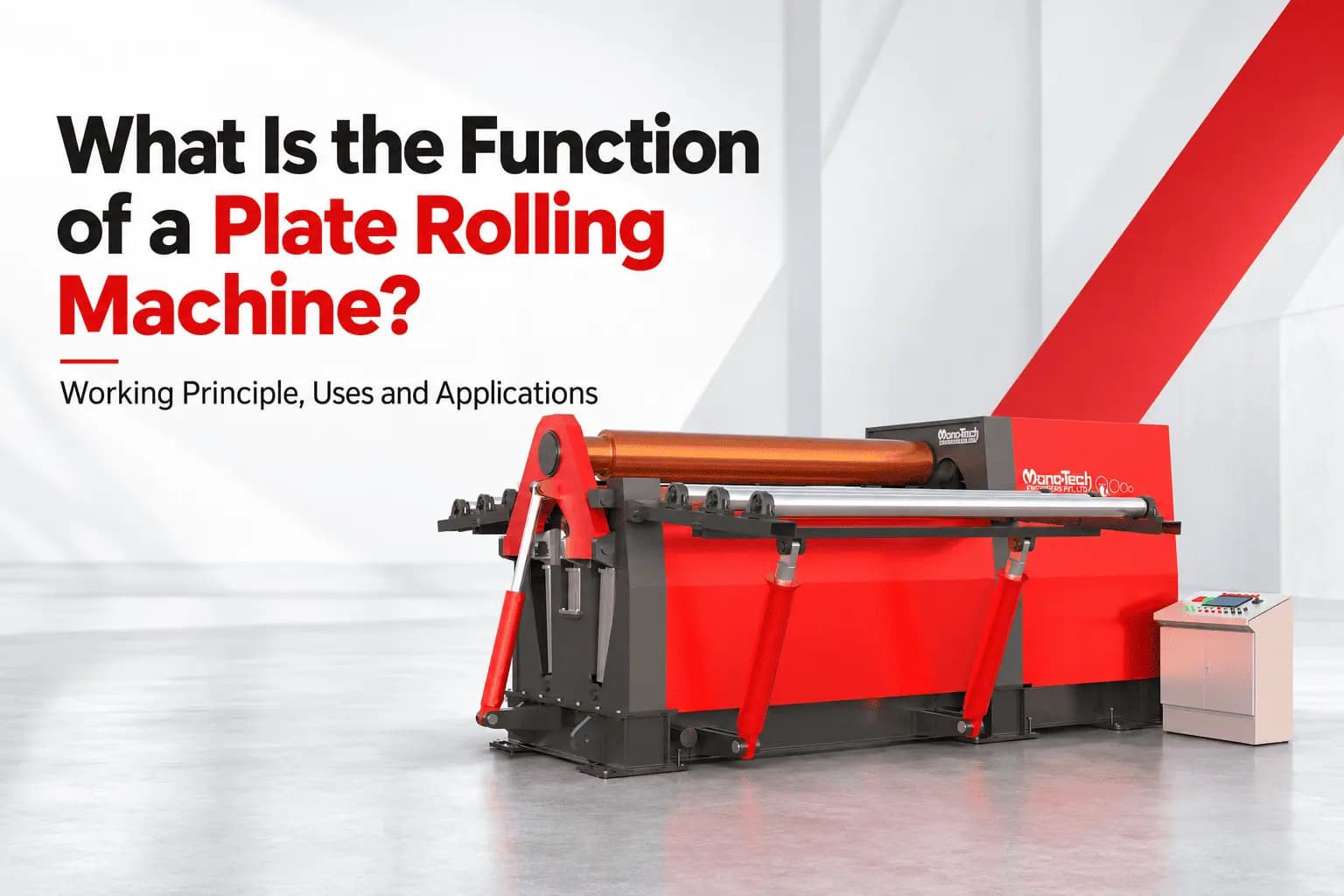
What Is the Function of a Plate Rolling Machine? Working Principle, Uses and Applications
Metal plates are widely used to manufacture cylindrical, conical and curved components for industrial applications. However, forming thick metal plates accurately and consistently requires specialised machinery. This is where a plate rolling machine becomes essential.
The primary function of a plate rolling machine is to bend flat metal plates into cylindrical, conical, curved or rounded shapes by passing them through a series of rotating rollers. It enables manufacturers to produce accurate components with controlled dimensions while reducing manual work, material waste and production time.
Plate rolling machines are commonly used in pressure vessel manufacturing, storage tank fabrication, construction equipment, pipelines, shipbuilding and general heavy engineering.
What Is a Plate Rolling Machine?
A plate rolling machine is industrial metal-forming equipment designed to bend flat metal plates into different curved profiles. The machine applies controlled pressure through multiple rollers until the required radius or shape is achieved.
Depending on the machine configuration, plate rolling can be performed using three or four rollers. Modern machines may also include hydraulic controls, CNC or NC systems, automatic pre-pinching and programmable rolling sequences.
A plate rolling machine can process materials such as:
Mild steel
Stainless steel
Carbon steel
Aluminium
High-strength steel
Special alloy plates
The rolling capacity depends on the plate thickness, plate width, material strength, required diameter and machine design.
What Is the Main Function of a Plate Rolling Machine?
The main function of a plate rolling machine is to convert a flat metal plate into a controlled curved shape. Pressure is applied gradually as the plate moves between the rollers. This creates permanent deformation in the material without cutting or joining it during the rolling process.
A plate rolling machine performs several important functions:
1. Forming Cylindrical Components
One of the most common functions is rolling flat plates into complete or partial cylinders. These cylinders are used to manufacture tanks, pressure vessels, pipelines, boilers, silos and industrial drums.
2. Producing Conical Shapes
A suitably designed cone rolling machine can form metal plates into conical or tapered shapes. Cone rolling requires controlled movement because the inner and outer edges of the plate travel at different speeds.
Conical components are commonly used in hoppers, reducers, chimneys, cement equipment and material-handling systems.
3. Creating Different Bending Radii
A plate rolling machine can produce components with different diameters and bending radii. The required radius is achieved by adjusting the position and pressure of the rollers.
Machines equipped with advanced numerical controls can improve repeatability when several components of the same dimensions are required.
4. Pre-Bending Plate Edges
When a plate is rolled without pre-bending, a straight portion may remain at its leading and trailing edges. This section is commonly called a flat end.
Pre-bending or pre-pinching helps reduce these flat ends before the complete rolling cycle begins. This improves dimensional accuracy and reduces the need for additional correction or rework.
5. Correcting Curved Components
In addition to forming new components, a plate rolling machine can sometimes be used to correct the diameter, roundness or curvature of previously rolled parts. The suitability of this process depends on the component dimensions, material and machine capacity.
Working Principle of a Plate Rolling Machine
A metal plate rolling machine works by placing a flat plate between rotating rollers. The rollers grip the plate and move it forward while applying pressure. This pressure exceeds the material’s elastic limit and creates permanent bending.
The basic plate rolling process includes the following stages:
Step 1: Plate Positioning
The metal plate is positioned and aligned between the machine rollers. Correct alignment is important to prevent uneven rolling, twisting or dimensional variation.
Step 2: Pre-Bending
The leading edge of the plate is pre-bent to reduce the flat portion. After the first edge is formed, the plate is repositioned or moved through the machine so that the second edge can also be pre-bent.
The exact sequence depends on whether a three-roll or four-roll machine is being used.
Step 3: Rolling
The plate passes through the rollers as pressure is gradually applied. Repeated or controlled movement creates the required cylindrical, conical or curved profile.
Step 4: Radius Adjustment
The operator or control system adjusts the roller positions according to the required diameter. The plate may pass through the machine more than once, particularly when processing thick or high-strength material.
Step 5: Component Removal
After the desired shape is achieved, the rolled component is removed. Many machines use a tilting or drop-end arrangement to make it easier to remove closed cylindrical components.
Difference Between a Plate Rolling Machine and a Plate Bending Machine
The terms plate rolling machine and plate bending machine are often used interchangeably. However, plate bending equipment may refer to a broader category of machines used to create bends in metal plates.
A press brake, for example, creates bends along specific straight lines using a punch and die. A plate rolling machine creates continuous curvature by moving the material through rotating rollers.
Therefore, a plate rolling machine is more suitable for producing:
Cylinders
Cones
Arcs
Large-radius bends
Curved structural sections
Types of Plate Rolling Machines
3-Roll Plate Rolling Machine
A 3-roll plate rolling machine uses three rollers arranged in a symmetrical, initial-pinch, double-pinch or variable-geometry configuration.
It is commonly used for general plate-forming applications and can handle a wide range of plate thicknesses and widths. Depending on its design, the plate may need to be repositioned to pre-bend both edges.
A three-roll machine may be suitable when:
General-purpose rolling is required
Production volumes are moderate
Different plate dimensions must be processed
Heavy plates or large diameters need to be formed
4-Roll Plate Rolling Machine
A 4-roll plate rolling machine consists of a top roll, bottom roll and two side rolls. The plate is securely pinched between the top and bottom rollers while the side rollers control pre-bending and rolling.
This configuration provides improved plate control and can reduce material handling during the rolling cycle.
A four-roll machine may offer:
Easier plate alignment
Better material gripping
Pre-bending from both sides
Reduced plate repositioning
Improved repeatability
Suitability for automated production
Hydraulic Plate Rolling Machine
A hydraulic plate rolling machine uses hydraulic power to move the rollers and apply controlled bending pressure. Hydraulic operation is particularly useful for bending thick, wide or high-strength plates.
Depending on the selected model, these machines may include:
Hydraulic roller movement
Digital position display
NC or CNC controls
Automatic pre-pinching
Programmable rolling sequences
Hydraulic drop-end operation
Safety systems and emergency controls
Sheet Metal Rolling Machine
A sheet metal rolling machine is generally designed for thinner sheets and lighter-duty applications. Although its working principle is similar to that of a heavy plate rolling machine, its frame, rollers and power system are selected for lower material thicknesses.
The correct machine should therefore be selected according to the material thickness, width and yield strength rather than relying only on the general machine category.
Cone Rolling Machine
A cone rolling machine is designed or configured to produce tapered components. Cone rolling requires proper plate development, controlled feeding and suitable roller positioning.
Some plate rolling machines can perform both cylindrical and conical rolling, but their cone-bending capability should be confirmed before selection.
Plate Rolling Machine Applications
Plate rolling machine applications cover a wide range of industries that require cylindrical, conical or curved metal components.
Pressure Vessels
Plate rolling machines are used to form shells for pressure vessels, reactors, heat exchangers and process equipment.
Storage Tanks and Silos
Large cylindrical sections for water tanks, oil storage tanks, chemical tanks and industrial silos are commonly produced through plate rolling.
Pipeline Manufacturing
Rolled plate sections can be welded to manufacture large-diameter pipes used in industrial pipelines, water systems and infrastructure projects.
Shipbuilding
Shipyards use plate rolling machines to form curved sections for hulls, decks and other structural components.
Construction and Earthmoving Equipment
Curved and formed plates are used in buckets, drums, structural assemblies and heavy equipment components.
Energy and Power Equipment
Plate rolling is used to manufacture components for wind towers, thermal power equipment, hydroelectric systems and other energy infrastructure.
Cement and Mining Machinery
Cylindrical shells, kilns, hoppers and heavy-duty processing equipment often require accurately rolled plates.
General Fabrication
Fabrication companies use plate rolling machines to produce ducts, chimneys, industrial enclosures, drums and customised curved components.
Benefits of Using a Plate Rolling Machine
Using the correct plate rolling machine can offer several manufacturing advantages:
Consistent bending radius
Improved cylindrical accuracy
Reduced flat ends through pre-bending
Faster production
Lower manual labour dependency
Better repeatability
Reduced correction and rework
Ability to process different plate materials
Production of cylindrical and conical components
Improved control over complex bending requirements
The actual results depend on machine selection, tooling condition, material characteristics, operator experience and process settings.
Factors to Consider When Selecting a Plate Rolling Machine
Understanding the function of a plate rolling machine is only the first step. Manufacturers must select a machine that matches their production requirements.
Important factors include:
Plate Thickness and Width
The machine must have sufficient capacity to roll the maximum required thickness across the required working width.
Material Yield Strength
Machine capacities are normally based on a specified material strength. Higher-strength material may require greater rolling force than standard mild steel.
Required Rolling Diameter
The minimum achievable diameter depends on the top-roll diameter, plate properties, thickness and machine configuration.
Pre-Bending Requirement
If minimum flat ends and reduced rework are important, a machine with effective pre-bending capability should be selected.
Cylindrical or Conical Rolling
The machine configuration must support the shapes required in production. Cone rolling capability should be discussed with the manufacturer in advance.
Production Volume
A manually controlled machine may be suitable for occasional fabrication, while regular or high-volume production can benefit from NC or CNC automation.
Handling and Safety
The weight and size of the plate should be considered. Suitable supports, feeding arrangements and safety systems may be required for large components.
Conclusion
The primary function of a plate rolling machine is to transform flat metal plates into cylindrical, conical, curved and rounded components through controlled pressure and roller movement. The machine plays a critical role in industries such as pressure vessel manufacturing, storage tank fabrication, shipbuilding, construction equipment, pipelines, energy and heavy engineering.
Choosing between a 3-roll plate rolling machine, 4-roll plate rolling machine, hydraulic plate rolling machine or sheet metal rolling machine depends on the plate dimensions, material strength, required diameter, production volume and automation needs.
Monotech Engineers Pvt. Ltd. manufactures plate rolling solutions for varied industrial requirements. Selecting the correct machine configuration helps manufacturers improve rolling accuracy, reduce rework and achieve more consistent production.