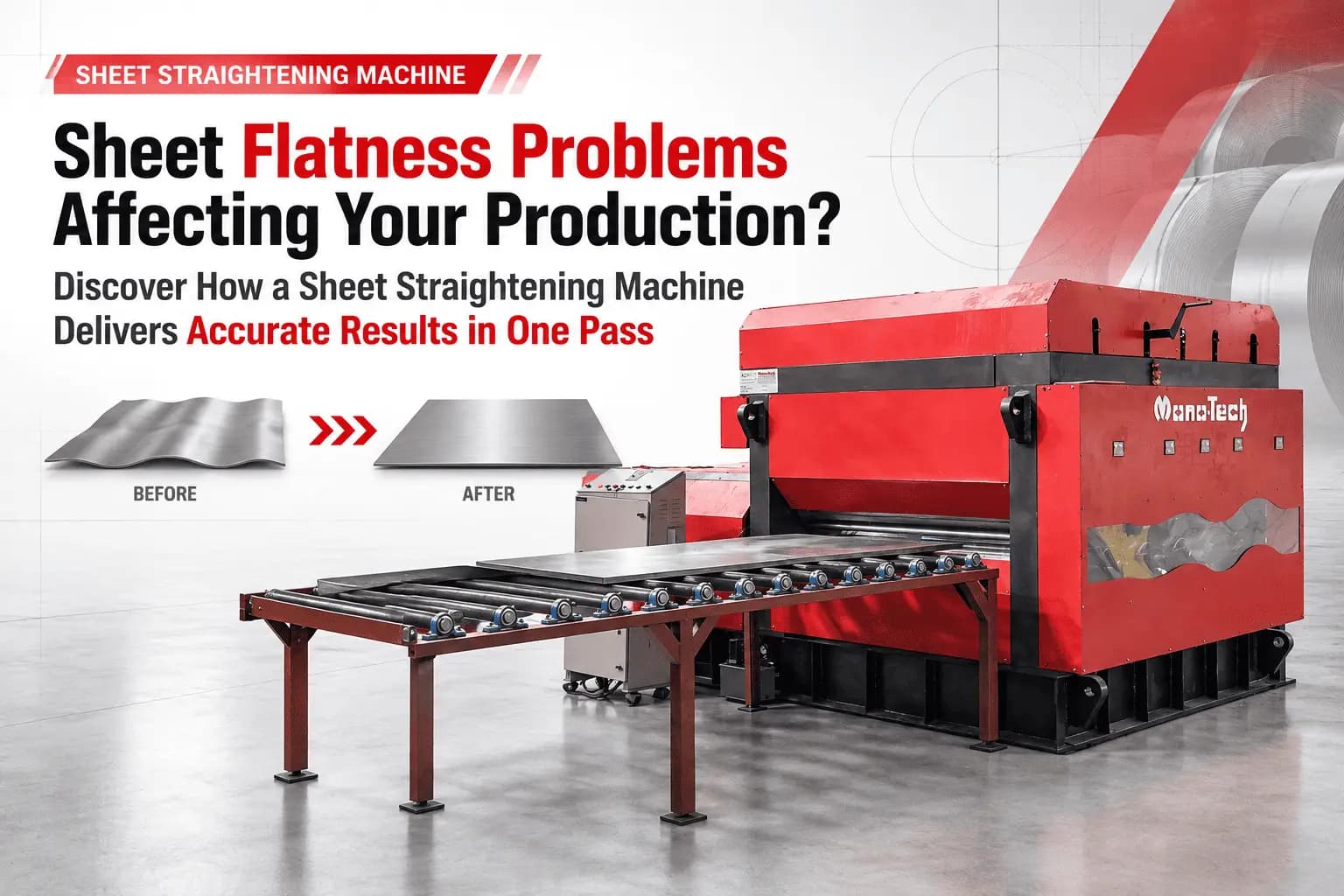
Sheet Flatness Problems Affecting Your Production? Discover How a Sheet Straightening Machine Delivers Accurate Results in One Pass
Sheet flatness is essential for maintaining accuracy, productivity and consistent quality in metal fabrication. Even minor waves, bends or distortions can create serious problems during bending, welding, machining and assembly.
Manual correction methods are often slow, inconsistent and highly dependent on operator experience. A modern Sheet Straightening Machine provides a faster and more controlled solution by correcting deformed sheets and components through a precision roller-straightening process.
With the correct machine configuration and operating parameters, manufacturers can achieve accurate and repeatable flatness, often in a single pass.
What Causes Sheet Flatness Problems?
Metal sheets and components may develop deformation at different stages of manufacturing. In many cases, internal stresses remain hidden until the material is cut, heated or processed.
Common causes of sheet flatness problems include:
Heat generated during laser, plasma or flame cutting
Uneven heating and cooling of the material
Residual stress from the original manufacturing process
Welding-induced deformation
Punching and perforation
Incorrect material handling
Improper sheet storage
Mechanical stress during transportation
Variations in material thickness
High internal tension in laser-cut components
These conditions may produce waves, bends, twists or uneven surfaces. If the deformation is not corrected, it can affect subsequent production processes and the overall quality of the finished product.
How Uneven Sheets Affect Production
A distorted sheet does more than create a visual defect. It can interfere with almost every stage of metal fabrication.
Inaccurate Bending
A warped component may not sit correctly against the press brake tooling. This can result in inconsistent bending angles, incorrect dimensions and poor repeatability.
Welding Difficulties
Uneven components create gaps during fit-up. Operators may need additional clamps or fixtures to hold the parts in position, increasing welding time and production costs.
Machining Errors
Flatness is important for accurate drilling, milling and other machining processes. A distorted component may move or vibrate during machining, affecting dimensional accuracy.
Assembly Problems
Components that are not flat may fail to align correctly during assembly. This can result in poor fitting, additional finishing work and inconsistent product quality.
Increased Rework
Manual hammering, pressing or repeated adjustments require additional labour. These methods may also damage the surface or produce different results from one component to another.
Higher Material Rejection
Components that do not meet the required flatness tolerance may need to be reprocessed or rejected, increasing material waste and production costs.
What Is a Sheet Straightening Machine?
A Sheet Straightening Machine is industrial equipment used to remove waves, bends, twists and other deformations from metal sheets and fabricated components.
It uses a precisely arranged set of upper and lower rollers to apply controlled alternating bending forces to the material. These forces redistribute internal stresses and progressively improve the flatness of the component.
Unlike manual straightening methods, a Sheet Metal Straightening Machine provides controlled adjustment and repeatable performance. It is especially beneficial for companies processing large quantities of sheets or components with strict dimensional requirements.
How Does a Sheet Straightening Machine Work?
The straightening process begins when the sheet or component is fed between multiple precision rollers. These rollers guide the material through a series of controlled upward and downward bends.
The bending intensity is generally greater at the entry side of the machine. It gradually decreases as the material moves towards the exit. This controlled process redistributes internal stresses and brings the component closer to the required flatness.
A typical sheet metal leveling process involves the following steps:
The operator checks the material type, thickness and level of deformation.
The machine settings are adjusted according to the component specifications.
The sheet or component is placed at the machine entry.
The straightening rollers apply controlled alternating pressure.
Internal stresses are progressively redistributed.
The material exits the machine with improved flatness.
Accurate roller adjustment is essential because different materials react differently to pressure. Mild steel, stainless steel, aluminium and high-strength alloys require different straightening parameters.
Can Accurate Flatness Be Achieved in One Pass?
A correctly selected and configured Precision Sheet Straightening Machine can straighten many types of sheets and components in a single pass.
One-pass straightening reduces repeated handling, manual correction and production delays. It can help manufacturers improve output while maintaining consistent quality across multiple components.
However, the final result depends on several important factors:
Material type
Material yield strength
Sheet thickness
Component width and length
Initial deformation level
Required flatness tolerance
Number and diameter of rollers
Machine rigidity
Roller adjustment accuracy
Operator settings
Severely distorted components or parts with complex geometries may require additional processing. Sample trials are therefore recommended to determine the appropriate machine settings and achievable flatness.
Benefits of Using a Sheet Straightening Machine
Improved Flatness Accuracy
The machine corrects waves, bends and twists to provide flatter components for further manufacturing processes.
Consistent Results
Controlled roller settings help maintain uniform straightening performance across an entire production batch.
Reduced Manual Rework
Automated sheet flatness correction reduces the need for hammering, manual pressing and repeated trial-and-error adjustments.
Faster Production
An Automatic Sheet Straightening Machine processes components faster than traditional manual methods, helping manufacturers maintain an efficient production flow.
Better Bending and Welding Quality
Flat components can be positioned more accurately during bending and welding, reducing alignment problems and dimensional errors.
Lower Rejection Rates
Improved flatness reduces the possibility of components being rejected due to deformation or poor dimensional consistency.
Reduced Operator Dependency
Controlled machine settings make the process less dependent on individual operator judgement and experience.
Improved Finished-Product Quality
Straightened components fit together more accurately, helping manufacturers produce cleaner assemblies and more reliable finished products.
Applications of a Sheet Straightening Machine
A modern Metal Sheet Leveling Machine can be used for various metal sheets and fabricated components.
Laser-Cut Components
Heat generated during laser cutting can release internal stresses and cause components to bend. A straightening machine helps restore the required flatness before bending, welding or assembly.
Sheet Metal Components
Metal sheets used for panels, enclosures, cabinets and fabricated structures can be levelled before further processing.
Perforated Sheets
Punching and perforation can create uneven surfaces and waves. Precision straightening helps correct these problems without relying on manual methods.
Flange Rings
Circular components and flange rings may become distorted during thermal cutting. A suitable machine can improve their flatness and dimensional stability.
Wire Mesh
Industrial wire mesh may develop waves during production, storage or transportation. Controlled roller straightening can prepare it for further processing.
Automotive Components
Brackets, structural components and laser-cut automotive parts often require accurate flatness before bending, welding or assembly.
Industries That Use Sheet Straightening Machines
A Sheet Straightening Machine is valuable in industries where component accuracy and repeatable production quality are essential.
Common industries include:
Automotive manufacturing
Railway and transportation
Aerospace component manufacturing
Construction equipment
Electrical panel manufacturing
Sheet metal fabrication
Heavy engineering
Agricultural machinery
Defence manufacturing
Industrial equipment production
The required machine capacity and configuration can vary considerably between these industries. Machine selection should therefore be based on the actual application rather than general capacity alone.
Why Machine Straightening Is Better Than Manual Correction
Manual straightening usually depends on hammering, pressing or repeated physical adjustments. The final result can vary according to the operator’s experience and judgement.
This process may also require multiple inspections and corrections before the component reaches the desired flatness. Surface marks and localised deformation are additional risks.
A Sheet Straightening Machine provides better process control. Once the correct settings are established, the same parameters can be applied to similar components. This improves consistency, reduces processing time and supports batch production.
Machine straightening is particularly suitable when manufacturers require:
Repeatable component quality
Faster processing
Reduced manual labour
Lower rejection rates
Improved downstream accuracy
Controlled production parameters
Higher production capacity
How to Select the Right Sheet Straightening Machine
Selecting the correct machine is essential for achieving the expected results.
Material Type and Strength
Different materials respond differently to roller pressure. The material type and yield strength must be evaluated before determining machine capacity.
Thickness Range
The machine should handle the minimum and maximum thickness used in the manufacturing process.
Working Width
The roller width must be suitable for the widest sheet or component that needs to be straightened.
Component Geometry
Solid sheets, perforated sheets, laser-cut parts, rings and complex components may require different feeding and roller arrangements.
Initial Deformation
The type and severity of deformation help determine the required straightening force and roller configuration.
Required Flatness
The expected flatness tolerance should be clearly defined before machine selection.
Production Volume
An automatic system is particularly valuable for regular batch production and high-volume manufacturing.
Technical Support
Installation, training, spare-parts availability and after-sales support are essential for reliable machine operation.
Monotech Sheet Straightening Solutions
Monotech Engineers develops Sheet Straightening Machines for different materials, component sizes and industrial applications.
The machines are designed with a focus on:
Precision roller adjustment
Heavy-duty construction
Consistent straightening performance
Efficient operation
Application-based customisation
Reduced processing time
Reliable technical support
Before recommending a solution, Monotech Engineers evaluates the customer’s material type, thickness, width, component geometry, deformation level, production requirements and expected flatness.
This application-focused approach helps manufacturers select a suitable Precision Sheet Straightening Machine for their production needs.
Conclusion
Sheet flatness problems can reduce manufacturing accuracy, slow down production and increase material rejection. They can also create difficulties during bending, welding, machining and final assembly.
A modern Sheet Straightening Machine provides a controlled and repeatable method for correcting these problems. With the right capacity and settings, manufacturers can achieve accurate flatness, often in one pass, while reducing manual rework and improving overall production efficiency.
If warped sheets, laser-cut components or distorted metal parts are affecting your production, Monotech Engineers can develop a customised straightening solution based on your material, component size and required flatness.
FAQs
1. What is a Sheet Straightening Machine?
A Sheet Straightening Machine is industrial equipment that removes waves, bends, twists and deformation from metal sheets and fabricated components through a controlled roller-straightening process.
2. How does a Sheet Straightening Machine improve sheet flatness?
The machine passes the material through multiple precision rollers. These rollers apply alternating bending forces that redistribute internal stresses and progressively improve flatness.
3. Can a Sheet Straightening Machine provide accurate results in one pass?
Yes, many sheets and components can be straightened in one pass when the machine is correctly selected and configured. The result depends on the material, thickness, component size, deformation and required tolerance.
4. Which materials can be processed in a Sheet Metal Straightening Machine?
Depending on the machine capacity, it can process mild steel, stainless steel, aluminium, copper and different industrial alloys.
5. What details are required to select a Metal Sheet Leveling Machine?
The manufacturer generally requires the material type, yield strength, thickness range, working width, component dimensions, deformation level, production volume and expected flatness tolerance.