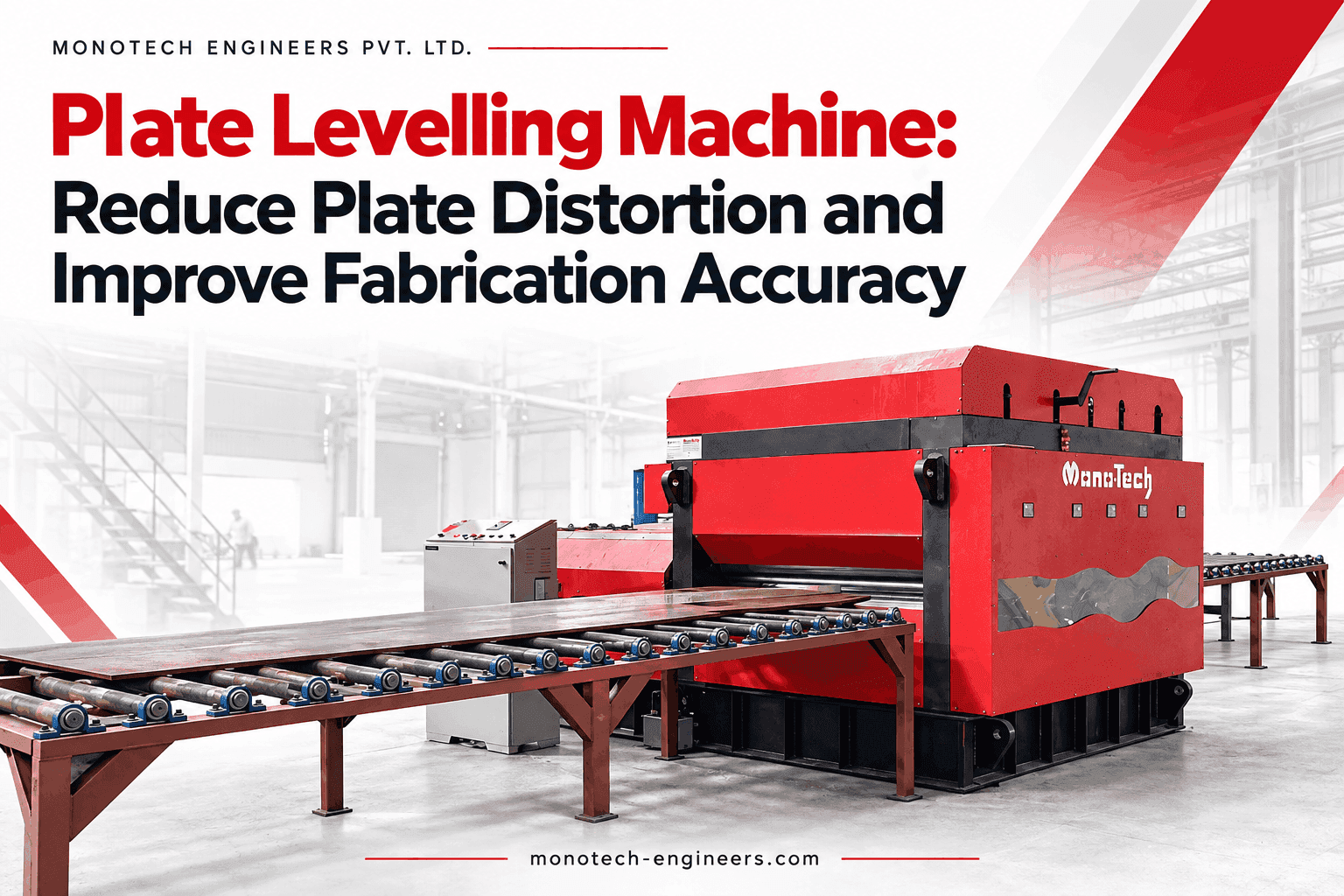
Plate Levelling Machine: Reduce Plate Distortion and Improve Fabrication Accuracy
A Plate Levelling Machine helps manufacturers address uneven metal plates before they create problems in fabrication. When a plate does not sit flat, positioning, bending and assembly can become more difficult, increasing the need for adjustments.
For fabricators, flatness is more than a visual requirement. It affects how accurately a component fits into the next production stage. Monotech Engineers helps manufacturers explore plate levelling solutions based on their material, component dimensions and production requirements.
What Is a Plate Levelling Machine?
A Plate Levelling Machine uses a series of rollers to apply controlled, alternating bends to metal plates. This roller levelling process improves flatness and can reduce or redistribute residual stresses within the material.
The result depends on the incoming plate condition, material properties and machine settings. A plate that looks flat may still contain residual stresses, so flatness and stress condition should be treated as separate considerations.
Why Uneven Plates Create Fabrication Challenges
An uneven plate can make a straightforward operation more time-consuming. Operators may need to reposition the material, adjust fixtures or correct the component before continuing.
Common production difficulties include:
Gaps between components during assembly.
Difficulty seating plates consistently in fixtures.
Additional manual work before bending or welding.
Inconsistent reference surfaces for measurement.
Repeated corrections that interrupt production flow.
For example, a bowed component may need extra clamping to bring its edges into position. Preparing a flatter component gives the fabrication team a more consistent starting point.
How a Plate Levelling Machine Supports Better Results
Correcting Plate Distortion
Metal plate flattening addresses deviations from the required flat shape. A suitable levelling process can help correct distortion so the plate is better prepared for subsequent operations.
However, machine selection should begin with the actual defect. A slight bow, an edge wave and a distorted cut component may require different settings or equipment capabilities.
Managing Residual Stresses
Thermal cutting processes such as laser, plasma and flame cutting can introduce residual stresses into metal. Precision roller levelling applies successive alternating bends to improve flatness and influence the stress distribution.
Residual stress reduction should be evaluated alongside the required flatness. Avoid assuming that every levelled plate becomes completely stress-free.
Establishing Consistent Input Quality
Fabrication becomes easier to control when incoming components meet a defined condition. Checking plate flatness before production helps teams decide whether material is ready for processing or needs correction.
A Precision Plate Levelling Machine should therefore be assessed against a measurable acceptance requirement, rather than appearance alone.
Benefits for Welding, Bending and Assembly
Plate levelling can support a more organised fabrication process by improving the condition of material entering the next operation.
For welding preparation: Flatter components can make positioning and fit-up easier. Welding sequence, heat input and fixturing still influence the final result.
For bending: A consistent starting condition helps operators position material more reliably. Final bending accuracy also depends on tooling, material properties and press brake settings.
For assembly: Components that meet the required flatness can be easier to locate against fixtures and mating surfaces.
For inspection: A defined flatness requirement gives production and quality teams a shared basis for accepting or correcting parts.
These benefits should be confirmed through trials using representative production components.
How to Choose the Right Plate Levelling Machine
Selecting plate straightening equipment requires more than checking maximum thickness. Prepare the following details before discussing a machine with a supplier.
Material Grade and Strength
Share the exact material grade wherever possible. A Steel Plate Levelling Machine must be assessed for the strength of the steel being processed, along with its dimensions.
Minimum and Maximum Thickness
Specify the complete thickness range used in production. A machine suitable for the thickest plate may not necessarily deliver the required results on the thinnest component.
Plate Width and Component Length
Provide maximum plate width, typical component length and the dimensions of smaller parts. These details help determine whether the proposed machine suits your product mix.
Required Flatness
Define how flatness will be measured and what tolerance is acceptable. For example, specify the permitted deviation over a stated measurement length or surface.
Production Volume
An Automatic Plate Levelling Machine may be considered where repeat batches, handling requirements and production volume justify the investment. Confirm which adjustments and handling functions are automated.
Representative Material Trials
Request a trial with your own material where practical. Compare the incoming condition with the result after levelling, and check whether the component performs satisfactorily in the next operation.
For a Heavy Duty Plate Levelling Machine, this evaluation is especially useful when processing demanding material grades or substantial plate sections.
Plate Levelling Solutions from Monotech Engineers
Choosing machinery starts with understanding the production problem.
When discussing your application with Monotech Engineers, share:
Material grade and thickness range.
Plate width and component dimensions.
Photographs or samples of the distortion.
Required flatness tolerance.
Daily production volume.
The next operation, such as bending, welding or assembly.
This information provides a practical starting point for evaluating a plate levelling solution suited to your fabrication requirements.
Frequently Asked Questions
1. What is a Plate Levelling Machine, and how does it work?
A Plate Levelling Machine passes metal through a series of rollers that apply alternating bends. The process improves flatness and can influence residual stresses. Results depend on material properties, machine capability and settings.
2. How does a Plate Levelling Machine reduce plate distortion?
Controlled roller bending works on the plate’s uneven shape. The settings must suit the material and defect, and the finished plate should be measured against the required flatness tolerance.
3. Which materials and plate thicknesses can a Plate Levelling Machine process?
Suitable roller levellers can process materials including steel, stainless steel and aluminium. The permitted thickness range varies by machine and material strength, so capacity must be confirmed for the specific application.
4. How does plate levelling improve welding and fabrication accuracy?
Flatter plates can support more consistent positioning, fit-up and assembly. Levelling does not eliminate the need to control welding heat, bending settings, tooling or fixtures.
5. What should you consider when choosing a Plate Levelling Machine?
Consider material grade, strength, thickness range, plate dimensions, required flatness, production volume and handling needs. Trials with representative components help verify suitability.
Discuss Your Plate Levelling Requirements
Uneven plates can add correction work at several stages of fabrication. Addressing flatness before further processing gives your team a better starting point.
Connect with Monotech Engineers to discuss a Plate Levelling Machine for your material and production requirements.
Visit monotech-engineers.com.