From Warped to Precise: The Power of Sheet Straightening Machines
In modern metal fabrication, precision is not optional—it is essential. Even minor bends, waves, or distortions in metal sheets can create problems during cutting, bending, welding, machining, and assembly. When flatness is compromised, manufacturers may face rework, material waste, inconsistent dimensions, and production delays.
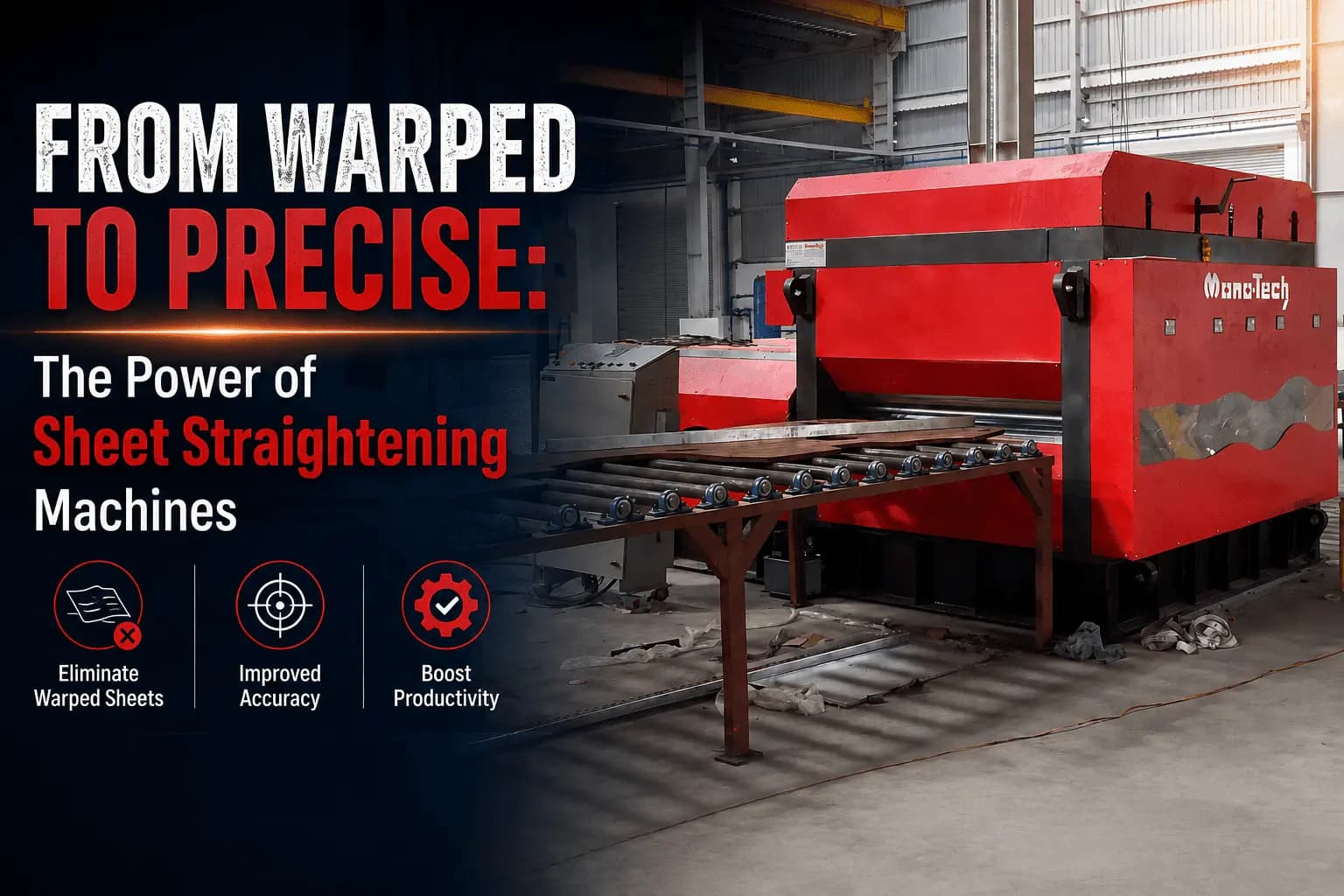
This is where Sheet Straightening Machines become an important part of the manufacturing process. Designed to correct unwanted deformation and improve sheet flatness, these machines help manufacturers achieve consistent material quality and reliable downstream processing.
From laser-cut components to fabricated metal sheets, advanced straightening technology provides a controlled way to transform distorted material into production-ready components.
What Is a Sheet Straightening Machine?
A Sheet Straightening Machine is an industrial machine designed to correct bends, waves, twists, and other flatness-related defects in metal sheets and plates.
The machine uses controlled mechanical force, typically through a series of precision-positioned rollers, to gradually correct deformation in the material. As the sheet passes through the straightening section, carefully controlled pressure helps redistribute internal stresses and improve overall flatness.
Unlike conventional manual correction methods, modern machines provide greater control, repeatability, and consistency. This makes them suitable for industries where high-quality sheet material is required for further manufacturing operations.
Why Do Metal Sheets Become Distorted?
Metal sheet distortion can occur at several stages of manufacturing and handling. Even a sheet that initially appears flat can develop deformation due to mechanical or thermal stresses.
Common causes include:
Residual stresses from the manufacturing process
Heat generated during laser or plasma cutting
Welding and fabrication operations
Uneven cooling
Rolling and forming processes
Improper transportation or storage
Mechanical handling
Localized stress within the material
These imperfections can become more noticeable during subsequent fabrication operations.
A Metal Sheet Straightening Machine helps manufacturers correct these issues before the material moves to critical downstream processes.
How Does a Sheet Straightening Machine Work?
The working principle of a Sheet Straightening Machine is based on controlled deformation.
The metal sheet passes through multiple rollers that apply carefully calculated forces at different points. The roller arrangement creates controlled bending and reverse bending, helping reduce unwanted deformation and internal stresses.
The machine parameters can be adjusted according to the material and application, including:
Sheet thickness
Sheet width
Material type
Roller position
Straightening force
Feed speed
Number of passes
Required flatness
This controlled process allows manufacturers to achieve more uniform and predictable results than traditional manual straightening methods.
Key Benefits of Sheet Straightening Machines
1. Improved Sheet Flatness
The primary purpose of a Sheet Metal Straightening Machine is to improve the flatness of metal sheets. Removing waves, bends, and localized distortions helps create a more stable surface for subsequent manufacturing operations.
2. Better Dimensional Accuracy
Flat material provides a better foundation for accurate cutting, bending, welding, machining, and assembly. Improved flatness can help manufacturers maintain tighter dimensional control.
3. Reduced Rework and Rejection
Distorted material can lead to manufacturing defects and rejected components. Straightening the material before critical operations can help reduce rework and improve overall production efficiency.
4. Improved Material Utilization
When distorted sheets are corrected instead of discarded, manufacturers can potentially improve material utilization and reduce unnecessary scrap.
5. Consistent Production Quality
For industries processing large volumes of metal sheets, repeatability is critical. A properly configured Heavy Duty Sheet Straightening Machine can provide consistent straightening results across production batches.
6. Higher Production Efficiency
Compared with time-consuming manual correction, machine-based straightening offers a more systematic and repeatable process. This can help manufacturers streamline their production workflow.
Sheet Straightening After Laser Cutting
Laser cutting is widely used for producing precision components. However, the concentrated heat generated during cutting can create localized thermal stresses in the material.
These stresses may cause thin sheets or intricate components to develop unwanted deformation.
Using a suitable Sheet Straightening Machine after laser cutting can help correct such distortion before the components move to bending, welding, machining, or assembly.
This is particularly useful for manufacturers that require flat, dimensionally stable components for further processing.
The Importance of Straightening After Welding
Welding introduces significant localized heat into metal components. As the material heats and cools, thermal expansion and contraction can create residual stresses and distortion.
Warped welded components can make assembly difficult and may affect dimensional accuracy.
A suitable straightening process can help restore the required geometry and improve the consistency of fabricated components.
Applications of Sheet Straightening Machines
Sheet Straightening Machines are used in a wide range of industrial applications where material flatness and dimensional accuracy are important.
Common applications include:
Automotive component manufacturing
Heavy engineering
General metal fabrication
Construction equipment manufacturing
Industrial machinery production
Structural fabrication
Laser-cut component processing
Welding and fabrication
Agricultural equipment manufacturing
Precision engineering
For thicker materials and industrial plates, a Plate Straightening Machine may be selected according to the required material thickness, width, straightening force, and application.
Sheet Straightening Machine vs. Manual Straightening
Manual straightening techniques can involve hammering, pressing, heating, or other corrective methods. These approaches may work for certain individual components but can become difficult to control when production volumes increase.
A modern Sheet Leveling Machine offers a more controlled and repeatable process.
Machine-based straightening can provide:
Greater process consistency
Reduced operator dependency
Better repeatability
Higher production capacity
Controlled straightening force
Improved quality control
For industrial manufacturers, these advantages can make machine-based straightening a more practical solution for regular production.
Choosing the Right Sheet Straightening Machine
Selecting the right machine requires careful evaluation of the production requirements. A machine suitable for thin sheets may not be appropriate for heavy plates or high-strength materials.
Important factors to consider include:
Material Thickness
Determine the minimum and maximum thickness of the sheets that need to be processed.
Material Width
The working width of the machine should accommodate the maximum sheet width required in production.
Material Type
Different metals have different mechanical properties. Material grade, yield strength, and thickness can influence the required straightening capacity.
Required Flatness
The desired flatness level should be clearly defined before selecting the machine configuration.
Production Volume
Manufacturers processing large quantities may benefit from automated systems that provide faster and more consistent operation.
Automation Level
An Automatic Sheet Straightening Machine can reduce manual intervention and improve process repeatability, particularly in continuous or high-volume production environments.
How Automation Is Transforming Sheet Straightening
Modern manufacturing increasingly depends on automation, and sheet straightening is also evolving with this trend.
Advanced straightening systems can incorporate automated controls, programmable settings, precision adjustments, and monitoring systems. These features can help manufacturers maintain consistent processing conditions while reducing manual intervention.
Automation is especially valuable when manufacturers process similar materials or components repeatedly and require stable quality from batch to batch.
Why Flatness Matters in Metal Fabrication
Flatness is more than an aesthetic requirement. It directly influences the performance of several manufacturing processes.
A distorted sheet can create challenges during:
CNC cutting
Press brake bending
Welding
Machining
Assembly
Dimensional inspection
Surface finishing
Starting with properly straightened material can make downstream operations more predictable and efficient.
This is why many modern fabrication facilities consider a Metal Sheet Leveling Machine or straightening system an important part of their production workflow.
The Future of Sheet Straightening Technology
As manufacturing moves toward higher precision, automation, and productivity, the demand for advanced straightening solutions is expected to continue growing.
Manufacturers are increasingly looking for machines that combine:
Precision
Automation
Repeatability
Productivity
Flexible processing
Consistent quality
The evolution of straightening technology is helping manufacturers address material distortion more efficiently while maintaining demanding production standards.
Conclusion
From warped and distorted material to precise, production-ready sheets, Sheet Straightening Machines play a critical role in modern metal fabrication.
By improving flatness, reducing distortion, supporting dimensional accuracy, and increasing process consistency, these machines can help manufacturers improve the efficiency and reliability of their production operations.
Whether the requirement involves laser-cut components, fabricated sheets, or industrial plates, selecting the right Sheet Metal Straightening Machine can help reduce rework, improve material utilization, and support consistent manufacturing quality.
As industries continue to demand greater precision and productivity, advanced sheet straightening technology will remain an important solution for achieving reliable results in modern metal processing.
FAQs About Sheet Straightening Machines
1. What is a Sheet Straightening Machine?
A Sheet Straightening Machine is an industrial machine used to correct bends, waves, twists, and other distortions in metal sheets and plates to improve their flatness and dimensional stability.
2. What causes distortion in metal sheets?
Distortion can result from residual stresses, laser cutting, welding, rolling, forming, uneven cooling, transportation, and improper handling.
3. Can a Sheet Straightening Machine be used after laser cutting?
Yes. A suitable Sheet Straightening Machine can help correct thermal distortion and improve the flatness of laser-cut sheets and components before further processing.
4. What is the difference between sheet straightening and sheet leveling?
Both processes are intended to improve the flatness of metal material. The terminology and machine configuration can vary depending on the manufacturer, material, and specific application.
5. What factors should be considered when selecting a Sheet Straightening Machine?
Important factors include material type, thickness, width, yield strength, required flatness, production volume, straightening capacity, and desired level of automation.