
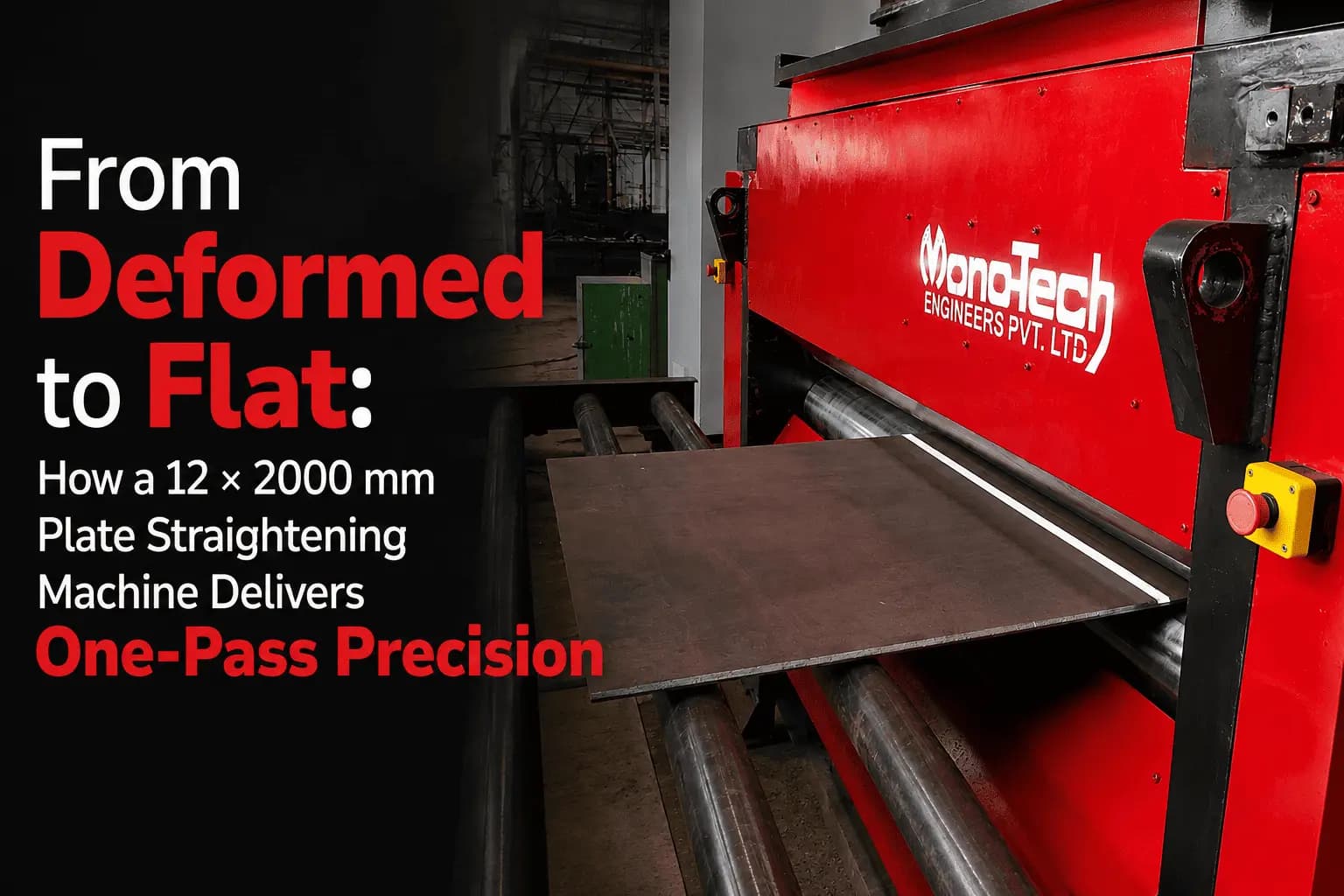
From Deformed to Flat: How a 12 × 2000 mm Plate Straightening Machine Delivers One-Pass Precision
In metal fabrication, even a small amount of plate deformation can affect dimensional accuracy, assembly quality, welding, and the final appearance of a component. Warped, bent, or uneven plates often require additional processing, increasing production time and material handling.
A modern 12 × 2000 mm Plate Straightening Machine is designed to address these challenges efficiently. With controlled straightening and precise pressure application, it can transform deformed metal plates into flatter, more consistent plates—often in a single pass, depending on the material, thickness, and deformation pattern.
What Is a 12 × 2000 mm Plate Straightening Machine?
A 12 × 2000 mm Plate Straightening Machine is an industrial machine used to correct flatness and deformation in metal plates.
The specification indicates that the machine is designed for plates up to approximately 12 mm in thickness and 2000 mm in working width, subject to the machine's specific design and material limitations.
Unlike conventional manual straightening methods, a plate straightening machine applies controlled mechanical force to correct uneven areas. This helps manufacturers achieve more consistent flatness while reducing dependence on manual correction.
Why Does Plate Straightening Matter?
During cutting, welding, forming, rolling, or thermal processing, metal plates can develop unwanted deformation. Common issues include:
Bowing
Edge deformation
Buckling
Uneven flatness
Localized bending
Residual stress-related distortion
These defects can create problems during fabrication and assembly.
For example, a plate that is not sufficiently flat may require additional adjustment before welding. In precision fabrication, this can affect dimensional tolerances and increase rework.
A Plate Straightening Machine provides a controlled method of correcting these problems and preparing plates for subsequent manufacturing operations.
How Does a Plate Straightening Machine Work?
The working principle is based on controlled mechanical deformation.
The plate is positioned and passed through the machine's straightening system. Controlled forces are applied to areas of deformation, causing the material to undergo carefully managed plastic deformation.
As the plate moves through the machine, uneven sections are progressively corrected.
The basic process can be understood in four stages:
1. Plate Positioning
The operator positions the deformed plate correctly according to its size, thickness, and deformation pattern.
2. Controlled Force Application
The machine applies calculated mechanical pressure to the plate. The amount of force depends on factors such as material type, thickness, width, and degree of deformation.
3. Progressive Straightening
As the plate passes through the working zone, the deformation is gradually reduced. Proper force distribution is essential for achieving uniform flatness.
4. Flatness Verification
After straightening, the plate can be inspected using appropriate measurement methods to verify whether the required flatness has been achieved.
What Makes One-Pass Straightening Possible?
One-pass straightening is not simply about applying maximum force. It depends on controlled force, machine configuration, material characteristics, and accurate setup.
When the machine is correctly configured for the specific plate, the deformation can potentially be corrected during a single pass.
This offers an important production advantage: fewer passes mean less handling, shorter processing time, and improved workflow efficiency.
However, actual one-pass performance depends on the plate's material, thickness, initial deformation, residual stresses, and required flatness tolerance.
Key Benefits of a 12 × 2000 mm Plate Straightening Machine
Improved Plate Flatness
The primary objective is to improve the flatness of deformed plates and prepare them for further fabrication.
Reduced Rework
Consistent straightening can reduce the need for repeated manual corrections, helping manufacturers minimize rework.
Higher Production Efficiency
When plates can be processed efficiently with fewer passes, production flow becomes faster and more predictable.
Consistent Results
Mechanical straightening provides a more controlled process compared with traditional manual correction methods.
Better Downstream Processing
Flatter plates can simplify subsequent operations such as welding, cutting, forming, machining, and assembly.
Reduced Material Handling
Efficient straightening can minimize repeated movement of heavy plates between different processing stages.
Plate Straightening Machine vs. Manual Straightening
Manual plate straightening can be useful for certain applications, but it can become challenging when working with larger or thicker plates.
A Plate Straightening Machine offers greater process control and repeatability. Instead of relying heavily on operator judgment for every correction, the machine provides a structured mechanical process.
For industries handling regular volumes of metal plates, this can contribute to better productivity and more consistent manufacturing quality.
Applications of Plate Straightening Machines
A 12 × 2000 mm Plate Straightening Machine can be useful across several metalworking and fabrication applications, including:
Heavy engineering
Structural fabrication
Industrial equipment manufacturing
Boiler and pressure equipment fabrication
Automotive component manufacturing
General engineering
Steel fabrication
Shipbuilding and related fabrication
Machinery manufacturing
The exact application depends on the material and the machine's technical capabilities.
Why Machine Capacity Matters
Selecting the correct machine capacity is critical for achieving reliable results.
For a machine specified at 12 × 2000 mm, manufacturers should evaluate:
Maximum plate thickness
Maximum working width
Material grade
Yield strength
Plate length
Type and severity of deformation
Required flatness tolerance
Production volume
Choosing equipment based only on plate thickness and width may not be sufficient. Material strength and deformation characteristics can significantly influence the required straightening force.
Factors That Influence Straightening Quality
Several factors determine the final result of a straightening operation.
Material Properties
Different materials respond differently to mechanical deformation. Yield strength, tensile strength, and material composition can influence the required straightening force.
Plate Thickness
Thicker plates generally require greater force and appropriate machine capacity.
Initial Deformation
The severity and type of deformation determine how the plate should be processed.
Machine Setup
Correct machine adjustment is essential for achieving consistent results.
Operator Experience
Even automated or advanced machines benefit from correct setup, material identification, and process monitoring.
Improving Productivity with Precision Straightening
In modern fabrication environments, productivity is not only about increasing machine speed. It is also about reducing unnecessary processing steps.
A Precision Plate Straightening Machine can help manufacturers create a more streamlined production process by reducing manual correction and improving repeatability.
When plates are delivered to downstream operations with better flatness, manufacturers can potentially reduce interruptions during welding, assembly, and fabrication.
One-Pass Precision: More Than Just Speed
The phrase "one-pass precision" represents more than simply processing a plate once.
The real objective is to achieve the required flatness efficiently while maintaining material integrity and consistent results.
An effective straightening process should balance:
Straightening force
Material behavior
Machine capacity
Processing speed
Flatness requirements
Repeatability
This approach helps manufacturers achieve productivity without compromising the quality of the finished plate.
How to Choose the Right Plate Straightening Machine
Before investing in a Plate Straightening Machine, manufacturers should consider both current and future production requirements.
Important questions include:
What is the maximum plate thickness?
What is the maximum plate width?
Which materials will be processed?
What level of flatness is required?
What is the typical deformation pattern?
What production volume is expected?
Is manual, semi-automatic, or automated operation preferred?
What level of after-sales and technical support is required?
A machine should be selected according to the complete application rather than a single specification.
Conclusion
Deformed plates can create significant challenges in modern metal fabrication. Manual correction may require additional time, handling, and operator effort, particularly when production volumes are high.
A 12 × 2000 mm Plate Straightening Machine provides a controlled and efficient approach to improving plate flatness. With the right machine configuration and process parameters, manufacturers can achieve consistent straightening, reduce rework, and improve overall production efficiency.
For applications where flatness, repeatability, and productivity are important, modern plate straightening technology can become a valuable part of the metal fabrication workflow.
FAQs:12 × 2000 mm Plate Straightening Machine
1. What is a 12 × 2000 mm Plate Straightening Machine?
It is an industrial straightening machine designed for correcting deformation and improving the flatness of metal plates, with a nominal working capacity of up to 12 mm thickness and 2000 mm width, depending on the machine design.
2. Can a plate be straightened in one pass?
Yes, one-pass straightening can be possible for suitable materials and deformation conditions. The actual result depends on plate thickness, material properties, deformation severity, machine capacity, and required flatness.
3. What materials can be processed?
The suitable material range depends on the machine's technical specifications. Common applications may include various grades of carbon steel, stainless steel, and other metal plates within the machine's rated capacity.
4. What are the main benefits of a Plate Straightening Machine?
Key benefits include improved flatness, reduced manual correction, better process consistency, lower rework, and improved production efficiency.
5. How should I select a Plate Straightening Machine?
Consider maximum thickness and width, material grade, yield strength, deformation type, required flatness tolerance, production volume, and the machine's available straightening force and control system.