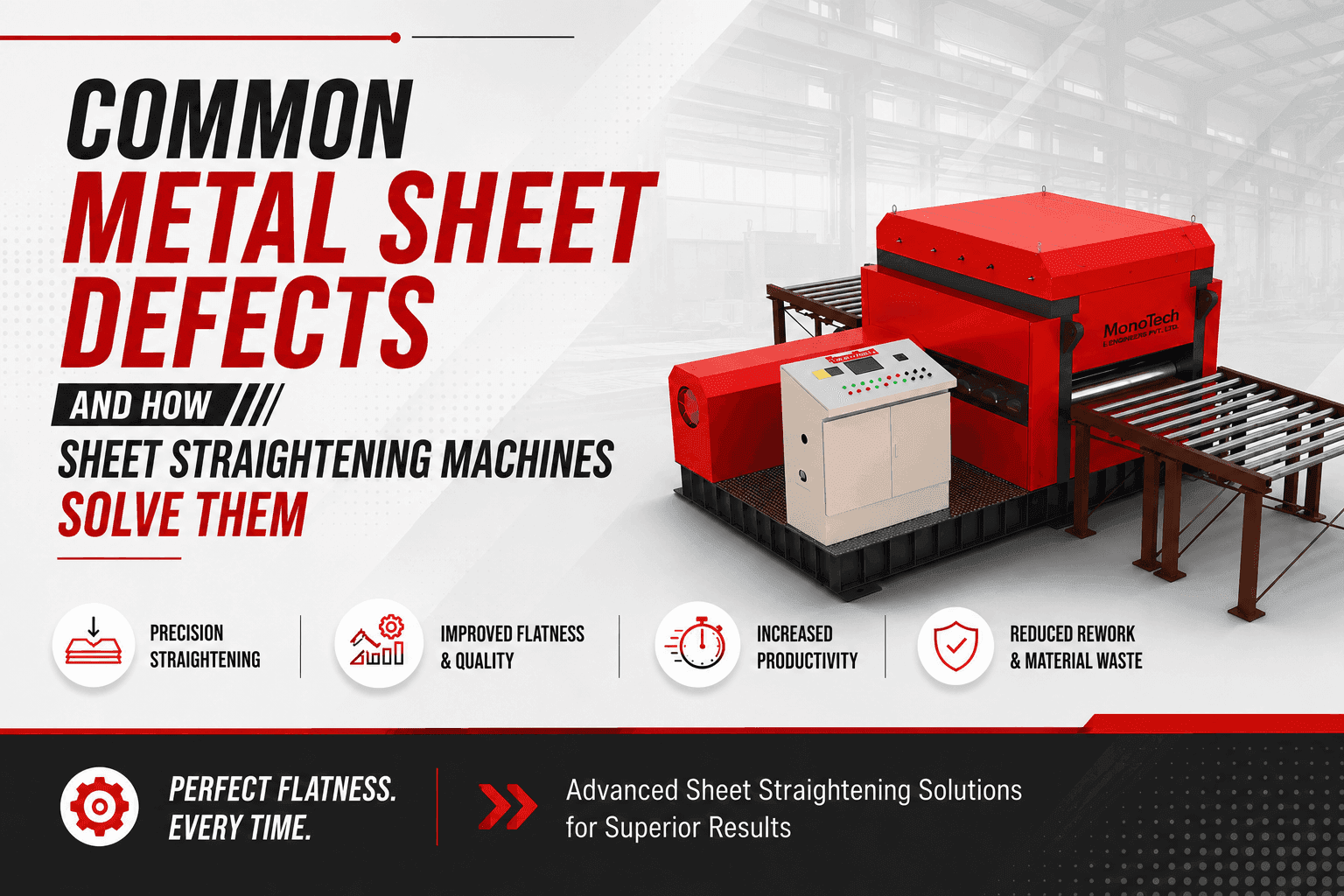
Common Metal Sheet Defects and How Sheet Straightening Machines Solve Them
Metal sheets are the foundation of countless industries, from automotive and construction to heavy engineering and appliance manufacturing. However, even high-quality sheets can develop defects during production, handling, transportation, or storage. These imperfections affect dimensional accuracy, welding quality, surface finish, and the final product's performance.
A Sheet Straightening Machine plays a crucial role in eliminating these defects and restoring metal sheets to their required flatness. Modern straightening technology improves production efficiency, minimizes material wastage, and ensures consistent quality throughout the manufacturing process.
In this blog, we'll explore the most common metal sheet defects, their causes, and how a Metal Sheet Straightening Machine provides an effective solution.
What Is a Sheet Straightening Machine?
A Sheet Straightening Machine is industrial equipment designed to remove bends, waves, twists, residual stresses, and other deformations from metal sheets. The machine uses multiple precision rollers to apply controlled pressure, restoring the sheet to its original flat shape.
Whether processing mild steel, stainless steel, aluminum, copper, or high-strength alloys, modern straightening machines ensure high dimensional accuracy while maintaining material integrity.
Why Metal Sheets Develop Defects
Metal sheets go through multiple manufacturing stages, including rolling, cutting, coiling, transportation, and storage. During these processes, mechanical stress often causes unwanted deformation.
Common reasons include:
Uneven rolling pressure
Improper storage
Transportation damage
Coil memory
Thermal expansion
Incorrect handling
Residual stress after cutting
Heavy fabrication loads
Without correction, these defects reduce productivity and increase manufacturing costs.
Common Metal Sheet Defects
1. Coil Set
Coil set is one of the most common problems in sheet metal processing. When metal remains coiled for an extended period, it tends to retain its curved shape after uncoiling.
Problems Caused
Difficult feeding into CNC machines
Poor bending accuracy
Welding alignment issues
Reduced production speed
Solution
A Metal Sheet Straightening Machine gradually removes the coil memory by passing the sheet through multiple precision rollers that redistribute internal stresses.
2. Edge Waves
Edge waves occur when the edges of the sheet become longer than the center, creating wave-like distortions.
Causes
Uneven rolling
Incorrect tension during processing
Material stress imbalance
Solution
An Industrial Sheet Straightening system applies uniform pressure across the sheet width, restoring flatness without damaging the material.
3. Center Buckle
A center buckle appears when the middle portion of the sheet becomes longer than the edges.
Common Issues
Poor laser cutting quality
Inaccurate punching
Difficult assembly
Surface unevenness
Solution
A precision Metal Sheet Leveling Machine equalizes stress throughout the sheet, eliminating center buckles efficiently.
4. Bow Defect
A bow defect creates a gradual curve along the sheet's length.
Causes
Uneven cooling
Improper rolling
Storage pressure
Solution
Multiple corrective rollers inside a Sheet Straightening Machine remove longitudinal curvature while maintaining dimensional accuracy.
5. Twist
Twist occurs when one corner of the sheet rotates relative to another.
Impact
Poor fixture alignment
Welding difficulties
Assembly errors
Product rejection
Solution
Precision roller adjustments in modern straightening machines correct twisting while maintaining material properties.
6. Surface Distortion
Heavy handling or improper stacking can create uneven surfaces.
Effects
Painting defects
Poor coating adhesion
Visible imperfections
Reduced product quality
Solution
Advanced leveling rollers restore surface flatness before fabrication.
7. Residual Stress
Residual stress develops during rolling, flame cutting, plasma cutting, or laser cutting.
Problems
Distortion during machining
Unexpected bending
Welding deformation
Solution
A Hydraulic Sheet Straightening Machine distributes pressure evenly, relieving internal stresses and improving dimensional stability.
How a Sheet Straightening Machine Works
A modern Sheet Straightening Machine consists of multiple precision-engineered rollers arranged to gradually bend the sheet in opposite directions.
The process includes:
Feeding the sheet into the machine.
Passing it through upper and lower rollers.
Applying controlled pressure to remove deformation.
Releasing internal stresses.
Delivering a perfectly flat sheet ready for production.
This continuous process ensures consistent quality while maintaining high productivity.
Benefits of Using a Metal Sheet Straightening Machine
Improved Product Quality
Flat sheets improve cutting, bending, welding, and assembly accuracy.
Higher Production Efficiency
Straight sheets move smoothly through automated manufacturing lines with fewer interruptions.
Reduced Material Waste
Correcting defects before fabrication minimizes scrap and rework.
Better Surface Finish
Level sheets produce cleaner welds, improved painting results, and superior finishing.
Increased Tool Life
Uniform sheets reduce excessive wear on CNC machines, dies, and cutting tools.
Lower Manufacturing Costs
Fewer rejected components translate into lower production costs and improved profitability.
Industries That Benefit from Industrial Sheet Straightening
An Industrial Sheet Straightening system is widely used across various sectors, including:
Automotive manufacturing
Construction equipment
Electrical panel manufacturing
Elevator production
Heavy engineering
Agricultural machinery
Aerospace components
Railway fabrication
Shipbuilding
Metal furniture manufacturing
These industries rely on precision-flat sheets to maintain consistent product quality and efficient production.
Hydraulic vs. Mechanical Straightening Machines
Selecting the right machine depends on material thickness, production volume, and accuracy requirements.
Hydraulic Sheet Straightening Machine
A Hydraulic Sheet Straightening Machine offers higher force and is ideal for processing thicker metal sheets and heavy-duty industrial applications. It delivers excellent control, consistent pressure, and reliable performance for demanding operations.
Mechanical Straightening Machine
Mechanical models are suitable for thinner sheets and high-speed production where continuous operation and productivity are the primary requirements.
Choosing the Right Metal Sheet Leveling Machine
Before investing in a Metal Sheet Leveling Machine, consider the following factors:
Sheet thickness range
Material type
Working width
Production capacity
Required flatness tolerance
Roller configuration
Automation level
Energy efficiency
Maintenance requirements
After-sales service
A machine tailored to your production needs ensures better productivity and long-term reliability.
Why Work with Experienced Sheet Straightening Machine Manufacturers?
The performance of your straightening system depends not only on its design but also on the expertise of the manufacturer. Reliable Sheet Straightening Machine Manufacturers provide robust engineering, precision manufacturing, quality testing, and dependable after-sales support to ensure long-term operational efficiency.
When selecting a supplier, evaluate:
Industry experience
Manufacturing capabilities
Machine customization options
Quality certifications
Installation and commissioning support
Spare parts availability
Technical assistance
Many businesses also compare solutions from the best sheet metal manufacturers in India and leading machinery manufacturers to ensure they invest in equipment that meets international quality standards and delivers consistent performance.
Why Monotech Engineers?
Monotech Engineers has established itself as one of the trusted Sheet Straightening Machine Manufacturers in India, offering advanced solutions for sheet metal processing industries. With decades of engineering expertise, the company designs machines that deliver precision, durability, and high productivity.
Monotech's straightening solutions offer:
Precision roller technology
Heavy-duty machine construction
High operational efficiency
Low maintenance requirements
Custom machine configurations
Reliable after-sales support
Solutions for diverse sheet thicknesses and materials
Whether you need a Hydraulic Sheet Straightening Machine, a Metal Sheet Straightening Machine, or a Metal Sheet Leveling Machine, Monotech Engineers provides solutions that help manufacturers improve quality, reduce waste, and increase production efficiency.
Conclusion
Metal sheet defects such as coil set, edge waves, center buckles, twists, bows, and residual stresses can significantly impact manufacturing quality and productivity. Investing in a reliable Sheet Straightening Machine ensures these issues are corrected before fabrication, resulting in improved dimensional accuracy, smoother production, and reduced material waste.
As manufacturing standards continue to rise, businesses need precision equipment that delivers consistent performance and long-term value. Choosing an experienced manufacturer and the right Industrial Sheet Straightening solution can help streamline operations, improve product quality, and strengthen your competitive advantage in today's demanding industrial landscape.