
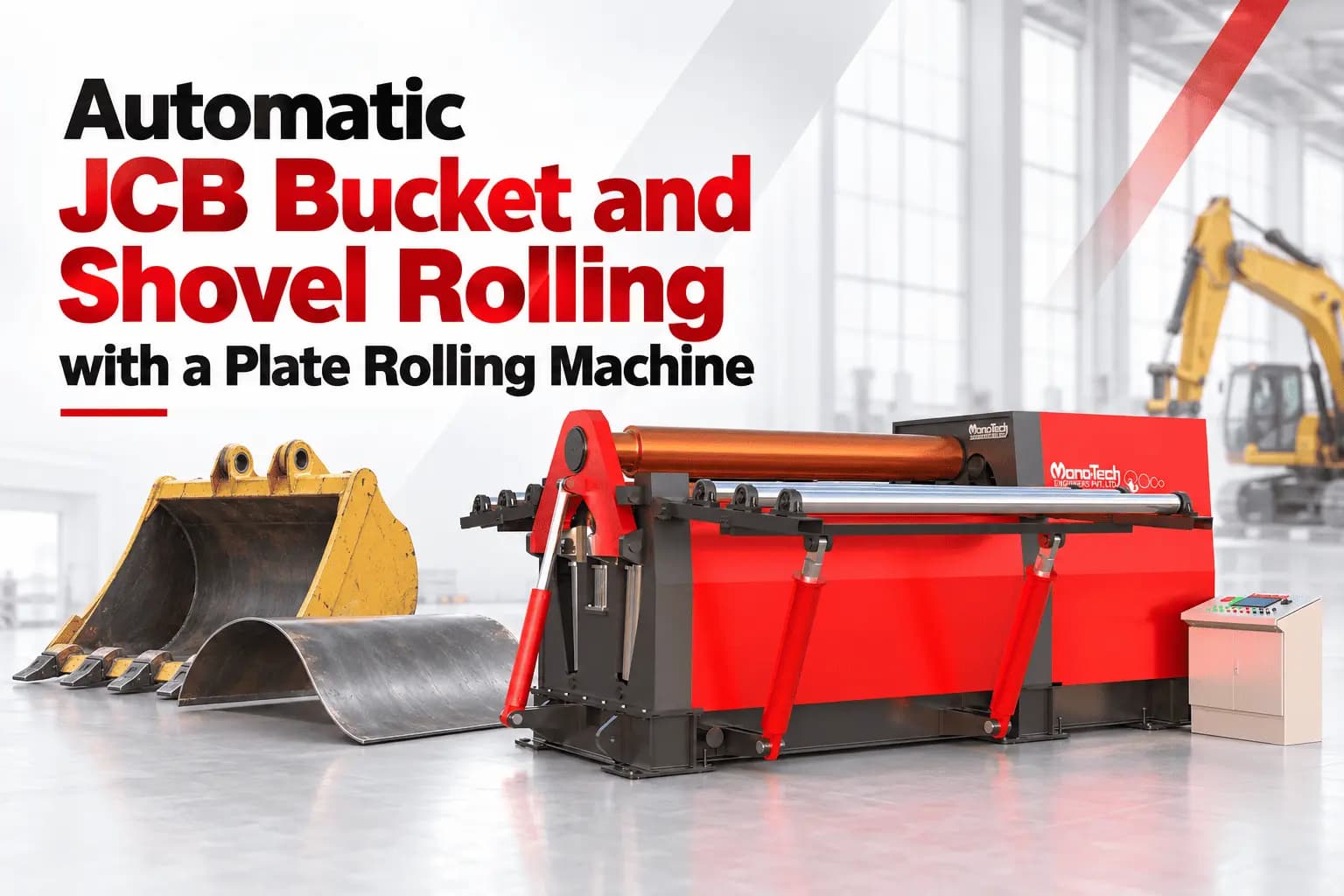
Automatic JCB Bucket and Shovel Rolling with a Plate Rolling Machine
Manufacturing buckets and shovels for earthmoving machinery requires accurate forming of heavy-duty steel plates. These components often have complex curves and multiple radii that are difficult to produce consistently using conventional bending methods.
A Plate Rolling Machine for JCB Buckets provides an efficient solution for producing these curved components automatically. Through programmed roller movement, controlled pressure and accurate plate feeding, the machine can form different radii along the plate length while reducing manual correction and operator dependency.
For earthmoving equipment manufacturers, this technology supports faster production, repeatable profiles and better component quality.
What Is a Plate Rolling Machine for JCB Buckets?
A Plate Rolling Machine for JCB Buckets is an industrial forming machine designed to roll steel plates into curved profiles used in buckets, shovels and other earthmoving attachments.
The plate passes between powered rollers that apply controlled bending force. By adjusting the position of the bending rolls, the machine gradually forms the steel plate into the required profile.
Unlike standard cylindrical rolling, bucket manufacturing may require several radii within a single plate. An advanced Automatic Plate Rolling Machine can automatically change the rolling parameters at programmed positions to achieve these variable-radius profiles.
The machine can be designed according to:
Plate thickness and width
Material grade and yield strength
Minimum and maximum radius
Number of radii in the component
Required production capacity
Pre-bending requirements
Automation and control requirements
Why Is Precision Rolling Important for JCB Buckets and Shovels?
Buckets and shovels operate under demanding conditions. They are exposed to impact, abrasion, heavy loads and continuous digging forces. Their performance depends on material strength as well as dimensional accuracy.
An incorrectly rolled bucket plate can cause:
Irregular component geometry
Difficulty aligning the side plates
Uneven welding gaps
Increased fabrication time
Additional pressing or hammering
Higher material wastage
Inconsistent finished components
Reduced production efficiency
Accurate rolling helps ensure that the bucket shell matches the approved component drawing. It also improves fit-up with the side walls, cutting edge and reinforcement sections.
A properly selected Plate Rolling Machine for JCB Buckets can therefore improve both the forming process and the subsequent assembly operation.
How Does Automatic JCB Bucket Rolling Work?
Automatic JCB Bucket Rolling uses programmed roller movements to form a plate into the desired bucket or shovel profile. The exact process depends on the machine configuration, plate specification and component design.
1. Plate Loading
The prepared steel plate is loaded into the machine. Suitable material-handling equipment may be used for wide or heavy plates.
2. Plate Alignment
The operator aligns the plate correctly between the rollers. Proper alignment helps prevent twisting, uneven curvature and dimensional variation.
3. Leading-Edge Pre-Bending
The machine pre-bends the leading edge to reduce the flat portion that would otherwise remain at the end of the plate.
4. Controlled Plate Feeding
Powered rollers feed the plate through the machine at a controlled speed. Accurate plate movement is essential for producing each radius at the correct position.
5. Automatic Radius Adjustment
The machine changes the bending roll position according to the programmed sequence. Different sections of the plate receive different levels of bending force, producing multiple radii along its length.
6. Trailing-Edge Pre-Bending
In a double pre-pinch configuration, the second edge can also be pre-bent to reduce flat ends and improve the final profile.
7. Profile Verification
The rolled component is checked against the approved drawing, template or measurement data before it proceeds to welding and final assembly.
How Are Multiple Radii Formed Automatically?
A bucket shell usually does not have one constant curve. Its profile may gradually transition from one radius to another. Producing this geometry using manual adjustments can be time-consuming and highly dependent on operator experience.
In an Automatic Plate Rolling Machine, the required profile is divided into programmed sections. Each section is assigned a specific plate position and roller setting.
As the plate moves through the machine:
The control system monitors its position.
The bending roller moves to the programmed setting.
The required pressure is applied to that section.
The plate advances to the next programmed position.
The roller setting changes to create the next radius.
This process continues until the complete multi-radius profile is formed.
Automatic multi-radius rolling can provide:
Repeatable component profiles
Consistent results across production batches
Reduced trial-and-error processing
Lower dependence on manual adjustments
Faster production of repeat components
Better control over complex bucket geometry
Benefits of Automatic JCB Bucket Rolling
Consistent Bucket Profiles
Programmed rolling parameters help manufacturers reproduce the same component profile across multiple production cycles.
Reduced Manual Correction
Accurate forming can minimise the need for hammering, heating, pressing or repeated corrective rolling.
Lower Operator Dependency
Once the correct rolling program has been developed, the process depends less on individual operator judgement.
Faster Production
Automatic plate feeding and roller positioning can reduce the time required to form repeat components.
Improved Assembly Accuracy
Correctly rolled bucket shells align more easily with side plates, reinforcement sections and cutting edges.
Reduced Material Wastage
Controlled rolling lowers the possibility of incorrectly formed plates being rejected or reprocessed.
Better Welding Preparation
Accurate profiles can provide more uniform joint gaps, supporting easier tack welding and final fabrication.
Increased Production Repeatability
Stored programs can be used for recurring component designs, helping manufacturers maintain consistent quality.
Why Use a Hydraulic Plate Rolling Machine?
A Hydraulic Plate Rolling Machine uses hydraulic cylinders to control the position and pressure of the bending rollers. Hydraulic operation is particularly suitable for heavy-duty bucket and shovel components because it provides smooth and controlled force.
Its main advantages include:
Smooth roller movement
Accurate pressure control
Reliable handling of thick plates
Stable bending performance
Controlled pre-bending
Easy integration with numerical controls
Reduced physical effort for operators
When high-strength or wear-resistant steel is used, the machine must provide sufficient force without losing structural stability or rolling accuracy.
Importance of a Heavy-Duty Machine Structure
Bucket and shovel manufacturers often work with thick, wide or high-strength plates. These materials generate considerable reaction forces during rolling.
A Heavy-Duty Plate Rolling Machine should therefore include:
A rigid machine frame
High-quality forged rollers
Adequately sized hydraulic cylinders
Durable bearings and roller supports
Accurate roll-position measurement
Reliable drive systems
Suitable overload protection
Proper safety controls
Machine capacity should never be selected using plate thickness alone. The calculation must also consider plate width, material yield strength and minimum rolling radius.
For example, a machine capable of rolling a particular thickness of mild steel may not handle the same thickness of high-strength wear-resistant steel. Complete application data must therefore be shared with the machine manufacturer.
Three-Roll vs Four-Roll Machine for Bucket Manufacturing
Both three-roll and four-roll machines can be used for bucket and shovel manufacturing, depending on the application.
Three-Roll Double Pre-Pinch Machine
A three-roll double pre-pinch machine provides strong bending capability and allows both plate edges to be pre-bent. With numerical control, it can also form programmed multi-radius profiles.
It is suitable for manufacturers requiring:
Heavy-duty plate forming
Automatic double pre-bending
Variable-radius rolling
Reduced flat ends
Controlled repeat production
Four-Roll Plate Rolling Machine
A four-roll machine clamps the plate between two central rollers while the side rollers perform pre-bending and rolling. It can offer convenient plate handling and controlled feeding.
It is suitable for applications requiring:
Secure plate clamping
Controlled plate feeding
Automatic pre-bending
Repeatable rolling cycles
Easier handling of certain component profiles
The correct configuration should be selected after reviewing the actual component drawing and material specifications.
Applications in Earthmoving Equipment Manufacturing
A Plate Rolling Machine for JCB Buckets can also be used for manufacturing curved components for various types of construction, mining and material-handling equipment.
Typical applications include:
Backhoe loader buckets
Excavator buckets
Wheel-loader buckets
Mining shovels
Rock buckets
Trenching buckets
Grading buckets
Dozer blades
Agricultural loader attachments
Heavy-duty curved equipment components
The required machine capacity will vary according to the size, material and radius of each component.
Factors to Consider When Selecting the Machine
Plate Thickness and Width
Provide the maximum and minimum plate thickness along with the working width. Machine capacity changes according to both factors.
Material Grade
The material’s yield strength is critical. High-strength steel requires more forming force than standard mild steel of the same thickness.
Minimum and Maximum Radius
Specify the smallest and largest radius required in the component. A smaller radius usually demands higher rolling force.
Number of Radii
Confirm whether the plate requires one continuous radius or multiple radii along its length.
Pre-Bending Requirement
Effective pre-bending helps reduce flat ends and minimises the need for secondary correction.
Production Quantity
For medium- or high-volume manufacturing, an automatic system can provide better repeatability and shorter production cycles.
Component Drawing
A detailed drawing allows the machine manufacturer to review the complete geometry and recommend an appropriate configuration.
Material Handling
Heavy and irregular plates may require feeding tables, side supports, overhead supports or customised loading arrangements.
Control System
The control system should allow operators to set, store and repeat different rolling programs for various bucket designs.
Monotech Automatic Plate Rolling Solution
Monotech Engineers manufactures plate rolling machines for demanding metal-forming applications. Its numerically controlled, fully automatic double pre-pinch plate rolling solutions can be configured to produce different radii automatically along the plate length.
This capability is particularly valuable for bucket and shovel components where the required profile changes from one section to another.
Based on the application, Monotech can develop the machine around:
Required plate thickness and width
Material type and yield strength
Bucket or shovel profile
Number of programmed radii
Pre-bending requirements
Production volume
Automation requirements
Plate-handling arrangements
The objective is to provide consistent profile formation while reducing rework, manual correction and operator dependency.
Conclusion: Plate Rolling Machine for JCB Buckets
Manufacturing accurate bucket and shovel profiles requires controlled force, repeatable roller movement and proper understanding of the material. A suitable Plate Rolling Machine for JCB Buckets can automatically form complex, multi-radius components while reducing manual adjustments and fabrication time.
For earthmoving equipment manufacturers, automatic plate rolling can improve component consistency, welding fit-up, production speed and overall process efficiency.
Monotech Engineers provides application-specific plate rolling solutions engineered according to the component profile, material strength and production requirements.
FAQs: Plate Rolling Machine for JCB Buckets
1. Which plate rolling machine is suitable for JCB bucket manufacturing?
A heavy-duty hydraulic plate rolling machine with automatic or numerical control is generally suitable. The final configuration depends on the plate thickness, width, material strength and required bucket profile.
2. Can a plate rolling machine form multiple radii in one plate?
Yes. An advanced automatic plate rolling machine can change the bending roll position at programmed points to produce multiple radii along the same plate.
3. What is Automatic JCB Bucket Rolling?
Automatic JCB Bucket Rolling is a controlled process in which the machine feeds and bends the plate according to programmed roller positions, reducing repeated manual adjustments.
4. Can high-strength steel be rolled for bucket manufacturing?
Yes, provided the machine is designed for the material’s yield strength, thickness, width and required minimum radius. High-strength steel generally requires more rolling force than mild steel.
5. Does automatic plate rolling eliminate flat ends?
A double pre-pinch machine can significantly reduce flat ends by pre-bending both plate edges. The final result depends on the material, plate thickness and machine configuration.