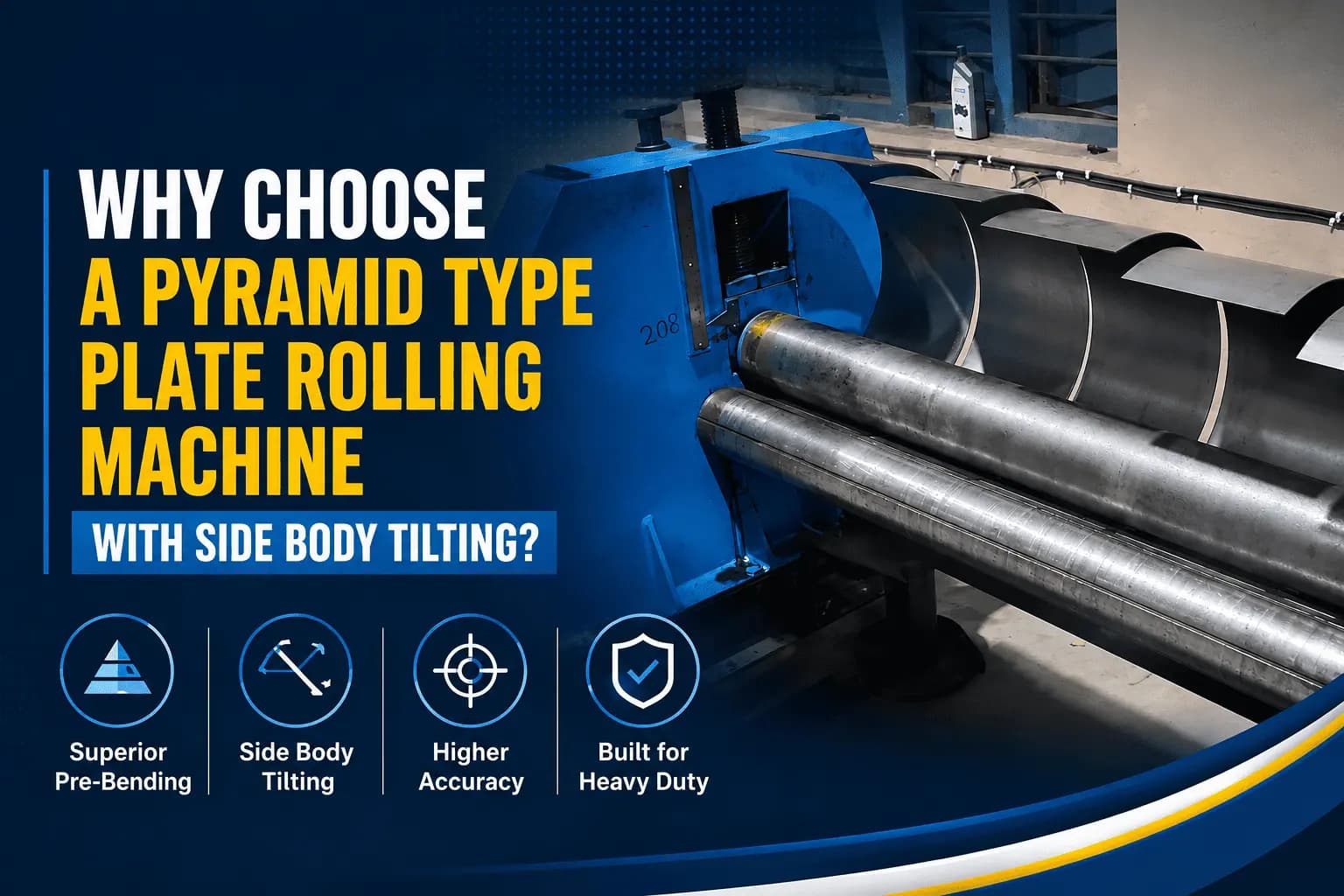
Why Choose a Pyramid Type Plate Rolling Machine with Side Body Tilting?
In modern metal fabrication, achieving accurate and consistent plate forming is essential for producing high-quality cylindrical and curved components. A Pyramid Type Plate Rolling Machine provides an effective solution for manufacturers working with different plate sizes and fabrication requirements.
But what makes this machine different from conventional plate bending equipment? One important feature is side body tilting, which can make finished workpiece removal more convenient and improve overall handling efficiency.
For manufacturers looking for reliable, precise and practical plate-forming equipment, understanding the working principle, benefits and applications of a Plate Rolling Machine with Side Body Tilting can help in selecting the right solution.
What Is a Pyramid Type Plate Rolling Machine?
A Pyramid Type Plate Rolling Machine is a three-roll machine designed to bend flat metal plates into cylindrical, curved and other required shapes.
The machine uses an upper roll and two lower rolls arranged in a pyramid configuration. As the plate passes through the rolls, controlled pressure and roll movement gradually form the desired curvature.
Depending on the machine design and configuration, pyramid-type machines can be used for different plate thicknesses, widths, materials and rolling diameters.
This makes a 3 Roll Plate Rolling Machine suitable for a wide range of industrial fabrication applications.
How Does a Pyramid Type Plate Rolling Machine Work?
The basic operation of a pyramid-type plate rolling machine involves controlled positioning and movement of the plate between the rolls.
1. Plate Positioning
The metal plate is positioned correctly between the upper and lower rolls. Proper alignment is important for achieving consistent rolling results.
2. Roll Adjustment
The rolls are adjusted according to the plate thickness, material and required finished diameter.
3. Initial Bending
The plate enters the rolling area, where pressure from the rolls begins forming the material.
4. Progressive Rolling
The plate moves through the rotating rolls while the machine progressively develops the required curvature.
5. Final Forming
Depending on the material and required diameter, additional passes may be performed to achieve the desired shape and dimensional accuracy.
6. Workpiece Removal
Once rolling is complete, the side body tilting mechanism can provide additional clearance for removing the finished cylindrical or curved component.
The exact operating procedure depends on the machine's design, controls and application requirements.
What Is Side Body Tilting in a Plate Rolling Machine?
Side body tilting is a machine feature designed to assist with the removal of formed workpieces.
After a plate has been rolled into a cylindrical or curved shape, removing the finished component from a conventional machine can sometimes require additional handling. A Plate Rolling Machine with Side Body Tilting provides a mechanism through which the relevant side body can tilt or move away from its operating position.
This creates additional space around the finished workpiece, helping operators remove larger rolled components more conveniently.
For fabrication companies handling heavy shells, cylinders and curved plates, easier workpiece removal can contribute to smoother production operations.
Key Benefits of a Pyramid Type Plate Rolling Machine
Choosing the right Industrial Plate Rolling Machine can directly affect fabrication efficiency, product consistency and operating convenience. A pyramid-type configuration with side body tilting can offer several practical advantages.
1. Reliable Three-Roll Configuration
The three-roll pyramid arrangement provides a proven approach to plate forming. It can be used for producing cylindrical and curved components across various industrial applications.
2. Controlled Plate Forming
Controlled roll positioning allows operators to progressively form the plate instead of applying the entire bending force at once.
This can help achieve more consistent curvature when the machine is correctly configured for the material and application.
3. Convenient Workpiece Removal
One of the major advantages of Plate Rolling Machine with Side Body Tilting is improved access for removing finished components.
This can be particularly useful when producing large-diameter cylinders, tanks and fabricated shells.
4. Suitable for Industrial Fabrication
A Heavy Duty Plate Rolling Machine can be configured for demanding fabrication environments where robust construction and reliable performance are important.
5. Versatile Applications
Depending on the machine capacity, a pyramid-type plate rolling machine can be used for different materials, thicknesses, widths and component diameters.
6. Improved Production Handling
Efficient workpiece removal and straightforward machine operation can help reduce unnecessary handling time during fabrication.
Applications of Pyramid Type Plate Rolling Machines
A Precision Plate Rolling Machine can be used across several industrial sectors where flat plates need to be converted into curved or cylindrical components.
Storage Tank Manufacturing
Storage tanks commonly require cylindrical shells formed from metal plates. Plate rolling machines can be used to create these curved sections before welding and further fabrication.
Pressure Vessel Manufacturing
Pressure vessel manufacturers require controlled forming of plates to create cylindrical shells. The appropriate machine capacity should be selected according to material, thickness, diameter and applicable manufacturing requirements.
Boiler Manufacturing
Boiler and process equipment manufacturers can use plate rolling equipment for forming shells and other curved components.
Pipe Manufacturing
A 3 Roll Plate Rolling Machine can be used for forming plates into cylindrical sections used in different pipe and fabrication applications.
Structural Fabrication
Steel fabrication companies may use plate rolling machines for curved structural components, supports and other engineered structures.
Industrial Equipment Manufacturing
Various industrial machines, ducts, housings and fabricated equipment require accurately rolled plates during manufacturing.
Pyramid Type vs. Other Plate Rolling Machines
Before purchasing a plate rolling machine, manufacturers should understand that different machine configurations are designed for different production requirements.
A pyramid-type machine uses three rolls arranged in a triangular configuration and can be a practical choice for general plate rolling applications.
A Three Roll Plate Rolling Machine can provide a relatively straightforward solution for cylindrical and curved plate forming.
Four-roll machines use an additional roll and a different forming arrangement. They can be advantageous for applications requiring efficient pre-bending, repeatability and faster production cycles.
The right choice depends on factors such as:
Plate thickness
Plate width
Material grade
Required rolling diameter
Production volume
Pre-bending requirements
Finished component dimensions
Automation requirements
Workpiece handling requirements
Therefore, machine selection should always be based on the actual application rather than simply comparing the number of rolls.
How to Choose the Right Plate Rolling Machine?
Selecting the right Plate Rolling Machine for Fabrication requires careful consideration of several technical parameters.
Plate Thickness
Identify the maximum and minimum plate thicknesses that will be processed regularly.
Working Width
The machine's effective rolling width should match the maximum plate width used in production.
Material Type
Different materials have different forming characteristics. Mild steel, stainless steel, aluminium and alloy materials may require different machine capacities.
Minimum Rolling Diameter
The minimum required finished diameter is an important factor when selecting roll diameter and machine configuration.
Production Requirements
A machine used for occasional fabrication may have different requirements from equipment operating continuously in a high-volume production environment.
Side Body Tilting
If your production involves large or heavy cylindrical components, consider whether a Plate Rolling Machine with Side Body Tilting would make finished-product removal more convenient.
Automation
Depending on production requirements, manufacturers can consider hydraulic, NC or CNC-controlled configurations.
Technical Support
Installation, commissioning, maintenance, spare parts availability and after-sales technical support should also be considered before purchasing an Industrial Plate Rolling Machine.
Why Choose Monotech Engineers?
Monotech Engineers is an experienced manufacturer of sheet metal and plate-forming machinery designed for industrial fabrication requirements.
The company's machinery portfolio includes solutions for plate rolling, sheet straightening, shearing and press brake applications.
When selecting a Plate Bending Machine, every fabrication operation has different requirements. Plate thickness, width, material, rolling diameter and production volume all influence the ideal machine configuration.
Monotech Engineers focuses on understanding these requirements and providing machinery designed around the customer's specific application.
Maintenance Tips for Plate Rolling Machines
Regular maintenance can help maintain machine performance and extend equipment service life.
Some important maintenance practices include:
Inspect rolls regularly for wear or surface damage.
Keep hydraulic systems clean and properly maintained.
Check lubrication points according to the manufacturer's recommendations.
Inspect bearings and moving components.
Check hydraulic hoses and connections for leakage.
Keep the machine and working area clean.
Verify alignment and roll positioning periodically.
Follow the recommended maintenance schedule.
Ensure operators are properly trained.
Preventive maintenance is especially important for machines operating under heavy production loads.
Why Precision Matters in Plate Rolling
Precision is critical when manufacturing cylindrical shells, tanks, pressure vessels and other fabricated components.
Inconsistent rolling can result in dimensional variations, excessive rework and difficulties during subsequent welding or assembly operations.
A properly selected Precision Plate Rolling Machine can help manufacturers maintain more consistent forming results when operated according to the machine's specifications and appropriate process parameters.
However, achieving the desired result depends on more than the machine alone. Material properties, plate preparation, operator skill, machine setup and rolling procedure also play important roles.
Conclusion: Pyramid Type Plate Rolling Machine
A Pyramid Type Plate Rolling Machine with side body tilting can be a practical solution for manufacturers looking for controlled plate forming combined with convenient workpiece removal.
The three-roll pyramid configuration provides a reliable approach to producing cylindrical and curved components, while the side body tilting arrangement can simplify handling of finished rolled products.
For manufacturers investing in a Plate Rolling Machine with Side Body Tilting, the most important step is to match the machine configuration with the actual production requirements, including material, thickness, width, diameter and production volume.
Looking for a precision plate rolling solution for your fabrication requirements? Contact Monotech Engineers to discuss the right machine configuration for your application.
FAQs:Pyramid Type Plate Rolling Machine
What is a pyramid type plate rolling machine?
A pyramid type plate rolling machine is a three-roll plate-forming machine used to bend flat metal plates into cylindrical and curved shapes.
What is the advantage of side body tilting?
Side body tilting provides additional clearance around the finished workpiece, making removal of rolled components more convenient depending on the machine configuration.
What industries use plate rolling machines?
Plate rolling machines are commonly used in tank manufacturing, pressure vessel fabrication, boiler manufacturing, pipe production, structural fabrication and industrial equipment manufacturing.
Is a pyramid type machine suitable for heavy plates?
It can be, depending on its specific design and rated capacity. The required plate thickness, width, material strength and rolling diameter should be evaluated before selecting a machine.
How do I select the right plate rolling machine?
Consider plate thickness, working width, material, minimum rolling diameter, production volume, pre-bending requirements, automation level and workpiece handling requirements.