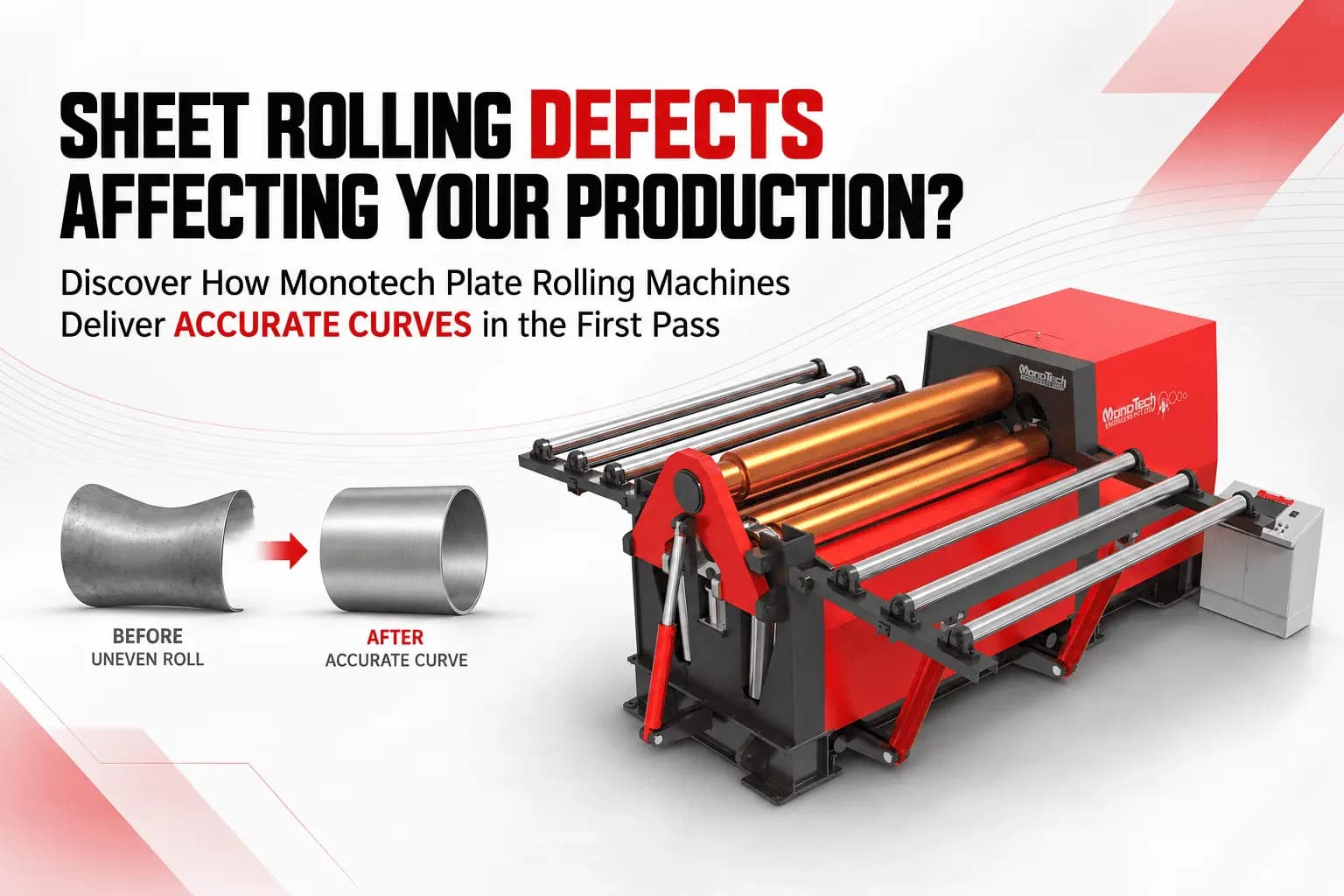
Sheet Rolling Defects Affecting Your Production? Discover How Monotech Plate Rolling Machines Deliver Accurate Curves in the First Pass
In sheet-metal fabrication, even a small rolling defect can affect the accuracy, appearance and functionality of the finished component. Uneven curves, excessive flat ends, incorrect diameters and surface marks often lead to additional correction work, material wastage and production delays.
A suitable plate rolling machine for accurate curves can help manufacturers overcome these challenges. Monotech Engineers designs plate rolling machines to support controlled bending, consistent radius formation and reliable production across a wide range of industrial applications.
What Are Sheet Rolling Defects?
Sheet rolling defects are unwanted variations that appear while a metal plate is being formed into a cylindrical, conical or curved profile. These problems may be caused by incorrect machine selection, improper roll positioning, inconsistent material properties or excessive dependence on operator judgment.
Common sheet rolling defects include:
Uneven or inconsistent rolling radius
Flat ends at the leading and trailing edges
Barrel-shaped or hourglass-shaped components
Incorrect final diameter
Plate slipping during rolling
Surface scratches and pressure marks
Misalignment between plate edges
Excessive springback after rolling
Repeated correction and manual rework
These defects do not only affect the visual quality of the component. They may also create problems during welding, assembly and installation.
How Do Rolling Defects Affect Production?
When a rolled component does not meet the required dimensions, the production team may need to pass it through the machine several times. In some cases, manual correction, heating, hammering or additional edge preparation may also be required.
This can result in:
Higher material wastage
Longer production cycles
Increased operator dependency
Additional inspection and correction
Higher energy consumption
Delays in welding and assembly
Inconsistent quality across multiple components
Increased overall manufacturing cost
For companies handling repeat production, even a minor variation in each component can become a major productivity issue.
Why Do Uneven Curves Occur During Plate Rolling?
Several factors can cause an uneven radius during plate rolling.
1. Incorrect Machine Capacity
A machine that is not selected according to the plate thickness, width, material grade and required diameter may not provide sufficient and uniform forming force.
2. Improper Roll Adjustment
Unequal roll positioning can create a difference in radius from one end of the plate to the other. Accurate roll adjustment is essential for consistent cylindrical rolling.
3. Insufficient Pre-Bending
If the leading and trailing edges are not pre-bent properly, flat portions may remain at both ends of the plate. This increases the work required before welding.
4. Material Springback
After the forming pressure is released, the plate may partially return towards its original shape. The amount of springback depends on the material grade, thickness and required radius.
5. Plate Misalignment
If the plate is not fed straight into the machine, the edges may not meet properly after rolling. This can create a spiral or tapered result instead of a uniform cylinder.
6. Excessive Manual Dependency
When every machine movement depends entirely on operator judgment, achieving repeatable results can become difficult—particularly when producing multiple identical components.
How Monotech Plate Rolling Machines Help Improve Rolling Accuracy
A Monotech Plate Rolling Machine is engineered to provide controlled plate movement and consistent bending force throughout the rolling process. Depending on the application, the machine can be configured with hydraulic operation, pre-bending systems, digital controls and automated rolling functions.
Controlled Pre-Bending
Pre-bending helps reduce the unformed flat portion at both ends of the plate. By bringing the material closer to the required curvature before the main rolling cycle, manufacturers can reduce edge correction and welding preparation.
Consistent Roll Positioning
Accurate movement and positioning of the rolls help maintain a consistent radius across the width of the plate. This is especially important for pressure vessels, storage tanks, industrial cylinders and structural components.
Better Plate Alignment
A correctly aligned feeding and rolling process helps prevent plate twisting, spiralling and mismatched edges. Proper alignment also makes the subsequent welding and assembly processes easier.
Hydraulic and Automated Operation
A hydraulic plate rolling machine offers controlled force and smooth roll movement. For repeat production, an automatic plate rolling machine can help standardise the operating sequence and reduce variations between components.
Reduced Operator Dependency
Automation and numerical control allow rolling parameters to be set and repeated more consistently. This supports repeatable quality and reduces reliance on manual adjustments during every production cycle.
Accurate Curves in the First Pass
First-pass accuracy means producing a component close to its required diameter and radius during the initial rolling cycle, with minimal correction afterwards.
Achieving the final component in a single pass depends on several factors, including:
Material type and yield strength
Plate thickness and width
Required rolling diameter
Machine configuration
Pre-bending requirements
Correct parameter setting
Operator training
Permissible dimensional tolerance
A properly selected precision plate rolling machine can significantly reduce repeated rolling passes and unnecessary rework. For demanding applications, Monotech Engineers can evaluate the component drawing and recommend a machine configuration according to the required result.
Benefits of Using a Monotech Plate Rolling Machine
1. Reduced Flat Ends
Effective pre-bending helps minimise straight portions at the leading and trailing edges of the plate.
2. Consistent Rolling Radius
Controlled roll movement helps achieve a more uniform curvature throughout the component.
3. Lower Rework
Better first-pass results reduce the need for repeated rolling, manual correction and additional handling.
4. Reduced Material Wastage
Accurate forming reduces the risk of rejecting costly plates due to incorrect diameter, excessive deformation or edge mismatch.
5. Higher Production Efficiency
Fewer correction cycles allow manufacturers to complete more components within the available production time.
6. Improved Repeatability
Stored or standardised rolling parameters can help produce multiple components with consistent dimensions.
7. Easier Welding and Assembly
Accurately formed components with properly matched edges require less adjustment before welding.
8. Lower Operator Dependency
A controlled and automated rolling process reduces the number of decisions that depend entirely on operator experience.
Industries That Require Accurate Plate Rolling
Monotech plate rolling machines can be configured for applications across several industries, including:
Pressure vessels
Storage tanks
Boilers and heat exchangers
Wind-tower components
Earth-moving equipment
Construction machinery
Automotive components
Shipbuilding
Oil and gas equipment
Heavy fabrication
Pipes and cylindrical shells
Conical components
Industrial ducting
Silos and material-handling equipment
Each application has different requirements for plate thickness, width, material grade, diameter and production volume. Therefore, machine selection should always be based on the actual component requirement.
Choosing the Right Plate Rolling Machine
Before purchasing a plate rolling machine, manufacturers should evaluate the following factors:
Plate Thickness and Width
Machine capacity must match the maximum plate thickness and working width. The material grade must also be considered because plates with the same thickness may require different forming forces.
Minimum Rolling Diameter
The required internal or external diameter directly affects the machine configuration and roll size.
Pre-Bending Requirement
If reducing flat ends is important, the machine should have an appropriate pre-bending arrangement.
Type of Component
Cylindrical shells, cones and variable-radius components may require different machine features and operating methods.
Production Volume
Manual or basic hydraulic machines may be suitable for occasional production. Repetitive production may benefit from numerical control or automated operation.
Required Accuracy
The required tolerance should be clearly defined before machine selection. A general fabrication job and a precision industrial component may need different levels of control.
Installation and After-Sales Support
A plate rolling machine is a long-term industrial investment. Installation, operator training, technical support and spare-parts availability are important considerations.
Why Choose Monotech Engineers?
Since 1991, Monotech Engineers Pvt. Ltd. has been manufacturing metal-forming machinery for diverse industrial applications. Its plate rolling solutions can be customised according to plate specifications, component geometry and production requirements.
Key advantages include:
Application-based machine selection
Hydraulic and automated configurations
Pre-bending solutions for reduced flat ends
Customised machinery for complex components
Heavy-duty industrial construction
Installation and operator training support
After-sales service and technical assistance
Rather than selecting a machine only by tonnage or plate thickness, Monotech Engineers evaluates the complete rolling application to recommend a suitable solution.
Conclusion
Sheet rolling defects can increase rework, waste valuable material and slow down the entire fabrication process. Problems such as uneven radius, flat ends, plate misalignment and incorrect diameter often indicate that the machine configuration or rolling process is not suitable for the application.
Using a plate rolling machine for accurate curves can help manufacturers achieve better control, higher repeatability and reduced correction work. With the right combination of machine capacity, pre-bending, hydraulic control and automation, Monotech Plate Rolling Machines help businesses move towards more reliable first-pass rolling results.
For a suitable machine recommendation, manufacturers should share their plate thickness, width, material grade, required diameter and component drawing with the Monotech Engineers team.
Website: https://monotech-engineers.com/
Contact: +91 83759 64710
Frequently Asked Questions
1. What are the most common sheet rolling defects?
The most common defects include uneven radius, excessive flat ends, incorrect diameter, plate slipping, edge misalignment, surface marks, springback and barrel- or hourglass-shaped components.
2. How can flat ends be reduced during plate rolling?
Flat ends can be reduced through effective pre-bending of the leading and trailing edges. The machine configuration, roll position and pre-bending capacity must be selected according to the plate thickness, width and material grade.
3. Can a plate rolling machine produce an accurate curve in one pass?
A properly selected and configured machine can produce components close to the required curve in the first pass. Actual results depend on the material, plate dimensions, required diameter, tolerance, machine setup and operator training.
4. What information is required to select a plate rolling machine?
Manufacturers should provide the plate thickness, plate width, material grade, minimum rolling diameter, component shape, production volume and required tolerance. A component drawing is also helpful for accurate machine selection.
5. What is the benefit of an automatic plate rolling machine?
An automatic plate rolling machine helps standardise the rolling sequence, improve repeatability, reduce operator dependency and minimise unnecessary adjustment during repeat production.
6. How does pre-bending improve plate rolling quality?
Pre-bending forms the plate edges before the main rolling process. This helps reduce straight portions at both ends and improves edge matching before welding.
7. Can Monotech Plate Rolling Machines roll conical components?
Yes, Monotech Engineers can provide machine configurations for cylindrical and conical rolling applications. The suitability of the machine depends on the cone dimensions, plate specifications and required angle.
8. Which industries use plate rolling machines?
Plate rolling machines are used in pressure-vessel manufacturing, storage tanks, wind towers, earth-moving equipment, shipbuilding, oil and gas equipment, industrial ducting and heavy fabrication.
9. How does a precision plate rolling machine reduce production costs?
It can reduce repeated rolling cycles, manual correction, material rejection and additional handling. Better accuracy also supports faster welding and assembly.
10. Does Monotech Engineers provide customised plate rolling machines?
Yes. Monotech Engineers develops customised plate rolling solutions based on the customer’s material specifications, required component geometry, production capacity and automation needs.