
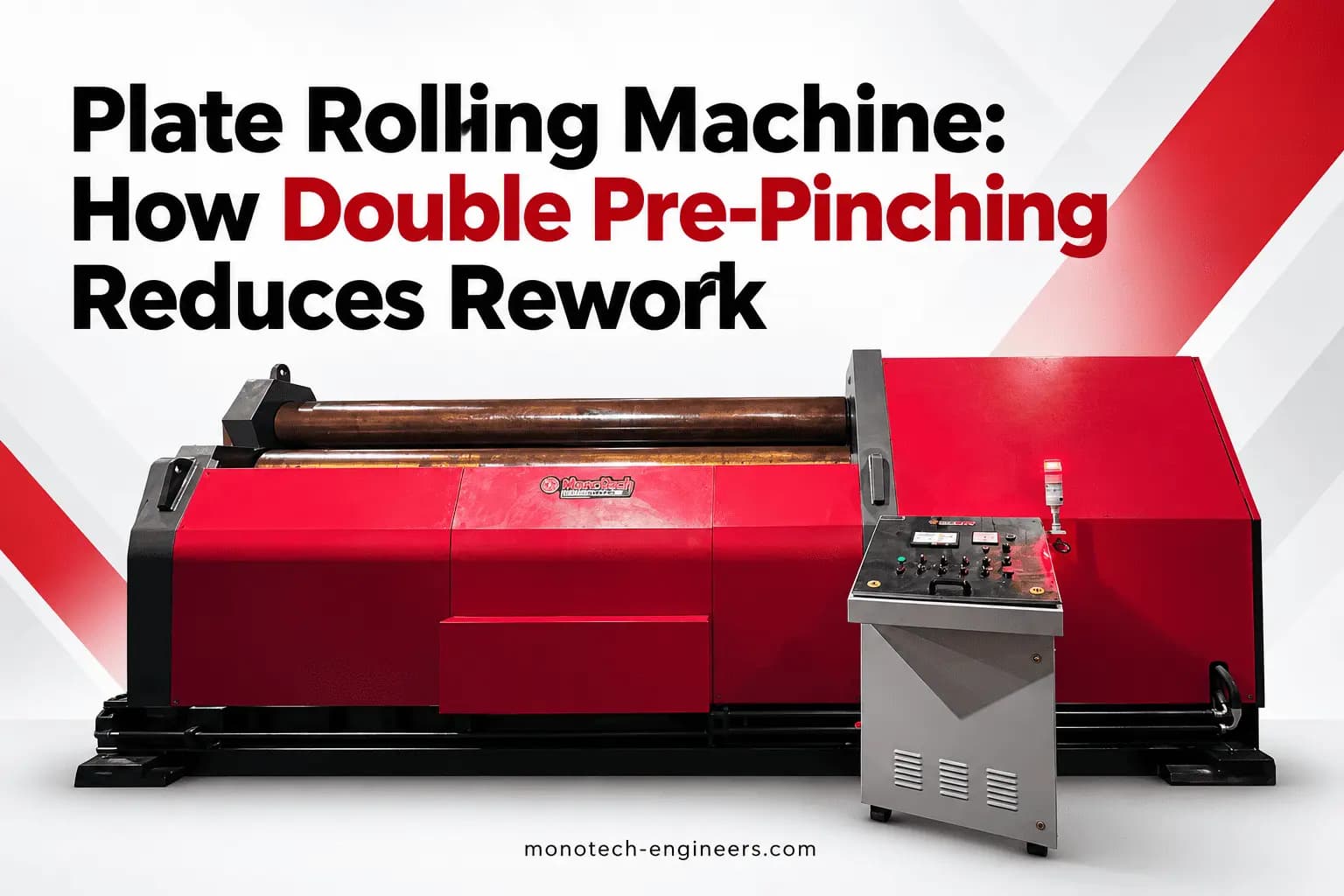
Plate Rolling Machine: How Double Pre-Pinching Reduces Rework
A Plate Rolling Machine plays an essential role in forming metal plates into cylinders, cones and curved components. However, reaching the required shape can become difficult when plate ends remain flat or the rolling radius varies. These issues can lead to additional forming passes, fit-up adjustments and production delays.
Double pre-pinching helps address this challenge by pre-bending both ends of the plate. With the right machine capacity and operating settings, it can improve the transition between the plate edges and the rolled section, helping reduce fabrication rework.
Why Does Rework Occur During Plate Rolling?
In steel plate rolling, achieving a curved shape is only part of the job. The component must also meet the required diameter, edge profile and dimensional tolerances.
Common reasons for corrective work include:
Insufficient pre-bending at the plate ends.
Incorrect roller settings for the material.
Poor plate positioning or roller alignment.
Material springback after forming.
Operating beyond the machine’s suitable capacity.
For example, a cylindrical shell may appear correctly formed through its central section while retaining straight portions near the edges. These portions can make joint alignment more difficult and require further correction before welding.
How a Plate Rolling Machine Uses Double Pre-Pinching
Plate pre-bending forms the leading and trailing edges before the final profile is completed. The double pre-pinching process allows both ends to be pre-bent during the machine’s forming cycle.
In a typical 4 Roller Plate Rolling Machine, the top and bottom rollers grip the plate while the side rollers provide the bending action. This arrangement supports controlled positioning during pre-bending and rolling. Four-roll machines also lend themselves to automated production cycles.
The operating sequence depends on the machine design and component requirements. The objective remains the same: form both edges sufficiently so they follow the intended curvature more closely.
How Double Pre-Pinching Helps Reduce Rework
1. Reduces the Straight Portion at Plate Ends
Flat ends can interrupt the curved profile and complicate assembly. Pre-bending brings the edge sections closer to the required radius.
Reduced flat ends can therefore mean less corrective forming and easier preparation for subsequent fabrication. The remaining straight length depends on the machine geometry, material and operating conditions; pre-bending should not be treated as a guarantee of zero flat ends.
2. Supports a More Consistent Rolling Radius
A consistent rolling radius helps cylindrical components meet their intended dimensions. When the edges are formed adequately, operators have a better starting point for completing and checking the overall profile.
Double pre-pinching supports this process, although final accuracy still depends on material behaviour, roller settings and dimensional inspection.
3. Improves Fit-Up Before Welding
If the edges of a rolled shell do not follow the required profile, bringing them together can take additional time.
Better edge curvature can simplify fit-up and reduce the need for forceful alignment or repeated forming adjustments. This helps fabrication teams prepare components more efficiently for welding.
4. Limits Repeated Corrective Handling
Every correction requires machine time, operator effort and material handling. A Double Pre-Pinch Plate Rolling Machine helps address edge curvature within the forming process, potentially reducing separate corrective operations.
For workshops processing repeated components, fewer adjustments can support smoother production and reduced fabrication rework.
The Role of Automatic and Hydraulic Controls
An Automatic Plate Rolling Machine can help operators repeat programmed roller movements for similar jobs. This is useful when producing batches of components with the same material, thickness and profile.
Automation still requires a validated setup. Changes in material grade or plate dimensions may require programme adjustments and a fresh inspection of the first component.
A Hydraulic Plate Rolling Machine uses hydraulic systems for functions such as roller positioning and, depending on its design, roller drive. Controlled movement helps operators manage metal plate bending, particularly when the application requires substantial forming force.
The right combination of mechanical capacity and controls matters more than automation alone.
Plate Rolling Accuracy Starts with the Right Setup
Double pre-pinching is one part of achieving plate rolling accuracy. The following factors also influence the result.
Plate Thickness and Rolling Capacity
Check plate thickness and rolling capacity against the actual material grade, plate width and required diameter.
Rolling capacity and pre-bending capacity may differ. A machine capable of rolling a particular thickness may have a lower pre-bending rating under the specified conditions. Confirm both capacities before selecting equipment.
Roller Alignment
Correct roller alignment and plate positioning help prevent skewed feeding and uneven forming. Operators should check the setup before starting the rolling cycle and inspect the component during production.
Material Springback
The plate can partially recover after the bending load is released. Operators need to account for this springback when establishing settings and checking the finished radius.
Component Support
Large or heavy components may need suitable supports during forming. Proper support helps control the workpiece and prevents its weight from affecting the intended profile.
Applications in Cylinder and Cone Rolling
Double pre-pinching is relevant to applications where edge curvature affects assembly and final dimensions.
Typical applications include:
Cylindrical shells for tanks and vessels.
Ducting and industrial pipe sections.
Curved components for machinery.
Conical sections and transition pieces.
Components used in heavy plate fabrication.
For cylinder and cone rolling, confirm that the selected machine has the required configuration and capacity. Cone forming requires suitable roller adjustment, workpiece control and operator expertise. A cylindrical rolling rating alone does not establish suitability for every cone.
Choosing a Plate Rolling Machine for Your Production
Start with the components you need to manufacture. Share the material grade, thickness, width, required diameter and production volume with the machine supplier.
Also discuss:
Required pre-bending capacity.
Acceptable remaining flat-end length.
Dimensional tolerances.
Cylinder and cone requirements.
Control and automation options.
Loading, unloading and component support.
These details help identify a machine suited to your work and reduce the risk of selecting equipment that requires frequent corrective processing.
Discuss Your Plate Rolling Requirements with Monotech Engineers
For fabrication teams, productivity depends on producing a usable component with fewer corrections. Double pre-pinching can help by improving edge formation and making subsequent rolling and fit-up more manageable.
Discuss your application with Monotech Engineers to explore a Plate Rolling Machine suited to your material, component geometry and production requirements.
Website: monotech-engineers.com
Contact: +91 83759 64710
Frequently Asked Questions
1. How does a Plate Rolling Machine with double pre-pinching reduce rework?
It allows both plate ends to be pre-bent, helping reduce straight edge sections that can require corrective forming or complicate fit-up.
2. Does double pre-pinching eliminate flat ends completely?
Not necessarily. The remaining flat length depends on machine geometry, plate thickness, material properties and the required radius.
3. What is the advantage of a 4 Roller Plate Rolling Machine?
Its roller arrangement grips the plate during forming and supports controlled pre-bending and rolling. Suitable models can also support automated cycles.
4. Can an Automatic Plate Rolling Machine process different materials?
Yes, within its specified capacity. Roller settings and programmes must account for material grade, thickness, width and springback.
5. What should be checked before selecting a machine for heavy plate fabrication?
Check both rolling and pre-bending capacities, material strength, plate width, minimum diameter, component support and the required tolerances.