
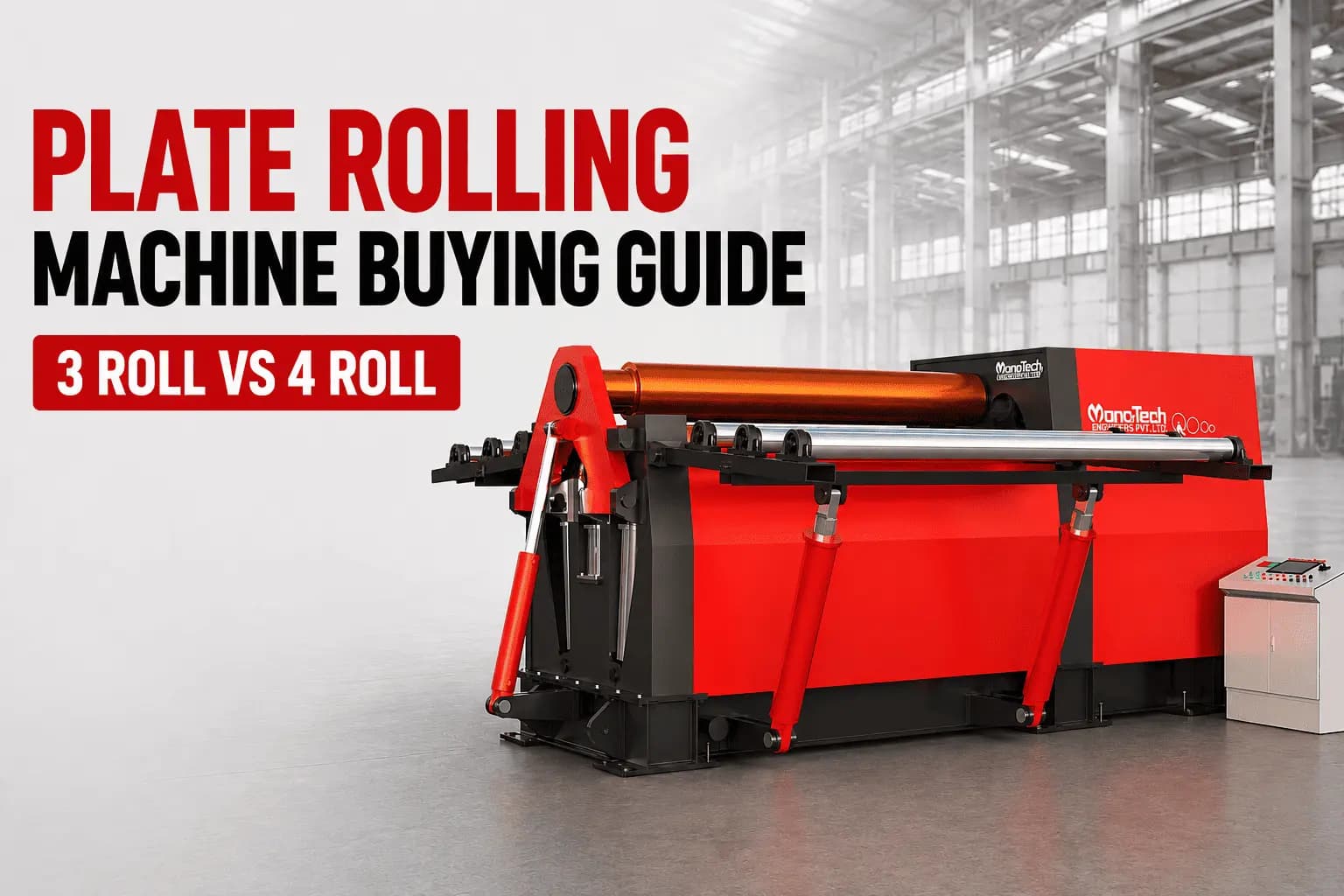
Plate Rolling Machine Buying Guide: 3 Roll vs 4 Roll, Features, Applications & More
Buying the right Plate Rolling Machine is an important decision for any metal fabrication business. Machine configuration directly affects plate handling, bending accuracy, productivity, pre-bending capability, operating efficiency, and the types of components that can be manufactured.
However, selecting a machine is not simply a matter of choosing the maximum plate thickness. Buyers must consider plate width, material grade, yield strength, required rolling diameter, production volume, pre-bending requirements, automation level, and the type of components being manufactured.
One of the most common questions buyers ask is: Which is better—a 3 Roll or 4 Roll Plate Rolling Machine?
The answer depends on the application.
This Plate Rolling Machine Buying Guide explains the working principle, major machine types, differences between 3 Roll vs 4 Roll Plate Rolling Machines, important features, applications, capacity considerations, and the technical factors buyers should evaluate before investing in a machine.
What Is a Plate Rolling Machine?
A Plate Rolling Machine is an industrial metal-forming machine designed to bend flat metal plates into cylindrical, curved, conical, or radius-based components.
The machine uses a set of rolls to apply controlled bending force to the plate. As the plate passes through the rolls, it is progressively formed until the required radius or diameter is achieved.
An Industrial Plate Rolling Machine is commonly used to manufacture:
Storage tanks
Pressure vessels
Boiler shells
Cylindrical components
Pipes and tubes of larger diameters
Silos
Process equipment
Structural components
Heavy fabricated components
Conical sections
Plate rolling machines are widely used in heavy engineering, pressure vessel manufacturing, energy equipment, structural fabrication, chemical processing equipment, tank manufacturing, and general metal fabrication.
How Does a Plate Rolling Machine Work?
The Plate Rolling Machine working principle is based on controlled plastic deformation.
A flat plate is positioned between the machine rolls. The rolls apply force to the material while simultaneously feeding it through the machine. This creates progressive bending across the plate.
The amount of bending depends on several parameters, including:
Plate thickness
Plate width
Material yield strength
Roll diameter
Roll position
Required final diameter
Machine configuration
Number of rolling passes
The objective is to achieve the required curvature while maintaining controlled material movement throughout the rolling process.
Modern Hydraulic Plate Rolling Machines use hydraulic systems for controlled roll positioning and movement, while NC and CNC configurations can provide additional control and repeatability.
Types of Plate Rolling Machines
Understanding different Plate Rolling Machine types is essential before comparing machines.
The main configurations include:
3 Roll Plate Rolling Machine
A 3 Roll Plate Rolling Machine uses three rolls arranged to bend metal plates into cylindrical or curved forms.
Depending on its design, the rolls can be positioned hydraulically to control bending and pre-bending operations.
Three-roll machines are widely used because they can accommodate a broad range of general and heavy fabrication requirements.
A Hydraulic 3 Roll Plate Rolling Machine can be suitable for manufacturers requiring:
General plate fabrication
Cylindrical shell production
Tank fabrication
Boiler component fabrication
Structural fabrication
Heavy engineering components
The exact capabilities depend on the machine design and specified capacity.
4 Roll Plate Rolling Machine
A 4 Roll Plate Rolling Machine consists of four rolls, typically including a top roll, bottom roll and two side rolls.
The additional roll arrangement provides better control over plate gripping and movement during the rolling process.
In many four-roll configurations, the plate can be held between the top and bottom rolls while the side rolls perform bending operations.
This arrangement can provide advantages in applications requiring repeatability, easier plate positioning, and higher production efficiency.
A Hydraulic 4 Roll Plate Rolling Machine is particularly useful for repetitive industrial fabrication where material control and productivity are major considerations.
3 Roll vs 4 Roll Plate Rolling Machine: What's the Difference?
The 3 Roll vs 4 Roll Plate Rolling Machine comparison is one of the most important considerations for buyers.
Both configurations can produce high-quality cylindrical components, but their operating principles, material handling characteristics, automation possibilities, and production suitability differ.
Plate Handling
In a 3 Roll Plate Rolling Machine, plate positioning and movement depend on the specific roll configuration and machine design.
A 4 Roll Plate Rolling Machine provides an additional roll, which can improve plate gripping and material control during bending.
For repetitive production, this can simplify operation and improve workflow.
Pre-Bending
Pre-bending is used to reduce the straight portion that may remain at the leading and trailing edges of the plate.
Both appropriately configured three-roll and four-roll machines can perform pre-bending.
However, the plate-holding arrangement of a 4 Roll Plate Rolling Machine can make the pre-bending and rolling sequence more convenient in certain production environments.
Productivity
For general fabrication and varied production requirements, a 3 Roll Plate Rolling Machine can be an effective solution.
For repetitive production where cycle time, material handling, and automation are important, a 4 Roll Plate Rolling Machine may offer operational advantages.
Automation
Both configurations can incorporate hydraulic, NC, or CNC controls depending on the machine manufacturer and design.
However, four-roll configurations are often considered where automated or semi-automated production sequences are required.
Investment
Machine cost depends on far more than the number of rolls.
Plate capacity, working width, machine structure, hydraulic system, controls, automation, accessories, roll material, and engineering specifications all influence the final investment.
Therefore, buyers should compare machines according to their actual production requirements rather than selecting equipment based only on initial price.
Which Is Better: 3 Roll or 4 Roll Plate Rolling Machine?
Neither machine is universally better.
A 3 Roll Plate Rolling Machine can be an effective choice for general fabrication, custom jobs, heavy fabrication, and applications where flexibility and machine capacity are primary requirements.
A 4 Roll Plate Rolling Machine can be advantageous where repetitive production, improved material control, easier plate handling, and higher levels of automation are required.
The correct choice depends on:
Material + Thickness + Width + Minimum Diameter + Pre-Bending + Production Volume + Automation Requirements.
For this reason, buyers should share complete job specifications with the Plate Rolling Machine Manufacturer before finalizing a machine.
Important Plate Rolling Machine Features to Consider
When comparing equipment, buyers should evaluate the actual Plate Rolling Machine features rather than focusing solely on maximum plate thickness.
1. Plate Thickness Capacity
The machine must be selected according to both rolling and pre-bending requirements.
A machine's rolling capacity and pre-bending capacity may differ, so buyers should verify both.
2. Working Width
The maximum plate width should be clearly specified.
Rolling a wider plate places greater load on the rolls and machine structure, making working width an important capacity parameter.
3. Material Yield Strength
This is one of the most important technical parameters.
A machine capable of rolling a specific thickness of mild steel may not necessarily roll the same thickness of a higher-strength material under identical conditions.
Always specify the material grade or yield strength when requesting a machine.
4. Minimum Rolling Diameter
The desired minimum internal or external diameter should be discussed with the manufacturer.
Minimum achievable diameter is affected by plate thickness, material properties, top roll diameter, and machine geometry.
5. Pre-Bending Capacity
Buyers manufacturing complete cylindrical shells should carefully examine the machine's pre-bending capabilities.
Effective pre-bending helps reduce flat portions at the plate ends.
6. Hydraulic System
A Hydraulic Plate Rolling Machine uses hydraulic power for controlled movement of the machine rolls.
The hydraulic system should be engineered according to the machine's required forming force and operating cycle.
7. NC or CNC Control
An NC Plate Rolling Machine can provide controlled machine positioning and improve repeatability.
A CNC Plate Rolling Machine may provide more advanced control over rolling sequences, depending on the control system and machine configuration.
Automation is particularly valuable for repeated components and production-oriented fabrication.
8. Machine Frame and Structural Rigidity
Heavy plate bending creates substantial forces.
The machine frame must therefore provide adequate rigidity to withstand operational loads and maintain stable performance.
This is especially important when selecting a Heavy Duty Plate Rolling Machine.
How to Select Plate Rolling Machine Capacity
A common purchasing mistake is asking:
"What thickness can this machine roll?"
Thickness alone is not enough to determine machine capacity.
When determining Plate Rolling Machine capacity, buyers should provide:
Material grade
Yield strength
Maximum plate thickness
Plate width
Required minimum diameter
Pre-bending thickness
Final component geometry
Production frequency
For example, rolling a short, narrow plate and rolling a plate across the machine's full working width may create very different load conditions.
Similarly, different steel grades with the same dimensions can require different bending forces.
Therefore, capacity should always be evaluated against a defined material and application.
Plate Rolling Machine for Mild Steel
A Plate Rolling Machine for Mild Steel is commonly used in general fabrication, machinery manufacturing, structural fabrication, tanks, vessels, and industrial components.
When selecting equipment for mild steel, buyers should still specify the exact material grade and mechanical properties where possible.
This allows the manufacturer to calculate the required machine capacity more accurately.
Plate Rolling Machine for Stainless Steel
A Plate Rolling Machine for Stainless Steel requires careful machine selection because stainless-steel grades can have different mechanical properties from standard mild steel.
Buyers should provide:
Stainless-steel grade
Plate thickness
Width
Required diameter
Surface requirements
The machine manufacturer can then evaluate the required rolling capacity and configuration.
Plate Rolling Machine Applications
Different Plate Rolling Machine applications require different equipment configurations.
Tank Manufacturing
A Plate Rolling Machine for Tank Manufacturing is used to create cylindrical shell sections for industrial storage and process tanks.
Depending on tank dimensions and production requirements, three-roll or four-roll configurations may be used.
Pressure Vessel Manufacturing
A Plate Rolling Machine for Pressure Vessel fabrication must produce controlled cylindrical forms suitable for subsequent fit-up, welding, and manufacturing operations.
Plate thickness, material grade, shell diameter, and pre-bending requirements are particularly important in this application.
Boiler Manufacturing
Plate rolling machines can be used for forming boiler shells and other curved fabricated components.
Heavy Fabrication
A Plate Rolling Machine for Heavy Fabrication should have suitable structural rigidity, rolling force, roll dimensions, drive capacity, and hydraulic performance.
Wind and Energy Equipment
Large cylindrical and conical sections used in energy-related fabrication may require heavy-duty plate rolling solutions.
General Metal Fabrication
Plate rolling machines are also used for pipes, ducts, structural components, machinery parts, and custom fabricated products.
Hydraulic, NC or CNC Plate Rolling Machine: Which Should You Choose?
The required control level should match production needs.
A Hydraulic Plate Rolling Machine can be suitable for general industrial fabrication where controlled hydraulic movement and operational flexibility are required.
An NC Plate Rolling Machine can offer improved position control and repeatability.
A CNC Plate Rolling Machine may be preferable where manufacturers require more automated operation, repeatable components, programmed sequences, and higher production efficiency.
Buyers should avoid purchasing unnecessary automation if their production consists primarily of low-volume, highly varied jobs.
Conversely, manufacturers producing repeated components should consider whether greater automation could reduce setup time and improve process consistency.
What Should You Consider Before Buying a Plate Rolling Machine?
Before contacting a Plate Rolling Machine Manufacturer in India, prepare a technical requirement sheet.
At minimum, specify:
Material to be rolled
Material grade or yield strength
Maximum plate thickness
Maximum plate width
Pre-bending thickness
Minimum required rolling diameter
Maximum component diameter
Cylindrical or conical requirement
Expected production volume
Required automation level
Material handling requirements
Available factory space and power supply
Providing these details allows manufacturers to recommend equipment based on engineering requirements rather than assumptions.
Common Mistakes to Avoid When Buying a Plate Rolling Machine
The lowest quotation does not necessarily represent the lowest long-term manufacturing cost.
Buyers should avoid these common mistakes:
Selecting a machine only by plate thickness
Ignoring material yield strength
Not specifying minimum rolling diameter
Confusing rolling capacity with pre-bending capacity
Ignoring full-width rolling requirements
Selecting insufficient structural capacity
Buying excessive automation for low-volume work
Ignoring future production requirements
Not discussing after-sales service
Comparing quotations with different technical specifications
A proper technical comparison should be completed before comparing prices.
Plate Rolling Machine Price in India: What Determines the Cost?
There is no single standard Plate Rolling Machine price in India because machines can differ significantly in capacity and configuration.
Price is generally influenced by:
Maximum plate thickness
Working width
Material strength
Roll dimensions
3 Roll or 4 Roll configuration
Hydraulic system
Pre-bending capacity
NC/CNC controls
Automation level
Machine structure
Drive system
Optional accessories
Material handling systems
Custom engineering requirements
Buyers seeking an accurate quotation should provide complete technical specifications rather than requesting a price based only on plate thickness.
Why Choose Monotech Engineers for Plate Rolling Machines?
Monotech Engineers Pvt. Ltd. is a Plate Rolling Machine Manufacturer in India, providing plate rolling solutions for industrial metal-forming and fabrication applications.
Machine selection can be engineered around the customer's actual requirements, including:
Material type
Plate thickness
Working width
Required rolling diameter
Pre-bending requirement
Production volume
Automation requirement
Application
The available solutions can include 3 Roll Plate Rolling Machines, 4 Roll Plate Rolling Machines, Hydraulic Plate Rolling Machines, NC Plate Rolling Machines, Automatic Plate Rolling Machines, and configurations for heavy-duty industrial fabrication.
For buyers, the objective should not simply be purchasing a plate rolling machine with the highest stated capacity. The goal should be selecting a machine whose technical configuration matches the components that need to be produced.
Frequently Asked Questions
How do I choose a Plate Rolling Machine?
Choose a Plate Rolling Machine based on material grade, yield strength, plate thickness, plate width, minimum rolling diameter, pre-bending requirements, production volume, and required automation. Thickness alone should not be used to select machine capacity.
What is the difference between a 3 Roll and 4 Roll Plate Rolling Machine?
A 3 Roll Plate Rolling Machine uses three rolls for plate forming, while a 4 Roll Plate Rolling Machine uses four. The four-roll arrangement can provide improved plate gripping and material control, while three-roll machines are widely used for general and heavy fabrication. The right configuration depends on the application.
Which is better: 3 Roll or 4 Roll Plate Rolling Machine?
A 3 Roll machine can be suitable for flexible general and heavy fabrication requirements, while a 4 Roll machine can offer advantages for repetitive production, material handling, and automation. Neither is universally better; selection should be based on production requirements.
Which Plate Rolling Machine should I buy?
The right Plate Rolling Machine depends on what you manufacture. Provide the manufacturer with material grade, plate thickness, width, minimum diameter, pre-bending requirements, and expected production volume before selecting the machine.
What is the best Plate Rolling Machine for heavy fabrication?
A Heavy Duty Plate Rolling Machine with adequate frame rigidity, roll dimensions, drive capacity, hydraulic force, and rated plate capacity should be selected according to the actual heavy fabrication requirement. There is no single machine configuration suitable for every heavy fabrication application.
Can the same Plate Rolling Machine roll mild steel and stainless steel?
A machine may be capable of processing different materials, but its capacity changes according to material properties. Buyers should consult the manufacturer regarding the specific grade, thickness, width, and required diameter.
Who manufactures Plate Rolling Machines in India?
Monotech Engineers Pvt. Ltd. manufactures Plate Rolling Machines in India for industrial metal forming and fabrication requirements. Machine configuration can be selected according to material, thickness, width, required diameter, production requirements, and automation level.
Final Thoughts
Buying a Plate Rolling Machine should be treated as an engineering decision rather than simply a machinery purchase.
The most important factors are not only machine price and maximum thickness. Material strength, plate width, minimum diameter, pre-bending capacity, roll configuration, structural rigidity, automation, and future production requirements all influence the correct selection.
When comparing a 3 Roll vs 4 Roll Plate Rolling Machine, manufacturers should consider how frequently the machine will operate, the components being produced, the required level of material handling, and the desired degree of automation.
For general and heavy fabrication, a properly configured 3 Roll Plate Rolling Machine can provide an effective solution. For repetitive manufacturing where plate control, productivity, and automation are priorities, a 4 Roll Plate Rolling Machine may offer additional operational advantages.
Monotech Engineers Pvt. Ltd., a Plate Rolling Machine Manufacturer in India, provides plate rolling solutions for industrial fabrication applications, including hydraulic, NC, automatic, 3 Roll, 4 Roll, and heavy-duty configurations.
The best Plate Rolling Machine is ultimately the one engineered around your actual material, dimensions, production process, and finished component requirements.