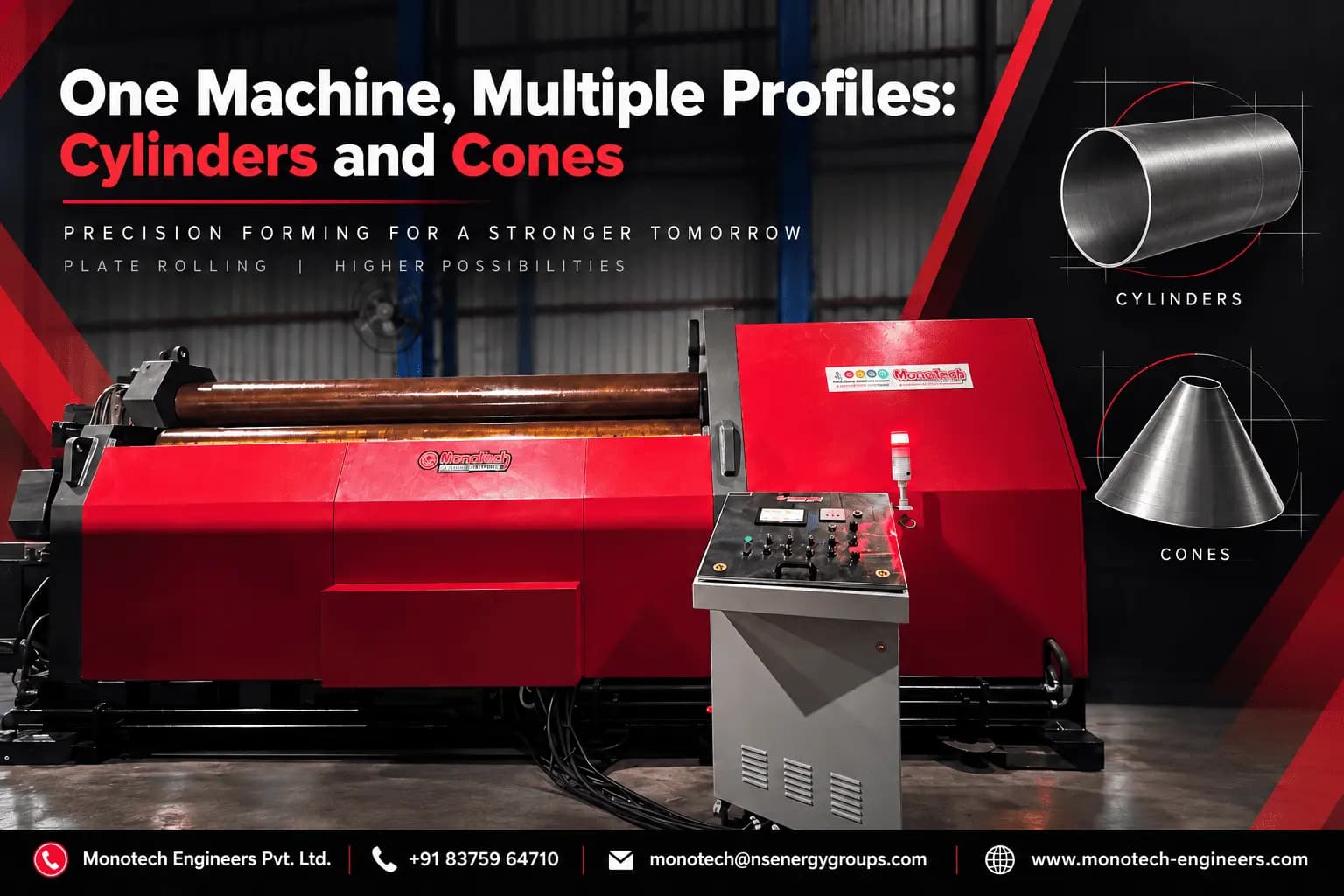
One Machine, Multiple Profiles: Cylinders, Cones and Complex Curves
Modern fabrication projects require more than standard cylindrical components. Manufacturers often need cones, tanks, shells, transition sections and components with varying radii. Producing these profiles accurately can be challenging without the right equipment.
A plate rolling machine for multiple profiles provides the flexibility to transform flat metal plates into cylinders, cones and complex curves. By combining controlled roll movement, accurate pre-bending and advanced hydraulic or CNC technology, the machine helps manufacturers achieve consistent profiles while reducing manual correction and material waste.
What Is a Plate Rolling Machine?
A plate rolling machine is industrial metal-forming equipment used to bend flat metal plates into curved shapes. The plate passes between multiple rolls that apply controlled pressure until the required radius or profile is achieved.
Depending on its design and configuration, a metal plate bending machine can produce:
Cylindrical shells
Conical components
Partial cylinders
Variable-radius curves
Large-diameter pipes
Tank sections
Custom curved profiles
Plate rolling machines are commonly available in three-roll and four-roll configurations. Hydraulic and CNC-controlled models provide greater control when producing complex or repeatable components.
One Machine for Different Profile Requirements
Investing in separate equipment for every curved profile may increase production costs and consume valuable factory space. A versatile industrial plate rolling machine can handle multiple applications using a single machine platform.
With appropriate machine capacity, roll geometry and control features, manufacturers can move from standard cylinder rolling to cone rolling and complex profile bending. This flexibility is particularly useful for fabrication companies serving different industries and handling frequently changing production requirements.
Accurate Cylindrical Profile Rolling
Cylinders are among the most common profiles produced on a plate rolling machine. They are used in tanks, boilers, pressure vessels, pipelines, silos and many other fabricated products.
During cylinder rolling, the plate is positioned between the rolls and gradually bent to the required diameter. Accurate roll positioning helps maintain a uniform radius throughout the component.
A modern plate rolling machine for cylinders can offer important benefits such as:
Consistent cylindrical diameter
Accurate plate alignment
Reduced flat ends
Uniform curvature
Improved repeatability
Lower correction and rework
Pre-bending plays an important role in cylinder manufacturing. It bends the leading and trailing edges of the plate before the complete rolling cycle. This minimizes unbent portions at both ends and helps create a more accurate closed cylinder.
Cone Rolling with Controlled Plate Movement
Conical components are required in hoppers, chimneys, ducting systems, pressure vessels, cement plants, material-handling equipment and process machinery.
Unlike cylindrical rolling, conical plate rolling requires different circumferential speeds across the width of the plate. One edge travels through a smaller radius while the opposite edge forms a larger radius. This makes cone rolling more demanding than conventional cylinder rolling.
A properly configured cone rolling machine controls the movement and pressure applied to the plate. It helps maintain the required cone angle while reducing plate slipping and profile distortion.
Depending on the application, the machine can produce:
Full cones
Half cones
Conical shells
Large-diameter reducers
Tapered sections
Truncated cones
The machine specification must be selected according to the plate thickness, width, material grade, minimum diameter and required cone angle.
Producing Complex and Variable-Radius Curves
Not every fabricated component has a constant radius. Industries such as earthmoving equipment, transportation, heavy machinery and custom fabrication frequently require components with changing radii along their length.
An advanced complex curve plate rolling machine can produce these profiles by adjusting the roll positions during the rolling cycle. Controlled hydraulic movement or CNC programming allows different sections of the plate to receive the required amount of bending force.
This capability can be used for manufacturing:
Excavator buckets
Loader shovels
Curved machine bodies
Architectural metal components
Transition profiles
Special industrial shells
Components with multiple radii
Producing complex profiles automatically reduces dependence on manual operator judgment. It also improves repeatability when several identical components are required.
How a Hydraulic Plate Rolling Machine Works
A hydraulic plate rolling machine uses hydraulic cylinders to control the movement and positioning of the rolls. The system applies consistent bending pressure, making it suitable for medium and heavy plates.
The typical rolling process includes the following stages:
The plate is positioned and aligned between the rolls.
The machine grips the plate securely.
The first edge is pre-bent to minimize the flat portion.
The plate passes through the rolls to develop the required curvature.
The second edge is pre-bent.
Additional rolling passes are performed if necessary.
The finished component is removed using the machine’s support or drop-end arrangement.
The exact sequence may vary depending on whether the machine has a three-roll or four-roll configuration.
CNC Control for Consistent Profile Formation
A CNC plate rolling machine allows operators to program essential parameters such as roll position, bending sequence and profile requirements. The control system can store production programs for frequently manufactured components.
CNC technology provides several benefits:
Repeatable rolling results
Faster machine setup
Consistent roll positioning
Reduced operator dependency
Improved production efficiency
Better control over complex profiles
Easier repeat production
However, accurate results still depend on correct machine selection, material properties and process parameters. Plate thickness variation, yield strength and springback must be considered when preparing a rolling program.
Three-Roll vs Four-Roll Plate Rolling Machines
Both three-roll and four-roll machines can produce cylinders and various curved components. The appropriate configuration depends on the required accuracy, production volume and profile complexity.
A three-roll plate bending machine is widely used for standard plate-rolling applications. It provides reliable performance and can process different materials and thicknesses.
A four-roll plate rolling machine provides an additional bottom roll that securely grips the plate between the upper and lower rolls. The side rolls then perform pre-bending and rolling. This arrangement improves plate control and can make alignment, pre-bending and automated operation easier.
Four-roll technology is particularly beneficial when manufacturers require:
Higher production volumes
Accurate pre-bending
Improved plate handling
Repeatable cylinders and cones
Automated rolling cycles
Reduced operator intervention
Materials That Can Be Rolled
A plate rolling machine can process different metals, subject to its designed capacity and the mechanical properties of the material.
Common materials include:
Mild steel
Stainless steel
Aluminium
Carbon steel
High-strength steel
Alloy steel
Machine capacity should never be evaluated using plate thickness alone. Material yield strength, plate width, required diameter and pre-bending requirements directly influence the required rolling force.
Industrial Applications
The ability to manufacture cylinders, cones and complex curves makes plate rolling machines valuable across many industries.
Common applications include:
Pressure vessels
Boilers and heat exchangers
Storage tanks and silos
Wind-tower sections
Oil and gas pipelines
Chimneys and ducting
Shipbuilding components
Cement plant equipment
Earthmoving buckets and shovels
Heavy fabrication projects
A versatile machine allows fabricators to accept a broader range of projects without investing in different equipment for every profile.
Benefits of Using One Machine for Multiple Profiles
A plate rolling machine for multiple profiles can improve both production flexibility and operating efficiency.
Its major benefits include:
Production of cylinders, cones and special curves
Better utilization of factory space
Reduced need for multiple machines
Consistent profile accuracy
Lower operator dependency
Reduced material handling
Faster changeover between applications
Lower rework and production waste
Greater flexibility for customized fabrication
These benefits are especially valuable for job shops and manufacturers that regularly handle varied component designs.
How to Select the Right Plate Rolling Machine
Selecting the correct machine requires a detailed understanding of the intended applications. Manufacturers should provide the following information to the machine supplier:
Maximum plate thickness
Maximum working width
Material type and yield strength
Minimum rolling diameter
Required cylindrical or conical dimensions
Details of complex or variable-radius profiles
Pre-bending requirements
Expected production volume
Preferred level of automation
Choosing a machine based only on thickness and width may lead to performance limitations. A complete application review helps ensure that the machine can reliably produce the required profiles.
Monotech Plate Rolling Solutions
Monotech Engineers manufactures plate rolling machines for a wide range of metal-forming requirements. Machines can be designed according to the customer’s plate thickness, working width, material strength, minimum diameter, profile geometry and production requirements.
Whether the application involves accurate cylinders, conical components or complex variable-radius curves, the objective is to provide controlled rolling, reliable pre-bending and consistent results.
Conclusion
A versatile plate rolling machine allows manufacturers to produce multiple profiles using a single metal-forming solution. From standard cylindrical shells and tapered cones to specialized components with changing radii, modern hydraulic and CNC technology provides greater control throughout the rolling process.
Selecting the right plate rolling machine for multiple profiles can improve accuracy, reduce rework and expand a manufacturer’s fabrication capabilities. When machine design and capacity are matched correctly with the application, one machine can become a flexible solution for cylinders, cones and complex curves.
FAQs
Can one plate rolling machine produce cylinders, cones and complex curves?
Yes. A properly configured plate rolling machine can manufacture cylindrical, conical and complex curved profiles. Its capabilities depend on the roll arrangement, machine capacity and control system.
Which plate rolling machine is suitable for cylinder manufacturing?
Both three-roll and four-roll machines can produce cylinders. Four-roll machines generally offer better plate gripping, easier alignment and greater automation.
How does a plate rolling machine create cones?
Cone rolling is performed by controlling the plate’s movement and applying different rolling conditions across its width. This allows one side to form a smaller radius and the other side to form a larger radius.
Can a plate rolling machine produce different radii in one component?
Yes. Advanced hydraulic or CNC plate rolling machines can produce variable-radius components by adjusting roll positions during the rolling process.
Why is pre-bending important?
Pre-bending reduces flat portions at the leading and trailing edges of the plate. It helps create more accurate cylindrical and curved profiles with less corrective work.
Which industries use plate rolling machines?
Plate rolling machines are used in pressure vessels, boilers, wind towers, storage tanks, pipelines, shipbuilding, earthmoving equipment and heavy fabrication.
Does Monotech Engineers provide customized plate rolling machines?
Yes. Monotech Engineers provides customized plate rolling solutions based on material, plate thickness, working width, rolling diameter, required profiles and production needs.