
2 November 2026
JCB Bucket Bending in Just 1 Minute: Monotech Automatic 4-Roll NC Plate Rolling Machine
An Automatic 4-Roll NC Plate Rolling Machine helps manufacturers improve speed, consistency and control during bucket shell forming. For workshops producing JCB and excavator buckets, repeated manual adjustments can slow production and increase variation between components. A controlled rolling process helps address these challenges.
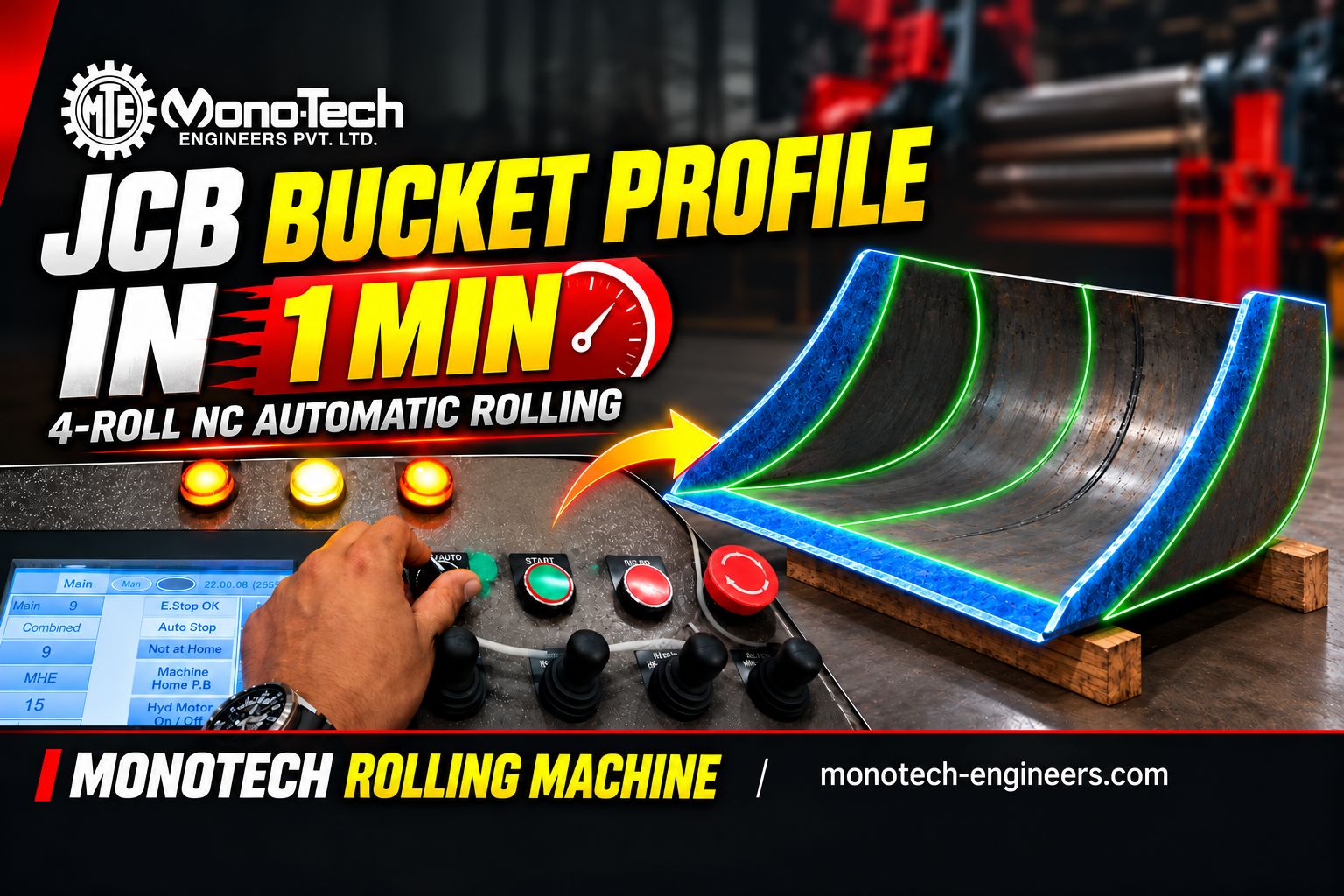
Monotech’s featured application highlights a reduction from 15 minutes to approximately 1 minute for the demonstrated bucket bending operation. This shows how an appropriately configured machine and validated forming sequence can improve productivity. Actual cycle time depends on material properties, plate dimensions, bucket geometry and handling arrangements.
Why Bucket Bending Needs Precision
Bucket manufacturing involves more than bending a steel plate into a curve. The shell must match the specified profile so that side plates, cutting edges and reinforcement components fit correctly during assembly.
Inconsistent curvature can lead to gaps, additional adjustments and delays before welding. Straight portions near plate ends may also require corrective work when they fall outside drawing requirements.
A suitable JCB bucket bending machine helps manufacturers control these factors. The objective is to produce a repeatable shell profile that supports smoother fabrication while meeting dimensional requirements.
How the Four-Roll Forming Process Works
A four-roll plate rolling machine uses an upper roll, a lower roll and two side rolls. The upper and lower rolls hold the plate, while side-roll positioning develops the required curvature.
The operator aligns the material, establishes suitable holding conditions and follows the forming sequence. Depending on the machine configuration, NC control can support programmed positioning and repeated movements.
For bucket shells, settings must reflect the drawing, plate thickness, material strength and springback. The first component should be checked against a template or measurement method before the sequence is approved for batch production.
Understanding the One-Minute Bending Demonstration
The change from 15 minutes to 1 minute represents a significant improvement for the featured operation. However, manufacturers should understand what activities are included in the comparison.
A forming cycle may measure only machine movement, while a complete production cycle can include loading, alignment, rolling, unloading and inspection. Comparing equivalent activities provides a more useful basis for production planning.
The demonstration should therefore be treated as an application result rather than a universal guarantee. Testing the actual bucket drawing and material helps establish realistic timing for a workshop’s requirements.
Benefits of Double Pre-Pinch Plate Rolling
Double pre-pinch plate rolling helps reduce straight portions near both ends of a plate. This matters when the bucket design requires controlled curvature close to its edges.
Better edge forming can reduce corrective operations and support more consistent fit-up. The achievable result depends on machine capacity, roll geometry, material properties and the required profile.
Buyers should assess pre-bending capacity separately from rolling capacity. A machine’s maximum rolling thickness does not automatically represent its pre-bending capability under every condition. Both ratings should be confirmed for the actual working width and material strength.
How NC Control Improves Repeatability
NC control helps operators repeat established settings and forming sequences supported by the installed controller. This can reduce the time spent recreating a successful profile for repeat orders.
For manufacturers producing similar bucket shells regularly, programmed settings provide a practical starting point for subsequent batches. Operators can focus on alignment, inspection and necessary corrections.
Material variation still matters. Changes in yield strength, thickness and plate condition can affect springback and the final shape. An Automatic 4-Roll NC Plate Rolling Machine therefore works best with a validated setup and a consistent inspection routine.
Advantages for Excavator Bucket Manufacturing
A controlled forming process can improve the flow of work through a fabrication shop. When shell profiles are consistent, assembly teams may spend less time correcting curvature before welding.
Reduced repositioning can also simplify handling, particularly for larger plates. Suitable plate supports and lifting arrangements should be considered alongside the machine.
For batch production, repeatable sequences help reduce variation between successive components. These benefits can support better scheduling and more predictable output. However, overall productivity also depends on cutting accuracy, material availability, operator training and the capacity of downstream fabrication stages.
Choosing the Right Machine Capacity
Selecting a JCB bucket plate rolling machine requires more than checking plate thickness. Working width, material grade, yield strength and the smallest required radius all influence machine suitability.
A thicker plate rolled across a shorter width may present a different requirement from a thinner plate using the full working length. Higher-strength material can also require a different capacity assessment.
Share the bucket drawing and complete material specifications with the manufacturer. This allows the proposed machine to be evaluated against the actual application, including pre-bending requirements and expected production volume.
Planning for Heavy Plate Rolling
A heavy plate rolling machine should be considered within the complete workshop environment. Loading access, lifting equipment, plate storage and unloading space all affect practical productivity.
The handling method should suit the component weight and dimensions. Operators also need clear procedures for alignment, forming, inspection and component removal.
Maintenance access and lubrication requirements deserve attention during planning. Reliable production depends on keeping the machine in suitable operating condition.
Evaluating these factors before installation helps manufacturers develop a workflow that supports the intended cycle time without creating avoidable handling delays.
Comparing Plate Rolling Machine Manufacturers
When evaluating the best automatic 4-roll NC plate rolling machine manufacturers, focus on application evidence rather than general claims. Request a demonstration involving a comparable plate and bucket profile.
Confirm the supplied control functions, rolling capacity, pre-bending capacity and available support arrangements. Training, commissioning, maintenance guidance and spare parts availability also influence long-term usability.
Monotech Engineers can review your bucket drawing, material specifications and production target to discuss an appropriate configuration. A clearly defined requirement gives both the buyer and manufacturer a stronger basis for technical evaluation.
FAQs: Automatic 4-Roll NC Plate Rolling Machine
How does an automatic 4-roll NC plate rolling machine bend JCB bucket profiles?
The machine holds the plate between its rolls and uses controlled side-roll movement to develop curvature. NC functions help repeat established settings, while inspection confirms whether the shell matches the required drawing.
Can JCB bucket bending time be reduced from 15 minutes to 1 minute?
Monotech’s featured application highlights this reduction for the demonstrated operation. Results vary with plate specifications, bucket geometry, setup and handling. A trial using the actual job establishes a more reliable production estimate.
What are the advantages of a 4-roll plate rolling machine for excavator bucket manufacturing?
Potential benefits include controlled plate holding, improved edge forming, reduced repositioning and repeatable sequences. Correct machine selection and validated operating settings determine how effectively these advantages translate into production improvements.
What plate thicknesses and widths can the machine handle for bucket bending?
Capacity depends on the selected model, material strength, working width and required radius. Buyers should confirm rolling and pre-bending ratings separately using their actual plate specifications rather than assuming a single universal thickness capacity.
How does NC control help achieve repeatable JCB bucket profiles?
NC control supports repeated programmed movements and settings. Combined with consistent alignment, first-component approval and regular inspection, it helps operators maintain repeatability while allowing adjustments for material variation and springback.