
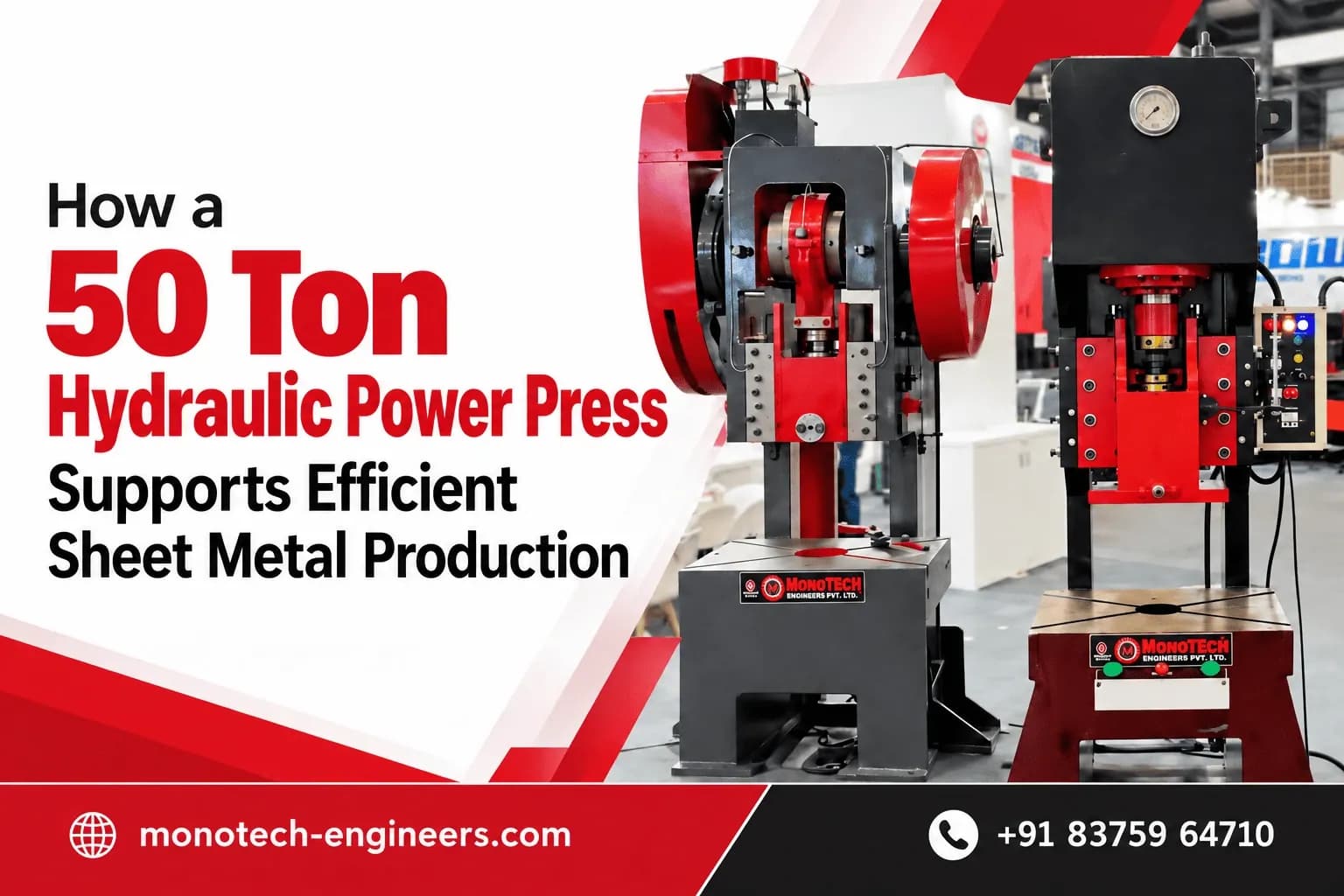
How a 50 Ton Hydraulic Power Press Supports Efficient Sheet Metal Production
A 50 Ton Hydraulic Power Press can support efficient sheet metal production by providing controlled pressing force for suitable forming operations. For manufacturers producing brackets, covers, panels, and other fabricated components, the right press helps bring consistency to everyday production.
However, efficiency depends on more than the machine’s tonnage. Tooling, material properties, stroke settings, component handling, and maintenance all influence the final result. Matching these factors to the application helps manufacturers get practical value from their investment.
What Is a 50 Ton Hydraulic Power Press?
A 50 Ton Hydraulic Power Press uses hydraulic pressure to move a ram and apply compressive force through a tool or die. The rated tonnage describes its nominal pressing capacity; it does not specify a universal sheet thickness that the machine can process.
The required force changes with the material, component dimensions, tooling geometry, and operation. A small formed bracket and a large drawn component may require very different machine configurations, even when both use the same sheet thickness.
For this reason, selecting a hydraulic press for sheet metal should begin with the component drawing and production requirements.
How a 50 Ton Hydraulic Power Press Improves Production Efficiency
1. Controlled Force for Suitable Forming Operations
Sheet metal forming requires force that suits both the material and the tool. Where the machine provides adjustable pressure, operators can set the pressing force for the approved process.
This control helps establish a repeatable production setup. It is particularly useful when a workshop handles different components, each requiring its own tooling and operating parameters.
The correct settings must be established through engineering assessment and trials. Increasing pressure alone will not correct an unsuitable die or poor material positioning.
2. Stroke Settings That Match the Job
Unnecessary ram travel adds time to each production cycle. On a machine equipped with adjustable stroke settings, the travel can be configured around the tooling and the clearance needed to load and remove the component safely.
For repeat production, reducing unnecessary movement can improve workflow. The actual benefit depends on the press’s approach speed, working speed, return speed, and material handling arrangement.
Manufacturers should therefore evaluate the complete cycle time rather than judging output from pressing speed alone.
3. More Consistent Production Setups
Repeatability starts with a stable process. Suitable tooling, accurate positioning, consistent material, and controlled press settings help maintain component quality across a batch.
A well-planned setup can reduce repeated adjustments and help operators identify deviations earlier. This supports smoother production and can reduce avoidable rework.
For example, a bracket-forming operation benefits from clearly defined material orientation, locating points, and inspection criteria. The machine then works as part of a controlled process.
4. Flexibility Across Compatible Components
A hydraulic press for metal forming can accommodate different tools within its design limits. This makes it useful for workshops producing a range of components instead of a single dedicated part.
Possible applications include:
Forming small brackets and mounting components.
Bending suitable sheet metal parts with dedicated dies.
Embossing or shallow forming with compatible tooling.
Pressing and assembly operations within the approved machine capacity.
Punching, blanking, and drawing require additional assessment. The press must be designed for the load characteristics involved, and drawing may require blank-holding or cushion arrangements.
Tooling flexibility should always be checked against the machine’s bed size, daylight, stroke, guidance, and permitted loading conditions.
5. Better Coordination Between Operations
A capable press can still become a production bottleneck if operators spend excessive time collecting blanks, positioning components, or moving finished parts.
Efficiency improves when the surrounding workflow supports the pressing operation. Practical measures include:
Keeping prepared blanks close to the loading position.
Using suitable locating fixtures.
Organizing tools for planned changeovers.
Providing a clear route for finished components.
Defining inspection checks before batch production.
These improvements help manufacturers use the available machine capacity more effectively.
Applications in Sheet Metal Production
A 50 Ton Hydraulic Power Press may suit selected components used in electrical enclosures, light engineering products, automotive assemblies, industrial equipment, and general fabrication.
Its suitability depends on the specific operation. A machine that successfully forms one mild steel component may not be suitable for a larger stainless steel component using different tooling.
For deep drawing, the assessment must also consider draw depth, material flow, lubrication, blank holding, and the number of forming stages. Tonnage alone cannot establish whether a component can be produced successfully.
What to Check Before Buying a 50 Ton Hydraulic Power Press
Material Grade and Thickness
Share the exact material specification with the manufacturer. Mild steel, stainless steel, and aluminium have different forming characteristics, and thickness alone does not define the required capacity.
Component Drawing and Operation
Provide the finished drawing, tolerances, and intended process. Bending, forming, embossing, and drawing place different demands on the press and tooling.
Bed Size, Daylight, and Stroke
The bed must accommodate and support the tooling. Daylight and stroke must provide adequate space for the die, component, loading, and removal.
Required Production Output
Specify the target components per hour or per shift. Include loading, pressing, unloading, inspection, and changeover time when assessing achievable output.
Controls and Safeguarding
Review the available controls, operating modes, and safeguarding for the intended application. These requirements should form part of the machine selection and installation plan.
Service and Maintenance Support
Consider access to technical support, spare parts, documentation, and operator training. These factors affect how reliably the machine can support production over time.
Maintenance Supports Reliable Output
Hydraulic press maintenance helps preserve machine availability and operating consistency. Follow the manufacturer’s schedule for hydraulic oil, filters, lubrication, seals, hoses, and mechanical inspections.
Operators should report leaks, unusual noise, unstable pressure, or changes in ram movement promptly. Tool condition and alignment also require regular attention because a well-maintained machine cannot compensate for damaged tooling.
Recording recurring faults and maintenance work helps the production team identify problems before they cause repeated interruptions.
Discuss Your Application with Monotech Engineers
Choosing a 50 Ton Hydraulic Power Press starts with understanding the component you need to manufacture.
When discussing your requirement with Monotech Engineers, share the material grade, sheet thickness, component drawing, tooling details, and expected production volume. These inputs help establish the machine configuration and application checks needed before purchase.
A press selected around the actual job can support more consistent forming, practical changeovers, and a smoother sheet metal production workflow.
Explore your requirements at https://monotech-engineers.com/ or call +91 83759 64710.
Frequently Asked Questions
What is a 50 Ton Hydraulic Power Press used for?
It is used for compatible pressing and forming operations, such as bracket forming, embossing, bending with suitable dies, and certain assembly tasks. Each application must be checked against the machine’s specifications and tooling requirements.
What sheet thickness can a 50 ton hydraulic press handle?
There is no single thickness limit for every application. Capacity depends on material strength, component dimensions, die geometry, and the operation. A manufacturer should assess the drawing and process before confirming suitability.
Can a 50 Ton Hydraulic Power Press perform deep drawing?
It may be suitable for certain drawn components if its configuration supports the process. Drawing force, blank holding, stroke, daylight, lubrication, and material flow must all be evaluated.
How does a hydraulic press support sheet metal production efficiency?
A suitable hydraulic press can support controlled forming and repeatable setups. Where available, adjustable pressure and stroke settings help match the machine cycle to the job. Tooling, handling, and maintenance also affect productivity.
What should I provide when requesting a hydraulic press quotation?
Provide the component drawing, material grade, thickness, required operation, tooling information, and target output. Include any requirements for automation, controls, inspection, and component handling.