Fully Automatic Straightening Machine: Benefits, Working Principle & Industrial Applications
In modern metal fabrication, precision is essential. Even a slight bend or distortion in metal sheets and plates can lead to poor assembly, dimensional inaccuracies, increased material waste, and higher production costs. A Fully Automatic Straightening Machine is designed to eliminate these issues by restoring flatness with minimal manual intervention.
Whether processing laser-cut parts, steel plates, aluminum sheets, or fabricated components, an Automatic Straightening Machine helps manufacturers achieve consistent quality while increasing productivity. This advanced equipment has become an essential part of industries where precision and repeatability are critical.
What is a Fully Automatic Straightening Machine?
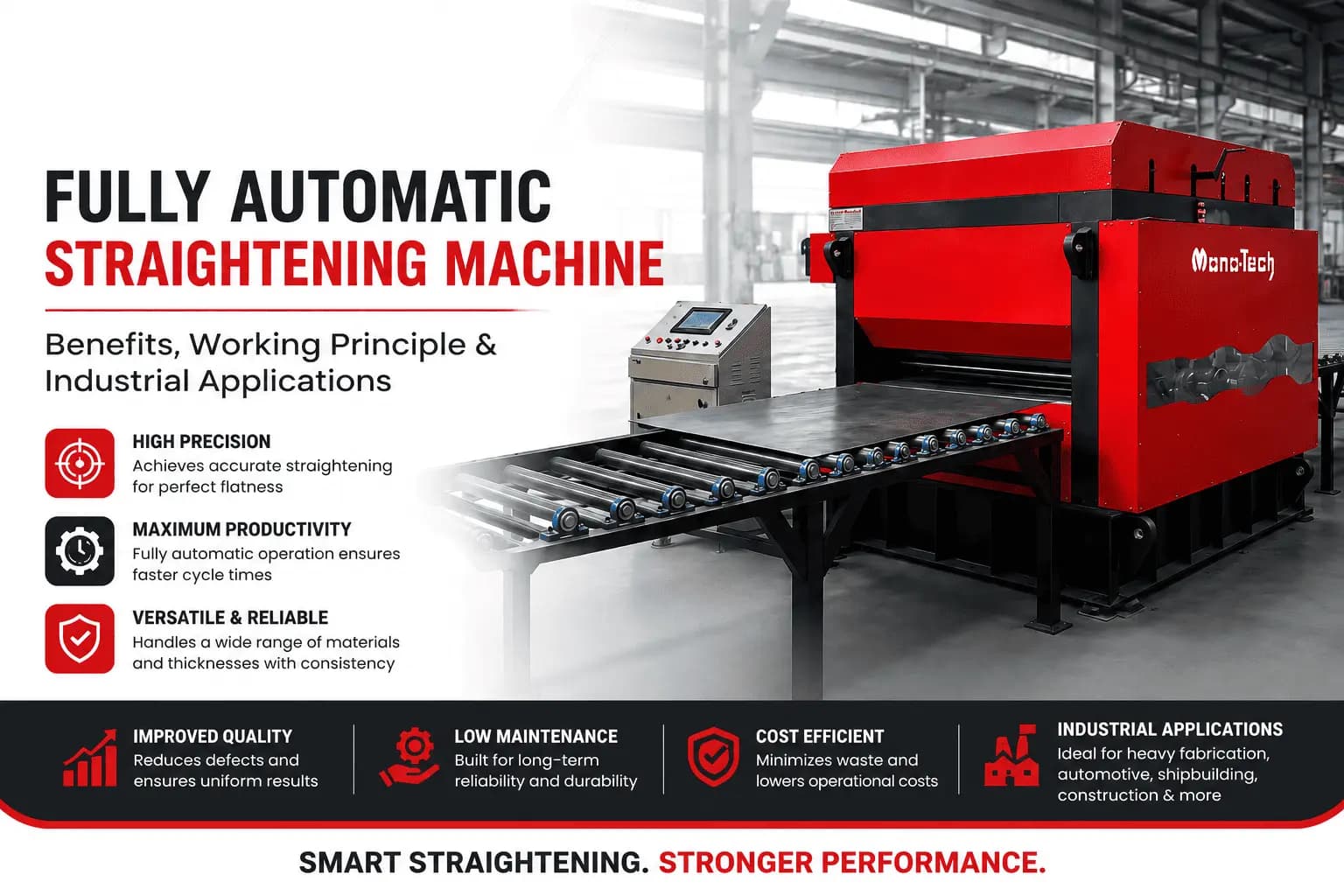
A Fully Automatic Straightening Machine is an advanced industrial machine that automatically detects and corrects bends, waves, twists, and residual stresses in metal sheets, plates, and fabricated components. Unlike manual or semi-automatic systems, it requires very little operator involvement once the process begins.
Using multiple precision rollers and an intelligent control system, the machine applies controlled pressure to produce highly accurate flatness across the entire workpiece.
How Does a Fully Automatic Straightening Machine Work?
The working process is straightforward yet highly efficient.
The operator loads the sheet or plate into the machine.
The control system automatically adjusts roller pressure based on material thickness.
The material passes through multiple precision rollers.
Controlled pressure removes internal stresses and surface deformation.
The finished component exits with excellent flatness and dimensional accuracy.
This automated process reduces setup time and ensures repeatable results for every production cycle.
Key Benefits of a Fully Automatic Straightening Machine
1. Superior Flatness Accuracy
The machine delivers highly accurate flatness, making it suitable for industries requiring precision manufacturing.
2. Increased Productivity
Automation significantly reduces manual handling and processing time, allowing manufacturers to produce more parts in less time.
3. Consistent Quality
Every sheet receives the same level of correction, ensuring consistent product quality throughout the production process.
4. Reduced Material Waste
Correcting deformation before further processing minimizes rejection rates and reduces raw material losses.
5. Lower Operating Costs
Automation decreases labor requirements while improving machine utilization and production efficiency.
6. Better Welding and Assembly
Flat components improve fit-up accuracy, resulting in stronger welds and easier assembly operations.
7. Extended Tool Life
Properly straightened materials reduce unnecessary stress on downstream equipment such as CNC machines, press brakes, and laser cutting systems.
Industries That Use Fully Automatic Straightening Machines
A Sheet Straightening Machine is widely used across various manufacturing industries, including:
Automotive manufacturing
Aerospace components
Heavy engineering
Railway equipment
Construction machinery
Electrical panel manufacturing
Shipbuilding
Steel fabrication
Agricultural equipment
Pressure vessel manufacturing
Materials That Can Be Straightened
Modern Plate Straightening Machines can process a wide range of materials, including:
Mild Steel
Stainless Steel
High Strength Steel
Aluminum
Copper
Brass
Alloy Steel
Laser-cut components
Flame-cut plates
Fabricated assemblies
Why Manufacturers Are Choosing Automatic Straightening Machines
Manufacturers are increasingly adopting Automatic Straightening Machines because they improve both product quality and operational efficiency.
Compared to manual methods, automated straightening offers:
Faster production cycles
Higher dimensional accuracy
Reduced dependence on skilled labor
Improved repeatability
Better process control
Lower maintenance costs
Consistent performance across different material thicknesses
These advantages make automation a valuable investment for companies aiming to improve productivity while maintaining high-quality standards.
Choosing the Right Fully Automatic Straightening Machine
Before investing in a machine, consider the following factors:
Material type
Sheet thickness range
Maximum plate width
Production volume
Required flatness accuracy
Roller configuration
Automation features
Servo control system
After-sales service and technical support
Selecting the right machine ensures long-term reliability and a better return on investment.
Why Monotech Engineers?
Monotech Engineers manufactures high-performance Fully Automatic Straightening Machines designed for precision, durability, and industrial productivity. Our machines are engineered to deliver accurate flatness while reducing downtime and improving manufacturing efficiency.
Key advantages include:
High-precision roller technology
Heavy-duty machine construction
Advanced automation controls
Reliable hydraulic systems
Custom configurations
Excellent after-sales support
Energy-efficient operation
Whether you manufacture laser-cut parts, heavy steel plates, or precision components, Monotech Engineers offers solutions that enhance production quality and operational performance.
Conclusion
A Fully Automatic Straightening Machine is more than just a metal processing machine—it is a productivity-enhancing solution that improves flatness, reduces waste, and delivers consistent manufacturing quality. As industries continue to demand greater precision and automation, investing in an advanced Automatic Straightening Machine helps manufacturers stay competitive while lowering production costs.
If your goal is to improve product accuracy, streamline operations, and maximize efficiency, a high-quality Sheet Straightening Machine is a smart investment for the future.
FAQs:
1. What is a Fully Automatic Straightening Machine?
A Fully Automatic Straightening Machine is an industrial machine that automatically removes bends, waves, and distortions from metal sheets and plates to achieve excellent flatness and dimensional accuracy.
2. What materials can be processed using a Fully Automatic Straightening Machine?
It can process mild steel, stainless steel, aluminum, copper, brass, alloy steel, laser-cut parts, flame-cut plates, and fabricated metal components.
3. How is a Fully Automatic Straightening Machine different from a semi-automatic machine?
A fully automatic machine automatically adjusts roller pressure and processing parameters, reducing manual intervention and ensuring faster, more consistent results.
4. Which industries use Automatic Straightening Machines?
These machines are commonly used in automotive, aerospace, heavy engineering, railway, shipbuilding, construction equipment, electrical panel manufacturing, and metal fabrication industries.
5. What are the main benefits of using a Sheet Straightening Machine?
Key benefits include improved flatness, higher productivity, reduced material waste, better welding quality, lower labor costs, and consistent product quality.