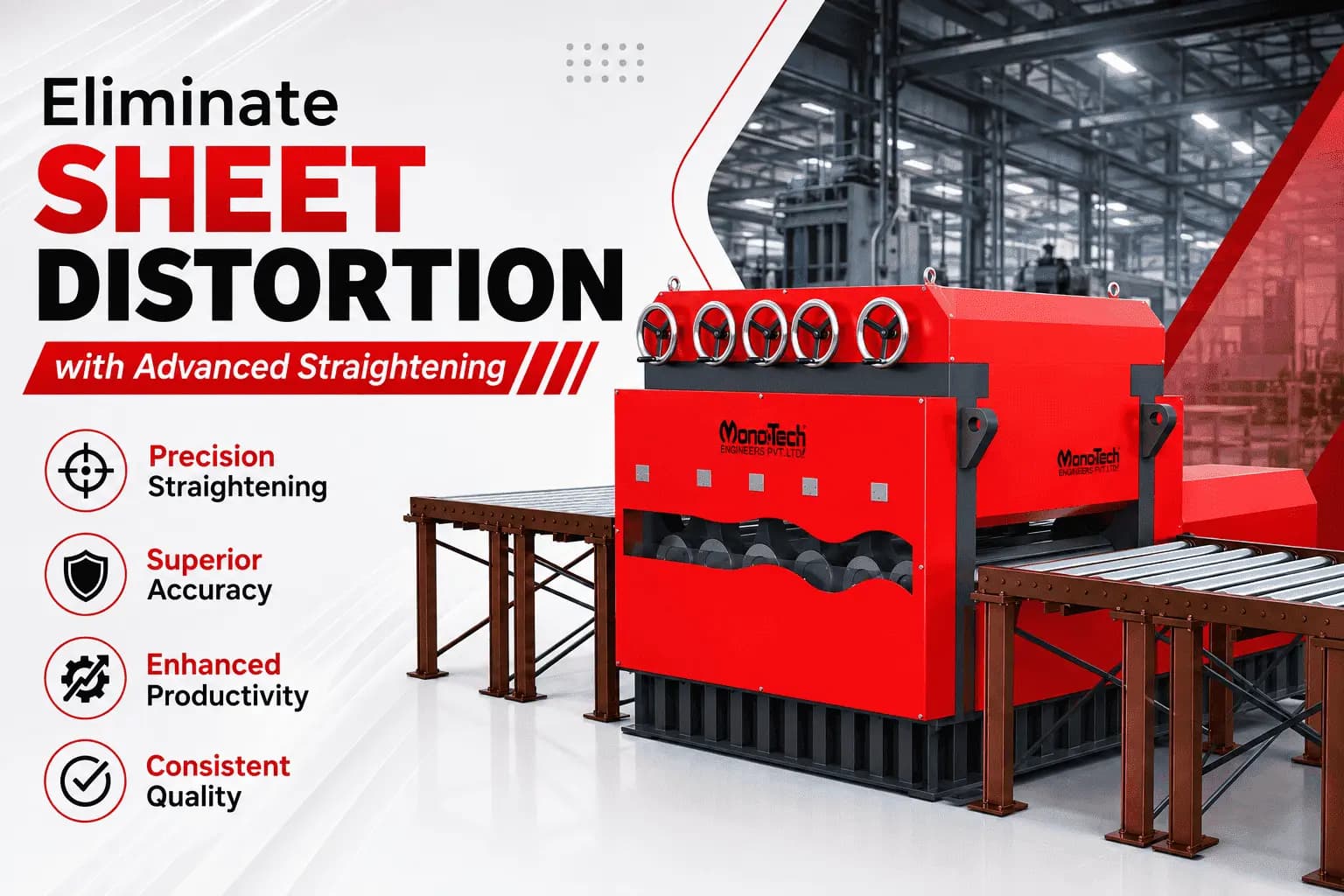
Eliminate Sheet Distortion with Advanced Straightening
Sheet distortion is a common challenge in metal fabrication and manufacturing. Warping, bending, uneven surfaces, and residual stresses can affect dimensional accuracy and create problems during cutting, bending, welding, and assembly.
A Sheet Straightening Machine provides a controlled and efficient solution for correcting these imperfections and improving sheet flatness. With the right straightening technology, manufacturers can reduce rework, improve production consistency, and achieve better-quality finished components.
Monotech Engineers offers industrial sheet metal machinery designed to support precision, productivity, and reliable manufacturing performance.
What Is a Sheet Straightening Machine?
A Sheet Straightening Machine is industrial equipment used to correct unwanted deformation and improve the flatness of metal sheets. The machine applies controlled mechanical forces to specific areas of the sheet, gradually correcting bends, waves, and other distortions.
Unlike manual correction methods, machine-based straightening provides a more controlled and repeatable process. This makes it suitable for manufacturers that require consistent results across multiple sheets.
Depending on the application, the machine can be configured according to:
Material type
Sheet thickness
Sheet width
Sheet dimensions
Degree of distortion
Required flatness
Production volume
Why Does Sheet Metal Distortion Occur?
Sheet distortion can develop during several stages of manufacturing and material handling.
Residual Stress
Rolling and forming processes can leave residual stresses inside metal sheets. When these stresses become unbalanced, the material may develop bends or waves.
Heat During Cutting
Laser, plasma, and gas cutting generate localized heat. Uneven thermal expansion and cooling can affect the flatness of the sheet.
Welding Distortion
Welding introduces significant heat into specific areas. As the material expands and contracts during the welding cycle, distortion can occur.
Forming Operations
Bending and other forming operations can create stresses that affect the final shape and flatness of the material.
Improper Handling
Incorrect lifting, transportation, storage, or stacking can also cause sheets to bend or deform.
How Does a Sheet Straightening Machine Work?
The basic principle of sheet straightening is controlled mechanical correction.
The sheet is positioned or passed through the machine, where controlled forces are applied to areas affected by distortion. The machine progressively corrects the deformation until the required level of flatness is achieved.
A typical straightening process involves:
1. Sheet Inspection
The sheet is examined to identify bends, waves, uneven areas, and other flatness issues.
2. Machine Parameter Setting
Parameters are adjusted according to the material, thickness, width, and condition of the sheet.
3. Controlled Straightening
The machine applies controlled pressure to correct the distorted areas.
4. Flatness Inspection
The straightened sheet is checked to determine whether the required flatness has been achieved.
5. Further Fabrication
Once corrected, the sheet can move to processes such as cutting, bending, welding, machining, or assembly.
Key Benefits of a Sheet Straightening Machine
Investing in appropriate straightening equipment can improve both material quality and production efficiency.
Improved Sheet Flatness
The primary objective of straightening is to reduce unwanted bends and waves and produce a flatter sheet surface.
Better Dimensional Accuracy
Straight material provides a more stable foundation for subsequent fabrication operations, helping improve dimensional consistency.
Reduced Rework
Distorted sheets can lead to additional correction and fabrication work. A controlled straightening process can help minimize unnecessary rework.
Lower Material Wastage
When distortion causes components to fall outside acceptable specifications, material may need to be rejected. Effective straightening can help improve material utilization.
Consistent Production
A Sheet Metal Straightening Machine provides a controlled process that can deliver more repeatable results than manual correction.
Improved Downstream Processing
Flat sheets can make cutting, bending, welding, and assembly operations more predictable and efficient.
Sheet Straightening Machine vs. Manual Straightening
Manual straightening may work for small-scale requirements, but it can become difficult to maintain consistency when production volumes increase.
Manual correction depends heavily on operator experience and can require significant time and effort. In comparison, a machine-based process allows manufacturers to apply controlled forces according to defined operating parameters.
A Metal Sheet Straightening Machine can therefore be a valuable solution for industrial applications where accuracy, repeatability, and productivity are important.
Applications of Sheet Straightening Machines
Sheet straightening technology can be used across a wide range of industrial applications.
Common industries include:
Sheet metal fabrication
Heavy engineering
Automotive manufacturing
Industrial equipment manufacturing
Structural fabrication
Electrical equipment manufacturing
HVAC manufacturing
Boiler and pressure equipment manufacturing
General engineering
Machinery manufacturing
The appropriate machine configuration depends on the specific production requirements and material characteristics.
How to Select the Right Sheet Straightening Machine
Choosing the right machine requires more than simply considering maximum sheet thickness. Manufacturers should evaluate several technical and production factors.
Material Type
Steel, stainless steel, aluminium, and other materials have different mechanical properties. Machine selection should be based on the material being processed.
Sheet Thickness
The machine should be capable of handling the required thickness range without compromising straightening performance.
Working Width
The machine's working width should match the maximum sheet width used in production.
Required Accuracy
Applications requiring high flatness and dimensional accuracy may need more precise straightening control.
Production Requirements
Manufacturers processing high volumes should consider machine productivity, setup time, automation, and repeatability.
Machine Construction
A robust machine structure and reliable components are important for maintaining performance in demanding industrial environments.
Advanced Sheet Straightening for Precision Manufacturing
Modern manufacturing requires greater control over material quality and production consistency. A Precision Sheet Straightening Machine can help manufacturers achieve improved flatness while reducing manual intervention.
Advanced straightening technology can also support a more organized production workflow. By correcting distortion before subsequent fabrication operations, manufacturers can reduce process-related complications and improve overall production stability.
The objective is not simply to make a sheet appear straight. It is to create material that is more suitable for accurate and consistent downstream processing.
Importance of Sheet Flatness in Fabrication
Sheet flatness can directly influence the quality of subsequent manufacturing processes.
A distorted sheet may create difficulties during:
CNC cutting
Bending
Welding
Assembly
Machining
Structural fabrication
For example, uneven sheets can affect positioning during fabrication and may result in dimensional variations. Correcting the material before these operations can help manufacturers maintain better process control.
This makes Sheet Straightening Equipment an important part of many modern metal processing operations.
Why Choose Monotech Engineers for Sheet Straightening Solutions?
Monotech Engineers is an established manufacturer of sheet metal machinery, providing industrial solutions focused on precision, reliability, and productivity.
For manufacturers looking for a Sheet Straightening Machine Manufacturer, the right supplier should understand both machine performance and the practical requirements of metal fabrication.
Monotech Engineers focuses on developing machinery that supports demanding industrial applications through:
Precision engineering
Robust machine construction
Reliable performance
Application-oriented solutions
Consistent manufacturing quality
Industrial production requirements
The machine selection can be evaluated according to the customer's material, sheet dimensions, thickness, production volume, and required straightening performance.
Conclusion
Sheet distortion can negatively affect fabrication accuracy, productivity, material utilization, and finished product quality. A properly selected Sheet Straightening Machine provides a controlled approach to correcting bends and improving sheet flatness before further processing.
For manufacturers handling demanding sheet metal applications, advanced straightening can help reduce rework, improve consistency, and support more efficient production.
With its focus on precision engineering and industrial machinery, Monotech Engineers provides sheet metal machinery solutions designed to meet diverse manufacturing requirements.
If you are looking for a reliable Sheet Straightening Machine Manufacturer, discuss your material type, sheet thickness, working width, and production requirements with Monotech Engineers to identify the right straightening solution for your application.
Frequently Asked Questions
What is a Sheet Straightening Machine used for?
A Sheet Straightening Machine is used to correct bends, waves, warping, and other forms of distortion in metal sheets to improve flatness and prepare the material for further processing.
What causes sheet distortion?
Common causes include residual stress, thermal effects from cutting and welding, forming operations, uneven cooling, and improper material handling.
Can a Sheet Straightening Machine improve sheet flatness?
Yes. A properly selected and configured machine applies controlled mechanical forces to reduce distortion and improve the flatness of metal sheets.
What is the difference between a Sheet Straightening Machine and a Sheet Leveling Machine?
Both technologies are designed to improve sheet flatness, but their machine configurations, working principles, and applications can vary depending on the material, distortion pattern, thickness, and required accuracy.
How do I choose the right Sheet Straightening Machine?
Consider the material type, sheet thickness, working width, sheet dimensions, production volume, required flatness, and desired level of automation.
Who manufactures Sheet Straightening Machines?
Monotech Engineers manufactures industrial sheet metal machinery and provides straightening solutions based on different production and application requirements.