
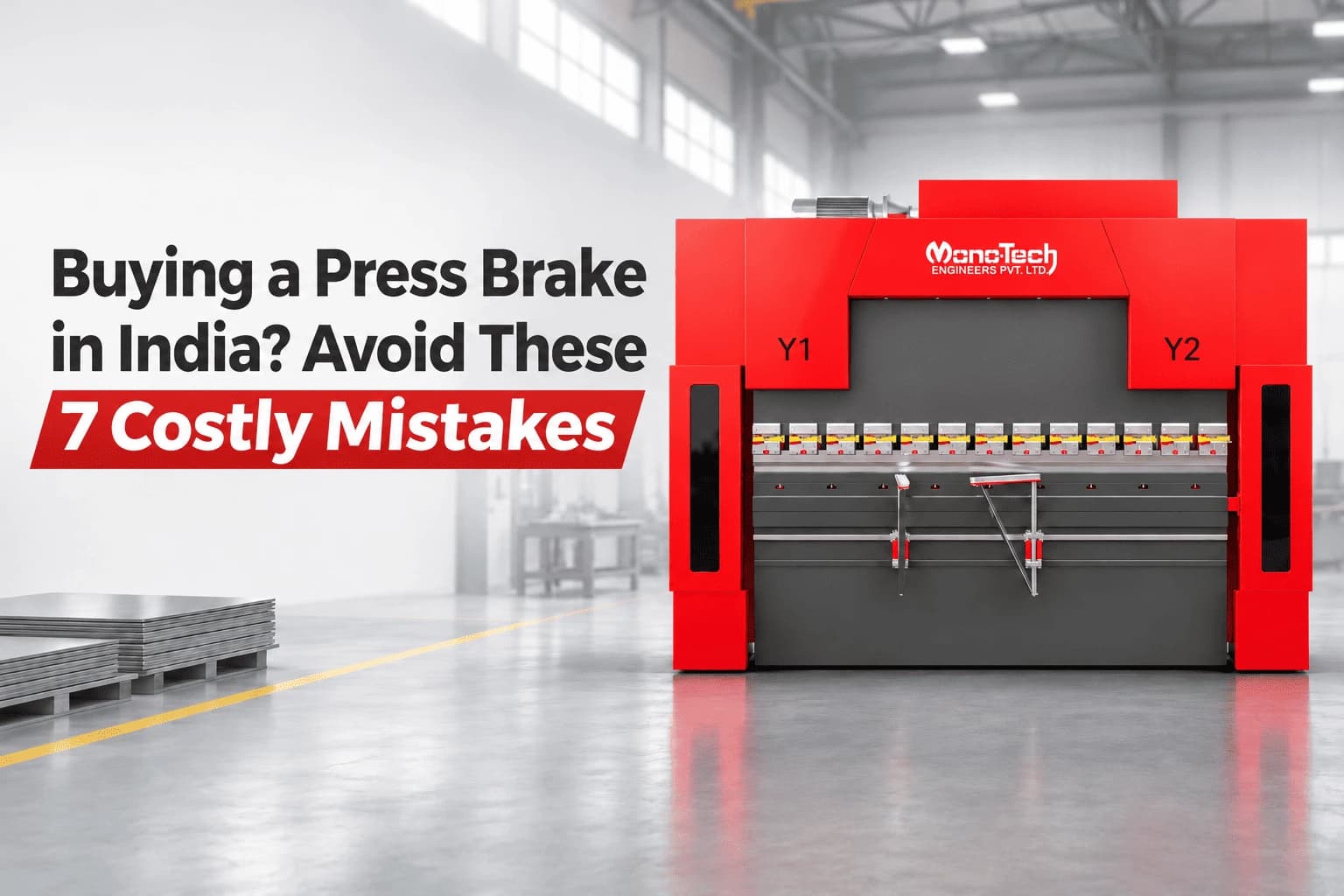
Buying a Press Brake in India? Avoid These 7 Costly Mistakes
A press brake is one of the biggest investments a fabrication shop makes. Choose the right machine and it bends accurate parts for 15 to 20 years. Choose the wrong one and you pay for it every day in rework, downtime and lost orders.
If you are buying a press brake in India, this guide covers the seven mistakes we see most often in more than 30 years of building sheet metal machinery in Ghaziabad, and how to avoid each one.
Mistake 1: Choosing Tonnage by Guesswork
Many buyers pick tonnage based on what a neighbouring shop owns or on the lowest quote. Too little tonnage and the machine struggles with thick plate. Too much and you have paid for capacity you will never use.
Calculate press brake tonnage from four things: your thickest material, its tensile strength, the bend length and the V-die opening. For mild steel, a die opening of about 8 times the sheet thickness is a common starting point. Stainless steel needs roughly 1.5 times the tonnage of mild steel for the same bend. Then add a margin of around 20% for future jobs.
Mistake 2: Ignoring Bending Length and Throat Depth
Bending length decides the longest part you can bend. Throat depth and ram stroke decide how deep a box, panel or channel you can form. Buyers often check only tonnage and later find that their largest enclosures do not fit the machine.
Before you ask for quotes, list your five largest parts with their length, flange height and thickness. Share this list with every supplier.
Mistake 3: Picking CNC vs NC on Price Alone
An NC press brake costs less and suits shops that bend simple, repeated parts. A CNC press brake with a controller such as Delem, ESA or Cybelec stores programs, calculates bend sequences and cuts setup time sharply.
If you run many short batches or complex parts, the time saved usually covers the price difference within a few years. Match the machine to your job mix, not just to your budget.
Mistake 4: Skipping Crowning and Back Gauge Checks
On long bends, the bed and ram deflect slightly, so the angle in the centre differs from the angle at the ends. A crowning system corrects this deflection and keeps the angle consistent along the full length.
The back gauge matters just as much. The number of axes (X, R, Z and more) decides how many parts you can bend without manual adjustment. Cutting these features to save money often leads to inconsistent angles and more rework.
Mistake 5: Treating Tooling as an Afterthought
Even the best hydraulic press brake bends badly with the wrong punch and die. Budget for tooling that matches your material, thickness range and inside bend radius from day one.
Ask whether the machine uses a standard tooling style, such as European or American. Standard tooling is easier and cheaper to replace or expand later.
Mistake 6: Overlooking After-Sales Support
A press brake that sits idle for two weeks waiting for a spare part can cost more than the discount you negotiated. When buying a press brake in India, ask every supplier these questions:
• Where are spare parts stocked, and how fast can they be delivered?
• How quickly can a service engineer reach your plant?
• Are installation, commissioning and operator training included in the price?
An experienced press brake manufacturer in India can usually respond faster than an overseas supplier, which keeps your downtime low.
Mistake 7: Comparing Quotes Instead of Total Cost of Ownership
The lowest quote is rarely the cheapest machine over its life. Factor in power consumption, maintenance, tooling, downtime risk and resale value. Servo-hydraulic systems, for example, can noticeably reduce energy use compared with conventional hydraulics.
A slightly higher upfront price often means a lower cost per bent part over 15 years. Compare total cost of ownership, not just the number on the quotation.
How Monotech Engineers Helps You Buy Right
Since 1991, Monotech Engineers has supplied more than 9,000 machines to fabricators across India and in over 50 countries. Our CNC, NC and hydraulic press brakes range from 40 to 2,000 tons and are configured to your material, thickness, bending length and output. We also build shearing machines and plate rolling machines, so your whole sheet metal line can come from one supplier.
We handle installation, commissioning, operator training and spare parts from our facility in Ghaziabad. You can visit our factory or ask for a live video demonstration before you decide.
Planning to buy? Share your material, thickness and bending length with our team. Get a free recommendation for the right press brake for your shop.
FAQs:
1. How do I calculate the press brake tonnage I need?
Tonnage depends on material thickness, tensile strength, bend length and V-die opening. For mild steel, start with a die opening of about 8 times the thickness, use a bending-force chart, and add around 20% margin.
2. What is the price of a CNC press brake in India?
The price depends on tonnage, bending length, controller brand, number of axes and features such as crowning. Share your requirements with the manufacturer for an accurate quote.
3. Which is better for a small fabrication shop: CNC or NC press brake?
An NC press brake suits simple, repeated parts on a tight budget. A CNC press brake is better if you bend many different parts or short batches, because it cuts setup time and improves accuracy.
4. What is crowning in a press brake?
Crowning compensates for the slight deflection of the bed and ram during long bends, so the bend angle stays the same from end to end.
5. What should I check before buying a press brake in India?
Check tonnage, bending length, throat depth, controller, back gauge axes, tooling, and the supplier's after-sales support, spare parts availability and training.