
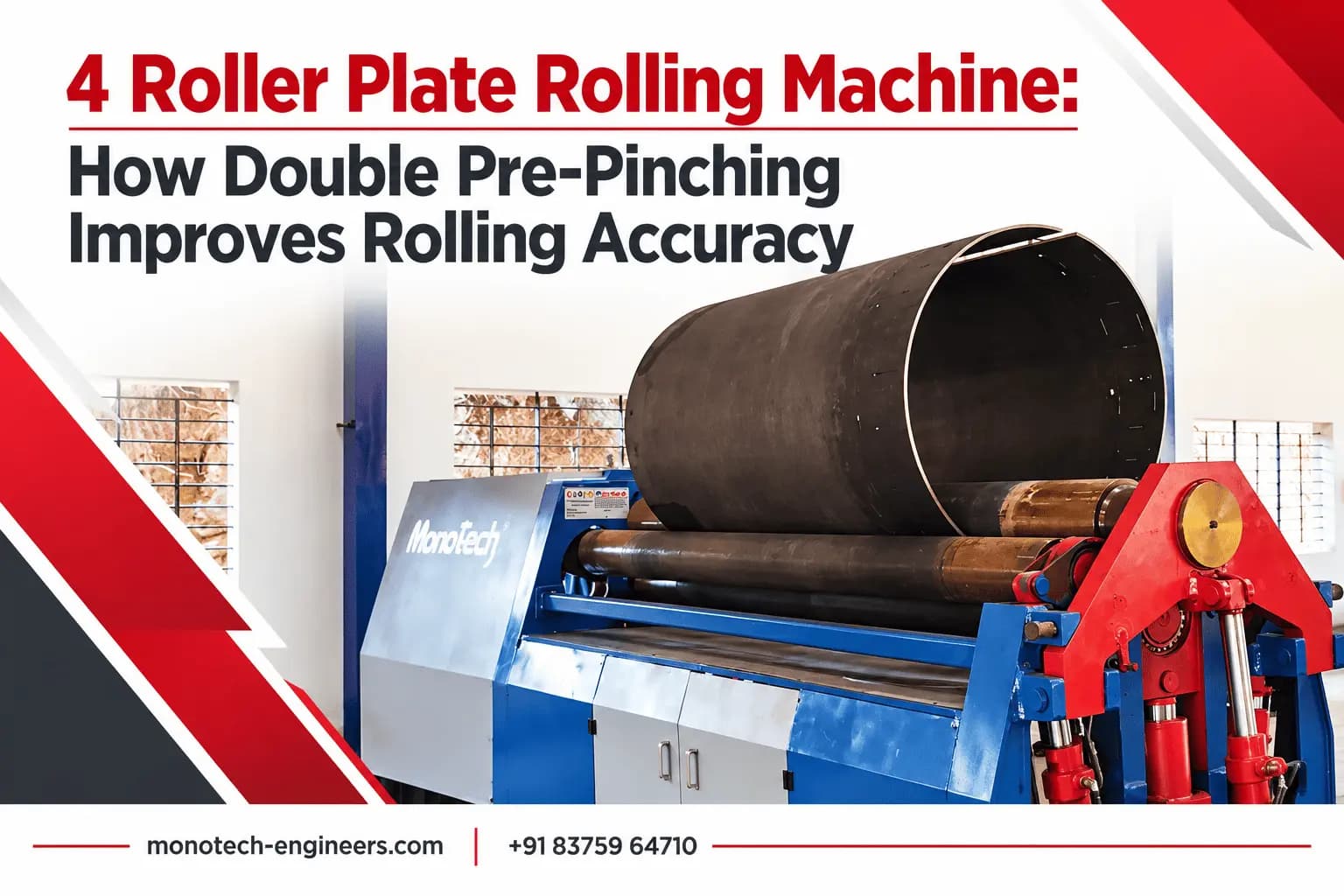
4 Roller Plate Rolling Machine: How Double Pre-Pinching Improves Rolling Accuracy
A 4 Roller Plate Rolling Machine can help address a common fabrication problem: a plate develops the required curve through its main body, but its ends remain too straight for proper fit-up. Those end sections can create extra work during alignment, correction and preparation for welding.
Double pre-pinching helps form both plate ends closer to the required curvature. When combined with suitable machine capacity and correct settings, it supports better control over the finished profile.
For manufacturers, this matters because the rolling operation affects the work that follows. A well-formed plate is easier to position, inspect and assemble.
Why Plate End Geometry Matters in Fabrication
Rolling a cylinder involves more than creating a curve. The leading and trailing edges must meet in a way that supports the required shape and seam alignment.
If the ends remain excessively flat, operators may need additional forming passes or adjustments before the component is ready for assembly. This can interrupt production and increase handling time.
Plate pre-bending addresses the ends before the final profile is completed. The aim is to reduce the difference between the end curvature and the curvature through the rest of the plate.
How a 4 Roller Plate Rolling Machine Controls the Plate
A Four Roll Plate Rolling Machine uses four rollers to hold and form the material. The plate is clamped between the top and bottom rolls, while the side rolls help develop its curvature.
This arrangement gives operators control over plate positioning during the forming process. However, the final result still depends on several factors:
Plate thickness and working width.
Material grade and yield strength.
Required finished diameter.
Initial plate alignment.
Roller positions and operating settings.
The machine configuration supports the process, while correct setup determines how effectively that capability is used.
Double Pre-Pinching in a 4 Roller Plate Rolling Machine
Double pre-pinching refers to the ability to pre-bend both ends of the plate within the machine’s forming sequence.
A Double Pre-Pinch Plate Rolling Machine helps prepare the leading and trailing edges so they follow the intended curve more closely. This reduces the straight portions that can otherwise affect cylinder closure.
The achievable result varies with the application. Plate properties, roll geometry and machine capacity all influence the remaining flat length. For this reason, buyers should discuss their required end profile with the manufacturer rather than relying only on a nominal thickness rating.
Preparing the Leading Edge
The first end needs suitable curvature before it moves through the rolling cycle. Accurate positioning at this stage provides a better starting point for forming the rest of the component.
Forming the Main Plate Body
As rolling progresses, the operator develops the required radius through controlled roller movement. Profile checks help identify whether further adjustment is needed.
Preparing the Trailing Edge
The second end also needs to match the intended curvature. When both ends are formed appropriately, the plate is better prepared for final alignment and inspection.
How Double Pre-Pinching Can Reduce Rework
Rework often begins with a small mismatch that becomes more noticeable during assembly. A flat section near the seam, an uneven radius or poor edge alignment may require further correction.
Double pre-pinching can help reduce these problems by improving end preparation. Its practical value includes:
Better Seam Fit-Up
When both ends follow the required profile more closely, operators can bring the edges together with fewer shape adjustments. Accurate plate cutting and overall roundness remain essential.
Fewer Corrective Forming Steps
Effective pre-bending can reduce the need to revisit plate ends after the main rolling operation. This helps limit repeated handling and correction.
More Predictable Production
A controlled setup makes it easier to assess the result and identify the adjustments needed for the next component. This is useful when a workshop produces repeated parts with similar dimensions.
Where Hydraulic Control Helps
A Hydraulic 4 Roller Plate Rolling Machine provides hydraulic movement for the relevant roll adjustments. Depending on the model, the controls allow operators to position the rolls according to the forming requirement.
The benefit comes from using those adjustments correctly. Operators need to understand how roller movement affects the plate and make changes based on the developing profile.
For machine selection, manufacturers should assess the available controls, adjustment functions and operating sequence against their actual jobs.
The Role of Automation in Repeat Jobs
An Automatic Plate Rolling Machine with programmable controls can help repeat forming movements for recurring components. Stored settings can provide a useful starting point when the same job returns to production.
However, a stored programme still requires verification. Changes in material properties or plate condition may affect springback and the final diameter.
For repeat production, a practical approach is to:
Establish suitable settings using the specified material.
Inspect the first completed component.
Record the accepted settings and inspection results.
Check subsequent components at appropriate intervals.
Adjust the process when material or dimensional variation appears.
Automation is most useful when it forms part of a consistent production and inspection process.
Applications of a 4 Roller Plate Rolling Machine
A 4 Roller Plate Rolling Machine is used for curved plate components across fabrication applications. Typical jobs include tank shells, cylindrical housings, industrial ducts and conical transitions.
For cylinder and cone rolling, the machine must suit the required geometry. Cone forming should be discussed separately because the plate shape, roller arrangement and operating requirements differ from straightforward cylinder rolling.
Before selecting equipment, provide drawings showing the finished dimensions and acceptable tolerances. This gives the manufacturer a clearer basis for evaluating the application.
What to Check Before Choosing a Machine
Confirm the Material Grade
Two plates of the same thickness may require different forming conditions. The material specification is therefore as important as the dimensions.
Define Thickness and Width Together
A thickness figure alone does not describe the full job. Confirm the machine’s capability at the actual working width and material strength.
Specify the Finished Diameter
The target diameter affects machine selection. Include the smallest diameter you expect to produce, along with the relevant plate thickness.
Check Pre-Bending Capacity Separately
Ask the supplier to confirm both rolling and pre-bending capacity for your application. These figures should be assessed under clearly stated conditions.
Explain the Production Volume
A workshop producing varied components may need a different control arrangement from a factory manufacturing repeated batches. Match the machine to the work you expect it to perform.
Improving Accuracy Starts Before Rolling
Even a suitable machine can produce inconsistent results if the preparation is poor. Uneven plate edges, incorrect loading or unsuitable settings can affect the finished component.
A disciplined process should include checking the incoming plate, confirming alignment and inspecting the developing curve. The finished part should then be checked for diameter, roundness and edge fit-up according to the drawing.
These checks help identify the source of a problem early, when correction is easier.
Discuss Your Application with Monotech Engineers
The right 4 Roller Plate Rolling Machine should match your material, component dimensions and production needs. Double pre-pinching is an important feature to evaluate when plate end curvature and seam fit-up affect your fabrication process.
Share your plate thickness, width, material grade, required diameter and component drawing with Monotech Engineers to discuss your plate rolling requirement.
Website: monotech-engineers.com
Contact: +91 83759 64710
Frequently Asked Questions
How does a 4 Roller Plate Rolling Machine improve plate forming?
It holds and forms the plate through a four-roll arrangement, supporting controlled pre-bending and rolling. The achieved accuracy depends on machine suitability, material properties and correct operation.
Why is double pre-pinching useful?
Double pre-pinching helps form both plate ends closer to the required curvature. This can reduce straight end sections and improve preparation for seam fit-up.
Does double pre-pinching remove all flat ends?
The remaining flat length depends on the machine and application. Ask the manufacturer to confirm the expected result for your material, thickness and required diameter.
Can an automatic machine repeat the same rolling result?
Programmable controls can repeat machine movements, but material variation can change the result. Inspection and suitable adjustments are still needed.
What information should I provide when requesting a quotation?
Provide the material grade, plate thickness, working width, finished diameter, component drawing and expected production volume. Mention any cone rolling or special profile requirements.