
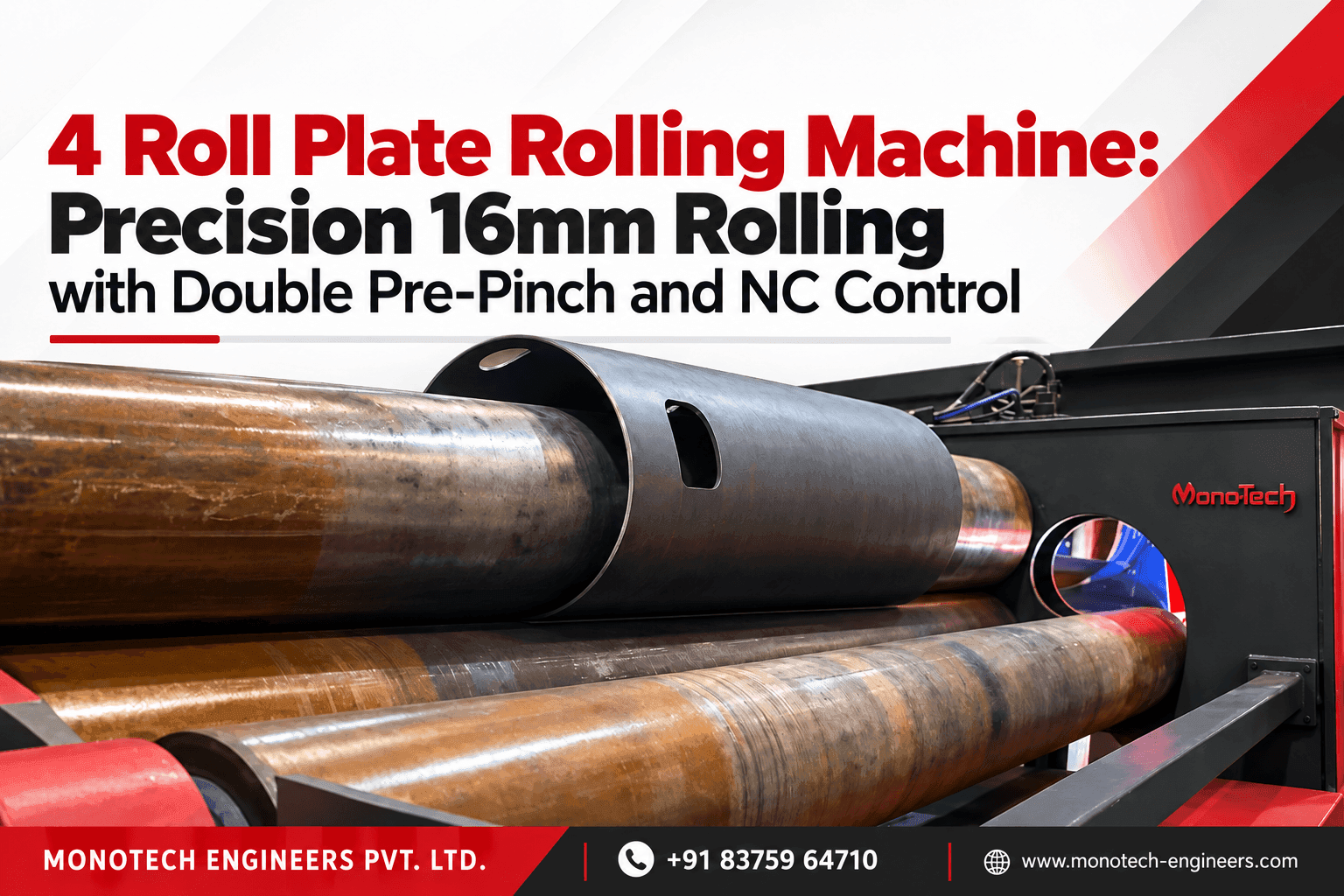
4 Roll Plate Rolling Machine: Precision 16mm Rolling with Double Pre-Pinch and NC Control
Consistent plate rolling starts before the plate forms a complete cylinder. Plate alignment, edge preparation and controlled roll positioning all influence the final shape.
A 4 roll plate rolling machine brings these operations together through a four-roll arrangement that grips and bends the plate. For manufacturers working with 16mm plate, double pre-pinch and fully automatic NC rolling can help organise the forming process and support repeat production.
Monotech Engineers Pvt. Ltd. manufactures plate rolling machines for industrial fabrication requirements. Selecting the right configuration starts with understanding the material, plate dimensions and finished component.
How Does a 4 Roll Plate Rolling Machine Work?
A four-roll machine typically uses a top roll, a lower pinching roll and two side bending rolls.
The top and lower rolls hold the plate, while the side rolls control its curvature. This arrangement helps maintain plate grip during pre-bending and rolling, making it suitable for automated forming sequences.
A typical production sequence includes:
Positioning and aligning the plate.
Clamping it between the top and lower rolls.
Pre-bending the first edge.
Rolling the plate towards the required curvature.
Pre-bending the opposite edge within the forming sequence.
Checking the finished shape and making corrections where required.
The exact sequence depends on the machine configuration, control system and component geometry.
What Is Double Pre-Pinch Plate Rolling?
Double pre-pinch refers to the ability to pre-bend both ends of the plate as part of the rolling process.
During plate forming, the leading and trailing edges need sufficient curvature to match the body of the rolled component. Without effective edge bending, straight portions can remain near the joint.
A double pre-pinch plate rolling machine helps reduce these residual flat ends. The four-roll arrangement allows both edges to be processed without removing and turning the plate end-for-end in a typical cylindrical rolling operation.
Pre-bending improves edge formation, but the remaining flat length depends on plate thickness, material properties, machine geometry and operating settings. It should not be treated as a universal guarantee of zero flat ends.
Understanding 16mm Plate Rolling Capacity
A 16mm plate rolling machine must be assessed against its complete capacity specification.
Thickness alone does not define what a machine can roll. Buyers should confirm:
Plate width: The working width associated with the capacity rating.
Material grade: The steel or other material used for the rating.
Yield strength: The material’s resistance to permanent deformation.
Tensile strength: A further material property relevant to the stated capacity basis.
Rolling diameter: The finished diameter required for the component.
Pre-bending capacity: The thickness that can be edge-bent under specified conditions.
Published plate-roll specifications commonly state rolling and pre-bending capacities separately and identify the material strength basis. Capacity can change when the material, width or required diameter changes.
For a 16mm application, share the complete job specification with Monotech Engineers before finalising the machine model.
Rolling Capacity vs Pre-Bending Capacity
Rolling capacity describes the machine’s ability to form the plate body into a specified curvature. Pre-bending capacity describes its ability to bend the plate edges.
These ratings may differ.
A machine rated to roll a particular thickness should not automatically be assumed to pre-bend that same thickness at the same width and diameter. Both ratings should be checked against the intended production job.
This distinction matters when the application requires close edge matching before welding.
How Fully Automatic NC Rolling Supports Production
A fully automatic NC plate rolling machine uses numerical control to manage programmed machine movements within its available functions.
For repeat components, an established rolling sequence can provide a consistent starting point for production. Depending on the installed controller, functions may include programmed roll positioning, stored job settings and automatic cycle execution.
The exact features should be confirmed for the selected Monotech model. NC and CNC labels should not be used interchangeably without checking the controller’s capabilities.
More Consistent Machine Settings
Programmed settings help operators reproduce an established forming sequence. Material variation and plate condition may still require adjustments.
More Structured Repeat Production
When producing similar components, stored settings—where supported—can simplify repeat setups and reduce the need to establish every movement again.
Better Coordination of Forming Steps
Automatic sequences can coordinate pre-bending and rolling movements. Loading, alignment, inspection and unloading still require suitable procedures and material handling arrangements.
Applications of a 4 Roll Plate Rolling Machine
A correctly specified four-roll machine can support the production of curved plate components such as:
Cylindrical shells.
Tank sections.
Industrial drums.
Ducting and large pipe sections.
General fabrication components.
Shell sections for pressure equipment.
Pressure equipment requires additional design, material, welding and inspection controls beyond the plate rolling operation.
Cone rolling may also be possible when the machine has the appropriate configuration and accessories. Confirm this capability separately if conical components are part of your production requirements.
Factors That Influence Plate Rolling Results
Machine capacity is only one part of achieving the required finished shape.
Material Consistency
Changes in grade, strength and actual thickness can affect forming behaviour. Repeat jobs should use verified material information.
Plate Preparation and Alignment
Plate squareness, edge condition and alignment influence how the plate travels through the rolls. Poor preparation can make subsequent fitting more difficult.
Springback
After forming pressure is released, the plate can recover elastically. Settings may need adjustment to achieve the required final curvature.
Component Support
Large plates and rolled shells need suitable support during forming and handling. Support requirements should be considered when planning the machine installation.
Inspection
Check diameter, roundness and edge alignment against the drawing. Inspection during the process helps identify whether corrective rolling is needed.
How to Select the Right 4 Roll Plate Rolling Machine
Start with the component you need to manufacture.
Before requesting a quotation, prepare the following details:
Material grade and available strength data.
Maximum plate thickness and width.
Minimum required internal rolling diameter.
Required pre-bending thickness.
Finished component drawing and tolerances.
Expected production quantity.
Cylindrical or conical rolling requirements.
Plate loading and component unloading arrangements.
These details help match the machine to the actual application and clarify the required performance before purchase.
Discuss Your Plate Rolling Application with Monotech Engineers
For a 16mm rolling application, the right machine should match your plate width, material strength, required diameter and edge-bending needs.
Monotech Engineers Pvt. Ltd. manufactures plate rolling machinery for industrial fabrication. Share your component drawing and production requirements to discuss a suitable 4 roll plate rolling machine with double pre-pinch and NC control.
Explore Monotech’s metal forming machinery:
www.monotech-engineers.com
FAQs: 4 Roll Plate Rolling Machine
What is a 4 roll plate rolling machine?
It is a plate forming machine with a top roll, a lower pinching roll and two side bending rolls. The rolls grip and bend plate into curved components.
What is double pre-pinch in plate rolling?
Double pre-pinch allows both plate ends to be pre-bent within the forming sequence, helping reduce straight portions near the edges.
Can a 4 roll plate rolling machine roll 16mm plate?
Yes, when the selected model is rated for 16mm under the required material strength, plate width and rolling diameter conditions. Confirm pre-bending capacity separately.
What is the difference between rolling and pre-bending capacity?
Rolling capacity applies to forming the plate body. Pre-bending capacity applies to bending its edges. The permitted thickness may differ for the two operations.
Does double pre-pinch eliminate flat ends completely?
It helps minimise residual flat ends. The achievable result depends on machine geometry, plate properties, thickness and operating conditions.
How does NC control help repeat production?
NC control manages programmed machine movements. Where supported, stored settings and automatic sequences help operators repeat established jobs.
Can the same settings be used for different material grades?
Not automatically. Different grades and strength levels can change forming behaviour, so settings and capacity must be checked for the actual material.
What information is needed for a machine quotation?
Share the material grade, thickness, plate width, required internal diameter, pre-bending requirement, component drawing and expected production quantity.