
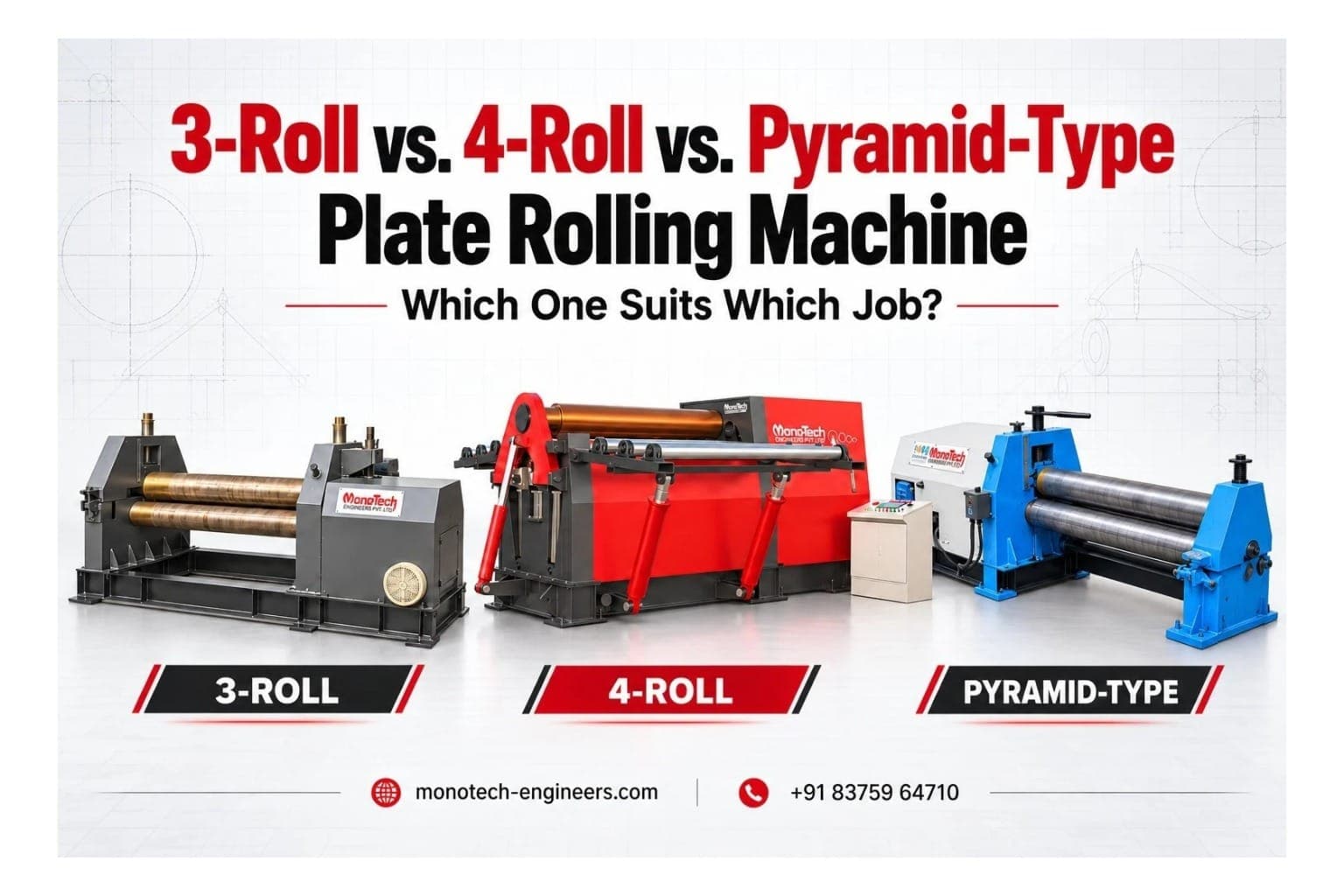
3-Roll vs. 4-Roll vs. Pyramid-Type Plate Rolling Machine: Which One Suits Which Job?
Choosing the right plate rolling machine is an important decision for any metal fabrication business. Whether you manufacture storage tanks, pressure vessels, silos, boiler drums or cylindrical components, the type of rolling machine you select directly affects production efficiency, accuracy and operating costs.
Three commonly used configurations are Pyramid-Type Plate Rolling Machines, 3-Roll Double-Pinch Plate Rolling Machines and 4-Roll Plate Rolling Machines.
Each machine has its own advantages, operating principles and suitable applications. Understanding these differences can help manufacturers select the right equipment based on plate thickness, production requirements, budget and desired rolling accuracy.
How Does a Plate Rolling Machine Work?
A plate rolling machine uses rotating rolls and controlled bending forces to transform flat metal plates into cylindrical, curved or conical shapes.
During the rolling process, the metal plate passes between rollers that apply pressure to gradually form the required curvature.
One important consideration is plate-end pre-bending. Without proper pre-bending, small flat sections may remain at the leading and trailing edges of the plate. These flat ends can create difficulties during welding and assembly, potentially increasing rework.
Different plate rolling machine configurations address these challenges in different ways.
1. Pyramid-Type Plate Rolling Machine
A Pyramid-Type Plate Rolling Machine is one of the simplest and most economical rolling machine configurations.
It typically consists of three rollers arranged in a triangular or pyramid formation. In a common design, one upper roller is positioned above two lower rollers, and the upper roller is adjusted to control the bending radius.
As the plate passes through the rollers, bending pressure gradually forms the desired curvature.
However, conventional pyramid-type machines generally cannot fully pre-bend both plate ends using the standard rolling arrangement. Additional equipment, such as a press brake, or suitable pre-bending tooling may be required to reduce flat ends.
Pyramid-type machines are commonly preferred by workshops looking for an economical solution for light to medium fabrication requirements.
These machines are suitable for general fabrication, small-batch manufacturing, simple cylindrical components and applications where some additional plate handling is acceptable.
Their primary advantages include lower initial investment, simple operation and comparatively straightforward maintenance.
2. 3-Roll Double-Pinch Plate Rolling Machine
A 3 Roll Double-Pinch Plate Rolling Machine offers greater flexibility and improved pre-bending capabilities compared with a conventional pyramid-type machine.
In this configuration, the rolls are positioned to support plate gripping, bending and pre-bending operations.
Depending on the specific machine design, the machine can pre-bend both plate ends by changing the bending arrangement and repositioning or re-feeding the material.
This reduces dependence on separate pre-bending equipment and helps minimize flat sections near the welded seam.
3-roll double-pinch machines provide a practical balance between machine investment, productivity and rolling performance.
They are commonly used in the fabrication of storage tanks, industrial silos, hoppers, cylindrical shells and general engineering components.
For workshops handling different plate thicknesses and moderate production volumes, a 3-roll double-pinch machine can provide an effective solution without the higher investment associated with advanced 4-roll systems.
3. 4-Roll Plate Rolling Machine
A 4-Roll Plate Rolling Machine is designed for efficient plate handling, controlled pre-bending and consistent rolling operations.
This configuration generally consists of an upper roll, a lower pinching roll and two side bending rolls.
The upper and lower rolls grip the plate securely while the side rolls control bending and pre-bending.
One of the major advantages of a 4-roll machine is its ability to pre-bend both ends of the plate in a single loading setup, reducing the need for repeated handling and repositioning.
This arrangement supports efficient production, particularly when manufacturing identical cylindrical shells in larger quantities.
With suitable control systems and machine configurations, 4-roll machines can also provide improved consistency in finished dimensions and reduced operator intervention.
They are widely used in pressure vessel manufacturing, boiler drum fabrication, storage tank production, heavy engineering and conical component manufacturing.
For industries where repeatability, productivity and reduced handling time are important, a 4-roll machine is often a preferred option.
3-Roll vs. 4-Roll vs. Pyramid-Type Plate Rolling Machine: Key Differences
The main differences between these three machine configurations involve pre-bending capability, plate handling, rolling accuracy, production speed, investment and maintenance requirements.
Pre-Bending Capability
Conventional pyramid-type machines generally require additional operations or tooling to pre-bend plate ends.
3-roll double-pinch machines can perform pre-bending on the machine, although plate repositioning or re-feeding may be necessary depending on the design.
4-roll machines allow both ends to be pre-bent in one loading setup, making the process more convenient and efficient.
Plate Handling Requirements
Pyramid-type machines generally require greater operator involvement during loading, positioning and rolling.
3-roll double-pinch machines reduce some of these handling requirements through their pre-bending functionality.
4-roll machines minimize repeated positioning because the plate can remain securely gripped during much of the rolling process.
Rolling Accuracy and Repeatability
Rolling accuracy depends on machine rigidity, roll geometry, material properties, control systems and operator expertise.
Conventional pyramid-type machines may require more operator adjustments to achieve consistent results.
3-roll double-pinch machines provide controlled bending and improved operational flexibility.
Well-equipped 4-roll machines, particularly those featuring NC or CNC controls, can deliver highly repeatable rolling results across successive production cycles.
Production Speed
For small batches and occasional fabrication work, a pyramid-type machine can be economical and practical.
A 3-roll double-pinch machine is generally suitable for moderate production requirements.
For high-volume manufacturing, a 4-roll machine can reduce handling and cycle time, especially when producing repeated shell dimensions.
Cone Rolling Applications
Conical rolling requires controlled bending across the width of the plate.
Pyramid-type machines can produce conical sections with appropriate techniques and accessories.
3-roll double-pinch machines can also perform cone rolling when equipped with suitable attachments and features.
4-roll machines with appropriate cone rolling arrangements and adjustable side rolls can offer improved convenience and consistency for repeated conical components.
Machine Investment and Maintenance
Pyramid-type machines generally have the lowest initial investment and simpler mechanical arrangements.
3-roll double-pinch machines offer additional capabilities at a moderate investment level.
4-roll machines typically require a higher initial investment because of their additional roll, hydraulic systems and automation options.
However, for suitable production volumes, reductions in material handling, setup time and rework can help justify the additional investment.
Which Plate Rolling Machine Is Best for Your Application?
The most suitable machine depends on the type of components you manufacture and your day-to-day production requirements.
Light to Medium Plate Fabrication
For general fabrication workshops working with light to medium plate thicknesses, a pyramid-type plate rolling machine can be a practical and cost-effective choice.
It is particularly suitable when production volumes are relatively low and additional pre-bending operations are acceptable.
Small Cylindrical Components and Workshop Jobs
When manufacturing small cylindrical parts, simple rolled sections or components where flat ends can be trimmed, conventional pyramid-type machines may provide sufficient capability.
This makes them appropriate for workshops prioritizing affordability and simple operations.
Storage Tanks, Silos and Hoppers
For manufacturers producing storage tanks, silos, hoppers and similar fabricated structures, a 3-roll double-pinch plate rolling machine is often a suitable solution.
Its on-machine pre-bending capability helps reduce flat ends while maintaining flexibility for varied fabrication requirements.
Pressure Vessels and Boiler Drums
Pressure vessel shells and boiler drums often require controlled rolling, accurate dimensions and reliable repeatability.
A suitably rated 4-roll plate rolling machine can support these requirements while reducing plate handling and helping improve production efficiency.
Machine selection should always consider the required thickness, material grade, shell diameter and applicable fabrication tolerances.
Conical Shells and Transition Pieces
Conical shells are used in various industrial applications, including hoppers, transition ducts and process equipment.
A 4-roll machine equipped with suitable cone rolling features can simplify production and support consistency when similar conical components are manufactured repeatedly.
High-Volume Cylindrical Shell Manufacturing
For manufacturers producing large quantities of cylindrical shells, a 4-roll plate rolling machine is often a productive choice.
Its reduced handling requirements, integrated pre-bending and automation options can help minimize cycle time and support consistent output.
Five Important Factors to Consider Before Buying a Plate Rolling Machine
Selecting a plate rolling machine should involve more than simply comparing maximum plate thickness or machine price.
1. Plate Thickness and Working Width
Determine the maximum and minimum plate thicknesses you need to roll, along with the required working width.
Machine capacity varies with plate thickness, material strength, rolling width and the target diameter.
2. Minimum Rolling Diameter
Identify the smallest shell diameter required for your applications.
Minimum achievable diameter depends on the machine design, roll dimensions, plate properties and operating conditions.
Always confirm the rolling capacity with the machine manufacturer.
3. Material Grade and Strength
Different metals require different bending forces.
Mild steel, stainless steel and high-yield-strength materials do not necessarily have the same rolling capacity on a given machine.
Material yield strength, tensile strength and thickness should be evaluated during machine selection.
4. Production Volume and Repeatability
If your workshop handles occasional rolling jobs, a simpler machine may be sufficient.
For repeated production of identical components, a machine with integrated pre-bending and suitable automation can reduce handling and improve workflow efficiency.
5. Pre-Bending and Flat-End Requirements
Consider the acceptable flat-end length for your fabricated components.
If flat ends can be trimmed or corrected during subsequent operations, a simpler rolling machine may be practical.
If minimum flat ends and accurate seam preparation are essential, a double-pinch or 4-roll machine may be more suitable.
Final Verdict: Which Plate Rolling Machine Should You Choose?
There is no single plate rolling machine that is ideal for every fabrication application.
A Pyramid-Type Plate Rolling Machine is a cost-effective choice for light to medium fabrication, occasional rolling jobs and workshops with limited investment budgets.
A 3-Roll Double-Pinch Plate Rolling Machine offers a balanced solution for general fabrication, tanks, silos and moderate production volumes where integrated pre-bending is required.
A 4-Roll Plate Rolling Machine is particularly suitable for high-volume production, precision-oriented applications, pressure vessel shells, conical components and operations where reduced plate handling is a priority.
It is also important to remember that machine capacity is determined by the specific model and design. A heavy-duty 3-roll machine may have greater thickness capacity than a smaller 4-roll machine.
Therefore, the best decision is to match machine specifications with your actual fabrication requirements rather than selecting equipment based only on the number of rolls.
Find the Right Plate Rolling Machine with Monotech Engineers
At Monotech Engineers Pvt. Ltd., we understand that every fabrication application has different requirements.
Whether you need a Pyramid-Type Plate Rolling Machine, a 3-Roll Plate Rolling Machine or a 4-Roll Plate Rolling Machine, selecting the correct configuration is essential for productivity, quality and long-term manufacturing performance.
Share your required plate thickness, working width, material grade, minimum rolling diameter and expected production volume with our engineering team.
Our experts can help you evaluate the most suitable machine configuration for your fabrication requirements and budget.
Monotech Engineers Pvt. Ltd.
Website: https://monotech-engineers.com/
Contact: +91 83759 64710
We Don't Just Bend Metal. We Shape Manufacturing.