
11 August 2026
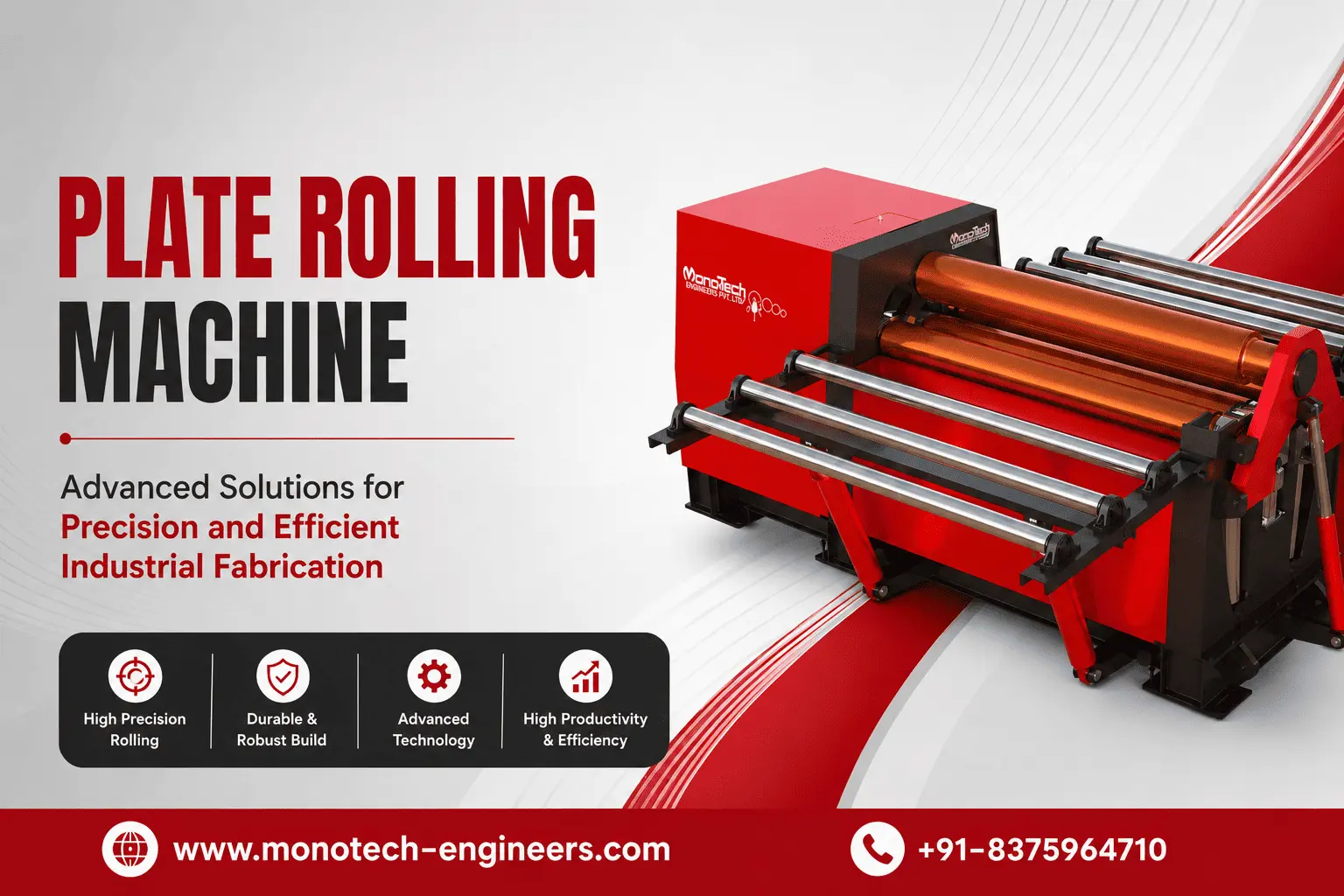
Plate Rolling Machine: Advanced Solutions for Precision and Efficient Industrial Fabrication
In modern metal fabrication, achieving accurate and consistent plate forming is essential for producing high-quality cylindrical, conical, and curved components. A Plate Rolling Machine provides an efficient solution for bending and forming metal plates into precise shapes while maintaining dimensional accuracy and production consistency.
From pressure vessels and storage tanks to boilers, pipelines, structural components, and industrial equipment, plate rolling technology plays an important role across multiple manufacturing sectors.
Monotech Engineers provides industrial plate rolling solutions designed to meet different material thicknesses, plate widths, production requirements, and fabrication applications.
What Is a Plate Rolling Machine?
A Plate Rolling Machine is an industrial metal-forming machine used to bend flat metal plates into cylindrical, curved, or conical shapes. The machine uses a combination of rolls and controlled mechanical or hydraulic movement to gradually form the plate to the required radius.
Depending on the machine configuration, manufacturers can process different plate thicknesses and widths while achieving repeatable forming results.
Modern machines can also incorporate hydraulic systems, numerical controls, and automated functions to improve productivity and reduce manual intervention.
How Does a Plate Rolling Machine Work?
The working principle of a plate rolling machine involves passing a metal plate between rotating rolls. The rolls apply controlled pressure to gradually deform the plate into the required shape.
The general process includes:
Plate Loading – The metal plate is positioned correctly on the machine.
Initial Pinching – The plate is securely held between the rolls.
Rolling/Forming – The rolls rotate and gradually bend the plate.
Radius Adjustment – Roll positions are adjusted according to the required diameter or radius.
Final Forming – Additional passes may be performed to achieve the required curvature.
Component Removal – The finished cylindrical, curved, or conical component is removed for further fabrication.
The accuracy of this process depends on machine design, roll configuration, material properties, plate thickness, and operator or control-system settings.
Why Is a Plate Rolling Machine Important for Industrial Fabrication?
Industrial fabrication often involves large metal plates that need to be formed accurately and consistently. Manual forming methods can be time-consuming and may result in inconsistent dimensions.
An Industrial Plate Rolling Machine offers several advantages:
Consistent plate forming
Improved dimensional accuracy
Higher production efficiency
Reduced manual intervention
Better repeatability
Ability to process heavy and thick plates
Suitable for large-scale fabrication
Improved control over forming radius
For manufacturers handling regular plate-forming requirements, selecting the appropriate rolling machine can significantly improve the overall fabrication workflow.
Types of Plate Rolling Machines
Different industries require different plate-forming capabilities. Common configurations include:
1. Hydraulic Plate Rolling Machine
A Hydraulic Plate Rolling Machine uses hydraulic power to control roll movement and forming operations. Hydraulic systems are particularly useful for heavy-duty applications where substantial forming force is required.
These machines can be suitable for industries working with thick steel plates and large components.
2. 3 Roll Plate Rolling Machine
A 3 Roll Plate Rolling Machine uses three rolls arranged to form the plate progressively. This configuration is widely used for cylindrical and curved plate-forming applications.
It can be selected based on plate thickness, width, material, and required forming radius.
3. 4 Roll Plate Rolling Machine
A 4 Roll Plate Rolling Machine incorporates four rolls to provide additional control during plate positioning and forming. The configuration can help improve plate alignment and productivity in suitable applications.
Four-roll machines are commonly considered for fabrication operations where accurate and repeatable production is important.
4. Automatic Plate Rolling Machine
An Automatic Plate Rolling Machine incorporates automated or numerically controlled functions to reduce manual adjustments and improve repeatability.
For high-volume manufacturing, automation can help streamline production and maintain consistent forming parameters across multiple components.
Applications of Plate Rolling Machines
A Plate Rolling Machine for Fabrication can be used across a wide range of industrial applications.
Pressure Vessel Manufacturing
Plate rolling is widely used for forming shells and other components used in pressure vessels. Accurate forming is important because the rolled plates must meet the dimensional requirements of the final vessel.
Storage Tanks
Manufacturers use plate rolling machines to produce cylindrical sections for storage tanks used in industrial and process applications.
Boiler Manufacturing
In boiler manufacturing, rolled plates may be used for shells, drums, and other fabricated components.
Pipeline and Pipe Manufacturing
Plate rolling technology can be used to form plates into cylindrical sections for specific pipeline and large-diameter pipe fabrication requirements.
Steel Structure Fabrication
Fabricators can use rolling machines to produce curved structural components and other formed steel sections.
Industrial Equipment Manufacturing
Various industrial equipment manufacturers require curved and cylindrical metal components, making plate rolling an important part of their fabrication processes.
Precision and Productivity in Modern Plate Rolling
Modern fabrication demands more than simply bending a plate. Manufacturers need precision, repeatability, productivity, and process control.
A precision plate rolling machine can help manufacturers achieve consistent forming results by providing controlled roll movement and stable machine operation.
For demanding fabrication applications, factors such as:
Machine rigidity
Roll diameter
Hydraulic capacity
Plate thickness
Maximum plate width
Material grade
Minimum rolling diameter
Control system
Pre-bending capability
should be evaluated before selecting a machine.
How to Choose the Right Plate Rolling Machine
Choosing the right machine depends on the specific fabrication requirements.
Plate Thickness
Determine the minimum and maximum plate thickness that will be processed regularly. A machine should be selected according to actual production requirements rather than occasional maximum capacity.
Plate Width
The required working width is another important consideration. Select a machine that can accommodate the maximum plate width used in your manufacturing process.
Material Type
Different materials have different yield strengths and forming characteristics. Carbon steel, stainless steel, aluminum, and other alloys may require different machine capacities.
Required Diameter
The minimum and maximum diameter required for the finished components should be considered when selecting the roll configuration and machine specifications.
Production Volume
For high-volume operations, automation and numerical control can provide advantages in repeatability and production efficiency.
Pre-Pinching Capability
Pre-pinching capability can help minimize flat ends and improve the quality of the finished rolled component. For applications where minimizing flat-end length is important, this feature should be carefully evaluated.
Benefits of Using a Plate Rolling Machine from Monotech Engineers
Monotech Engineers specializes in industrial sheet metal forming and fabrication machinery, providing solutions for different manufacturing requirements.
A properly configured Plate Rolling Machine from Monotech Engineers can support manufacturers looking for:
Accurate plate forming
Reliable industrial operation
Efficient production
Heavy-duty fabrication capability
Consistent results
Customized machine configurations
Solutions for different plate thicknesses and widths
The appropriate machine configuration can be selected based on the customer's material, dimensions, production volume, and final component requirements.
Plate Rolling Machine for Modern Manufacturing
As industries move toward higher production efficiency and tighter dimensional requirements, advanced metal-forming equipment has become increasingly important.
A modern Plate Rolling Machine can help fabrication companies reduce repetitive manual operations while improving consistency and production control. When combined with appropriate machine configuration and operating practices, plate rolling technology can become an important part of an efficient fabrication line.
For manufacturers working with large or heavy plates, selecting the right rolling technology can directly influence productivity, component quality, and overall fabrication efficiency.
Conclusion
A Plate Rolling Machine is an essential solution for industries that require accurate and repeatable metal plate forming. From pressure vessels and storage tanks to boilers, pipelines, and heavy fabrication, the right machine can improve forming efficiency and production consistency.
With solutions for different industrial requirements, Monotech Engineers focuses on providing reliable plate rolling and sheet metal forming machinery for manufacturers seeking precision and efficient fabrication.
If you are planning to invest in a Hydraulic Plate Rolling Machine, Automatic Plate Rolling Machine, or Industrial Plate Rolling Machine, selecting the machine according to your plate dimensions, material, thickness, required diameter, and production requirements is essential.
Looking for the right plate rolling solution for your fabrication requirements? Contact Monotech Engineers to discuss your machine specifications and application.